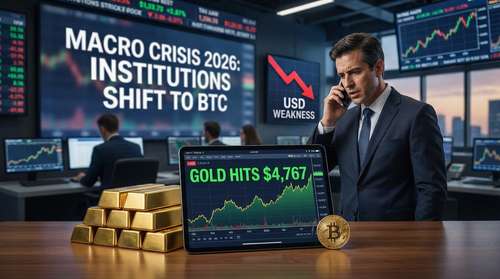
Wednesday, January 21, 2026 – The global financial landscape shifted violently this morning as gold prices shattered expectations, piercing the $4,767 mark to set a new all-time high. This historic move comes as US markets reel from a deepening "Sell America" trade, with the Nasdaq and S&P 500 posting their sharpest weekly declines since the 2022 correction. As the US dollar weakness accelerates, institutional investors are aggressively rotating capital into alternative stores of value, cementing Bitcoin's safe haven status alongside the precious metal.
The $4,767 Signal: Gold's Unprecedented Rally
Gold's ascent to $4,767 per ounce is not merely a technical breakout; it is a resounding vote of no confidence in fiat stability. Analysts at major desks, including JPMorgan and Bank of America, had forecasted a bullish 2026, but the velocity of this move has stunned Wall Street. The primary driver is the sheer volume of central bank accumulation, which is on pace to exceed 950 metric tons this year.
"We are witnessing a structural repricing of risk," notes a senior commodities strategist at Goldman Sachs. "The traditional 60/40 portfolio is failing to protect real purchasing power in this environment. Gold hitting a record high in 2026 is the market's response to fiscal dominance." This surge reflects a desperate flight to tangible assets as the macro financial crisis narrative gains traction among mainstream asset managers.
"Sell America" Trade: The Dollar in Distress
The catalyst for the current turmoil is the resurgence of the "Sell America" trade—a coordinated dumping of US assets, including Treasuries and equities. This sentiment has been exacerbated by the fallout from the "One Big Beautiful Bill Act" (OBBBA) passed in mid-2025, which the Congressional Budget Office (CBO) estimates will add over $3.4 trillion to the federal deficit over the next decade. With the national debt now surpassing $38 trillion, foreign creditors are becoming increasingly skittish.
The US Dollar Index (DXY) has shed nearly 10% of its value over the last six months, a trend that is creating a vicious cycle for US equities. As the dollar weakens, foreign investors are repatriating funds, leading to a massive Wall Street sell-off. The 10-year Treasury yield has spiked as bond prices plummet, leaving the Federal Reserve in a precarious position: cut rates to save the market and risk hyperinflation, or hold rates and crush the economy.
Bitcoin: The Institutional Safe Haven
Amidst this chaos, a new paradigm is emerging: the crypto hedging strategy. Unlike previous market corrections where Bitcoin correlated with tech stocks, 2026 sees the asset decoupling and behaving as a true digital store of value. Institutional demand has skyrocketed, with spot Bitcoin ETFs recording their highest weekly inflows since their inception.
"Institutions are no longer treating Bitcoin as a risk-on asset," says the CIO of a major digital asset fund. "In a world of $38 trillion debt, Bitcoin is being bid as a sovereign-grade safe haven." Reports suggest that sovereign wealth funds and even smaller central banks, such as the Czech National Bank, are exploring or actively building Bitcoin reserves to diversify away from the toxic US dollar exposure.
The Digital Gold Rush
While gold offers stability, Bitcoin offers portability and unseizable property rights, features that are commanding a premium in this volatile geopolitical climate. With Bitcoin consolidating above key resistance levels, the "digital gold" narrative is converting skeptics into buyers. The rotation is clear: capital is leaving the traditional system and finding a home in decentralized finance.
Wall Street's Red Winter
For the traditional stock market, the outlook remains grim. The Wall Street sell-off has dragged the S&P 500 down significantly, with tech heavyweights taking the brunt of the damage. The realization that the Federal Reserve may be powerless to stop the bleeding without destroying the currency has led to a "risk-off" sentiment for equities, but a "risk-on" sentiment for hard assets.
As the US dollar weakness persists, the divergence between paper assets and hard assets (Gold and Bitcoin) is expected to widen. Investors are advised to brace for continued volatility and review their exposure to US-domiciled risk. The era of US financial exceptionalism is being tested like never before, and the markets are voting with their wallets.