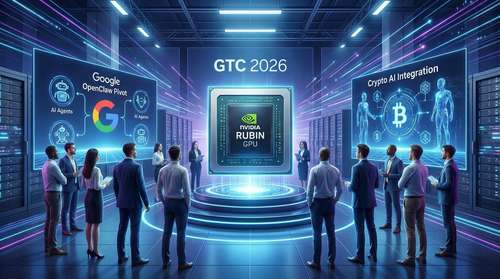
The global technology landscape is undergoing a violent structural shift this week. Following the explosive debut of the NVIDIA Rubin GPU architecture at the GTC 2026 conference in San Jose, the industry focus has rapidly migrated from conversational generative models to autonomous digital workers. This AI Agent Revolution is moving faster than anticipated, forcing heavyweights across every sector to adapt or face obsolescence. From Silicon Valley cloud providers to decentralized financial exchanges, organizations are aggressively ripping up their 2026 roadmaps to build around agentic workflows.
NVIDIA Rubin GPU: The Engine of the Agent Economy
If there is one clear takeaway from the GTC 2026 Highlights, it is that inference is the new battleground. NVIDIA CEO Jensen Huang took the SAP Center stage to unveil the Vera Rubin AI Platform, specifically engineered to power the heavy compute-bound context phases of agentic AI inference. By integrating 72 Rubin GPUs, 36 Vera CPUs, and the newly integrated Groq 3 LPU within a massive liquid-cooled NVL72 rack, the system operates effectively as a single gargantuan computational engine.
This hardware is purpose-built to execute the fourth scaling law of AI: agentic scaling. Delivering up to 10x better inference performance per watt compared to previous generations, the platform provides the raw horsepower needed to run trillion-parameter models continuously. These massive models no longer simply answer isolated queries; they think, plan, and execute complex, multi-step operations across varied digital environments without human intervention. Jensen Huang emphasized that 2026 is the undisputed "inflection point for inference," projecting AI factory demand to exceed $1 trillion over the next few years.
Powering Physical AI Infrastructure
The implications of this processing density extend far beyond enterprise software. NVIDIA's simultaneous launch of the Vera Rubin DSX platform establishes a robust Physical AI Infrastructure for the next decade. Ecosystem partners can now design and simulate gigawatt-scale AI factories using high-fidelity digital twins before pouring a single yard of concrete. This infrastructure bridges the gap between massive data center compute and edge robotics, allowing autonomous agents to operate seamlessly in both the digital and physical realms.
The Google OpenClaw Pivot: Tearing Down the Walled Garden
Hardware breakthroughs require software ecosystems to match, and big tech is recognizing the immediate threat of closed networks. The most glaring example is the sudden Google OpenClaw Pivot. Just days ago, Google released a specialized command-line interface (CLI) that officially allows third-party AI agents to connect directly with Google Workspace applications like Gmail, Drive, and Docs. This effectively breaks down Google's historic walled garden, signaling a drastic departure from their traditional consumer lock-in strategy.
The move was heavily influenced by the viral explosion of OpenClaw, an open-source autonomous agent framework created by developer Peter Steinberger. After a messy incident in late February where Google suspended normal users whose OpenClaw agents racked up massive API token usage on Gemini models, the search giant abruptly reversed course. By embracing the Model Context Protocol (MCP), Google is ensuring its enterprise tools remain the canvas of choice for the incoming swarm of autonomous workers. When a user deploys an agent to audit their inbox and draft replies based on extensive historical context, Google wants that action executing within its own ecosystem, regardless of which underlying proprietary or open-source model powers the bot.
Crypto AI Integration: Autonomous Markets Take Shape
While legacy tech giants open their enterprise APIs, the blockchain sector is actively monetizing these autonomous operations. Crypto AI Integration has moved from a speculative concept to a deployable reality over the last 48 hours. Crypto.com recently unveiled a highly anticipated AI Agent SDK, allowing developers to map natural language commands directly to complex decentralized finance functions on the Cronos blockchain.
Instead of relying on human traders to execute smart contract swaps or manage multi-signature wallets, decentralized applications can now authorize AI agents to handle these tasks programmatically through verified structured skills. Furthermore, the ecosystem is rapidly expanding beyond simple algorithmic trading. Following CEO Kris Marszalek's high-profile Super Bowl rollout of the ai.com platform, the vision for a decentralized network of self-improving agents is gaining serious commercial traction.
Retail and institutional users can now deploy verified autonomous agents that react instantly to macroeconomic conditions. You can instruct an agent to purchase specific digital assets the exact millisecond the US Federal Reserve adjusts interest rates. Powered by AI agent tokens like AI16Z—which function as utility and governance assets for decentralized autonomous systems—this new framework ensures that multi-agent networks can negotiate, trade, and settle transactions transparently.
The convergence of NVIDIA's brute-force inference hardware, Google's willingness to integrate open-source agents, and the frictionless financial rails provided by crypto platforms creates a perfect technological storm. We are no longer waiting for the next generation of artificial intelligence. The agentic economy is officially online, and the infrastructure required to scale it globally is already rolling out of the data centers.