
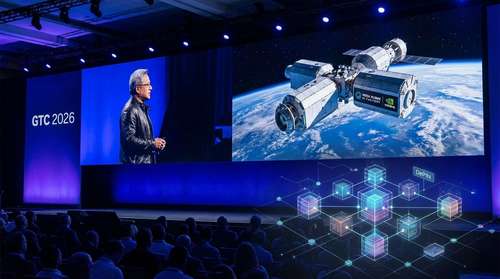
The technology landscape witnessed a historic paradigm shift in late March 2026. During a watershed moment surrounding the GPU Technology Conference, NVIDIA CEO Jensen Huang boldly declared the arrival of functional Artificial General Intelligence (AGI). This artificial general intelligence milestone coincides with the unveiling of the Space-1 Vera Rubin module—a space-hardened superchip designed to power extraterrestrial data centers. As these orbital AI factories prepare to bypass Earth's mounting power constraints, a parallel revolution is igniting the blockchain sector, where a new asset class of decentralized compute tokens is surging to support the voracious infrastructure demands of autonomous AI agents.
The NVIDIA AGI 2026 Declaration
Jensen Huang's assertion that "we've achieved AGI" fundamentally redefines the trajectory of global tech. Speaking shortly after his keynote, the GTC 2026 Jensen Huang interview clarified a critical distinction. While cognitive, human-equivalent AI across all open-ended domains may still be maturing, functional AGI—agentic systems capable of autonomously executing complex multi-step workflows, writing production code, and operating technology businesses—is already functioning in the wild.
To power this newly achieved intelligence, NVIDIA fully detailed its Vera Rubin architecture at the San Jose conference. Unlike previous hardware generations focused purely on brute-force training, the Rubin platform is specifically optimized for agentic workloads and multi-modal reasoning. With projected global AI infrastructure demand surpassing $1 trillion by 2027, the deployment of NVIDIA AGI 2026 capable GPUs marks the transition from experimental models to industrial-scale autonomous execution.
Space-1: Deploying Orbital AI Factories
To handle this massive processing workload, Earth's power grids are proving insufficient. The power density required by next-generation data centers is heavily straining terrestrial electrical infrastructure, prompting a radical rethink of where computation physically happens. NVIDIA's solution, unveiled to a stunned audience, is the Space-1 Vera Rubin module. This specialized hardware extends the company's accelerated computing stack directly into the exosphere.
Engineered specifically to operate in size, weight, and power-constrained environments, the Space-1 module delivers up to 25 times the AI compute performance of a legacy H100 GPU for space-based inferencing. By utilizing continuous solar energy and the natural cooling properties of the vacuum of space, these orbital AI factories can process massive data streams from satellites in real-time. Leading aerospace pioneers like Aetherflux, Planet Labs, and Axiom Space are already integrating this hardware into their next-generation fleets.
Rethinking Mission Architecture
According to aerospace engineers, the Space-1 module fundamentally alters how we manage planetary data. Instead of constantly transmitting raw, heavy sensor data down to Earth—a high-latency, bandwidth-choking process—these platforms perform advanced geospatial analytics and autonomous decision-making directly in orbit. The lightweight, actionable insight is beamed down, while the heavy computation remains safely above the clouds.
DePIN Infrastructure and Decentralized Compute Tokens
As AI agents gain autonomy, they require permissionless financial rails to procure server space, API access, and rendering power. Traditional banking infrastructure is fundamentally incompatible with non-human entities, positioning blockchain as the native settlement layer for the machine economy. Following the GTC announcements, the cryptocurrency market reacted aggressively, with AI-linked assets surging between 10% and 20% in a matter of days.
This overwhelming demand is supercharging DePIN infrastructure. Projects operating at the intersection of blockchain and AI are moving beyond speculative narratives to become critical utility layers. For example, in late March 2026, Bittensor (TAO) saw its active subnet count double, establishing a global, permissionless brain for machine learning models. Simultaneously, networks handling graphics rendering experienced a massive supply-side expansion driven entirely by the demand for agentic processing, while protocols like NEAR rolled out confidential computing modules tailored for privacy-first AI workloads.
Rather than relying solely on centralized cloud providers—who are currently hoarding hardware to meet their own enterprise demands—independent developers and autonomous bots are utilizing decentralized compute tokens to tap into a globally distributed grid of GPUs. This structural shift replaces massive centralized capital expenditure with highly efficient, token-incentivized physical networks.
The Future of Global Intelligence Markets
The convergence of space-based hardware and blockchain coordination represents the next frontier of digital economics. We are witnessing the birth of verifiable "intelligence tokens"—digital assets that represent cryptographic compute power, model training contributions, and data routing efficiency.
As orbital networks powered by the Space-1 Vera Rubin module come online, they will require highly resilient, decentralized ledgers to manage data loads and distribute actionable insights back to terrestrial hubs. DePIN infrastructure is uniquely positioned to handle this distributed coordination. In this new era, decentralized compute tokens are no longer just alternative investments; they are the essential fuel powering the nervous system of an increasingly automated, interplanetary economy. For investors and technologists alike, the message is undeniable: intelligence has been decentralized, and its physical footprint is already leaving the atmosphere.