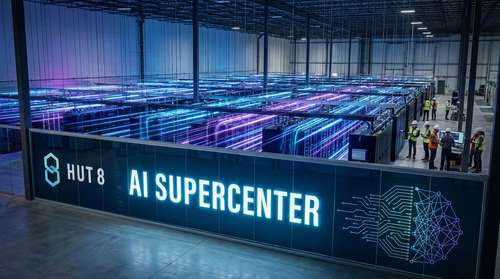
The boundaries between cryptocurrency mining and artificial intelligence development are officially blurring. As the global race for computational dominance accelerates into late March 2026, the Hut 8 AI expansion is radically reshaping the digital infrastructure sector. Following a landmark $7 billion partnership involving Anthropic, Google, and Fluidstack, the former pure-play crypto miner is aggressively transforming its massive energy pipeline into a high-performance computing powerhouse. This is no longer just a theoretical crossover. With tech giants scrambling to secure every available megawatt to train next-generation large language models, repurposed Bitcoin facilities have emerged as the ultimate commercial real estate. Hut 8 is capitalizing on this unprecedented demand, laying down a blueprint for the future of commercial-scale computing.
The $7 Billion Blueprint: Repurposing Bitcoin Mines for AI Compute
The foundation of this strategic pivot was cemented with the historic 15-year lease agreement at the River Bend campus in Louisiana. Valued at $7 billion over the base term—and potentially reaching $17.7 billion if all renewal options are exercised—the deal commits an initial 245 megawatts of IT capacity specifically for high-performance AI workloads.
What makes this transition viable is the underlying hardware environment. Historically, Bitcoin mining AI compute shared several foundational requirements: access to high-voltage transmission lines, industrial-scale cooling solutions, and specialized zoning permits. By retrofitting these energy-heavy sites, Hut 8 circumvents the years-long regulatory and construction delays that typically plague greenfield data center developments. Fluidstack will operate the compute clusters running Anthropic's advanced models, while Google provides a crucial financial backstop, guaranteeing lease payments and massively de-risking the venture for institutional investors.
'LEGO Block' Architecture and the 10-Gigawatt Pipeline
During recent industry briefings, executives provided fresh visibility into how the company will manage its staggering 10-gigawatt development pipeline. The secret lies in a highly adaptable, modular infrastructure design that management likens to interchangeable LEGO blocks.
Rather than locking physical sites into a single, permanent use case, facilities are constructed with dynamic components. This modularity allows operators to dynamically shift computational capacity between AI training workloads and traditional crypto mining, depending on which sector offers superior margins at any given moment. The company's Vega facility in Texas is the earliest operational proof of concept for this crypto AI convergence. Originally brought online to mine digital assets, Vega now effortlessly supports complex AI workloads. This agile deployment strategy ensures that capital is only committed once power access, financing, and customer demand are fully secured, eliminating the risk of speculative overbuilding.
Asher Genoot's Vision: Mastering AI Data Center Power Supply
At the core of this operational overhaul is a fundamental shift in corporate philosophy. Asher Genoot, Hut 8 CEO, has relentlessly championed a "Power First" methodology. Instead of merely viewing the company as a hardware operator, leadership now treats the "electron as a critical, scarce asset".
Finding reliable AI data center power supply is arguably the single largest bottleneck throttling the global tech sector. Building an AI-ready facility is highly capital-intensive, yet leveraging legacy expertise in negotiating direct utility agreements and managing massive electrical loads allows Hut 8 to secure the raw energy first. Once the power rights are locked in, the company can selectively upgrade the infrastructure to meet the rigorous redundancy and uptime demands of Tier III AI data centers, maximizing the value of every megawatt it controls.
Wall Street's Take on HUT Stock Valuation in 2026
Institutional investors are taking notice of this hybrid business model. For fund managers evaluating AI infrastructure stocks 2026, Hut 8 presents a highly compelling asset. It blends the explosive upside of frontier tech development with the predictable, utility-like cash flows of long-term commercial real estate leases.
Wall Street analysts have reacted positively, with firms like B. Riley and Benchmark setting aggressive price targets of $76 and $85, respectively. This bullish HUT stock valuation is anchored by the projected $454 million in annual net operating income expected to be generated by the River Bend lease alone. Backed by a strategic liquidity reserve of over 13,000 Bitcoin—valued at approximately $1.6 billion as of late 2025—and an expanding roster of blue-chip tenants, the company possesses the non-dilutive capital necessary to seamlessly fund its multi-gigawatt ambitions.