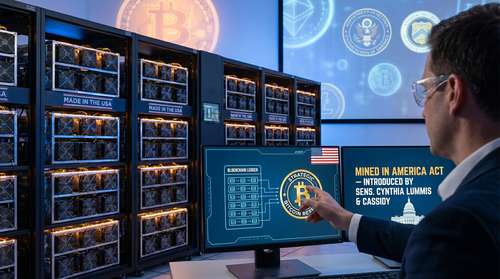
On March 30, 2026, U.S. Senators Cynthia Lummis (R-WY) and Bill Cassidy (R-LA) introduced the Mined in America Act, a sweeping legislative package that merges industrial policy with digital asset management. The landmark bill is designed to establish a federal certification program for domestic crypto miners while taking the historic step of formally codifying the Strategic Bitcoin Reserve into law. By directly targeting the U.S. industry's overwhelming reliance on foreign-manufactured hardware, the legislation attempts to redefine the geopolitical landscape of cryptocurrency.
Securing Supply Chains: The Digital Asset Mining Certification
A central pillar of the legislation is the creation of a voluntary Digital Asset Mining Certification program, to be administered by the Department of Commerce. Facilities and mining pools that earn the "Mined in America" label will gain integrated access to existing federal energy and rural development programs.
However, this federal backing comes with a strict national security mandate. Certified operators must commit to a phased transition away from mining equipment produced by companies tied to foreign adversaries. While the United States currently commands roughly 38% of the global Bitcoin hash rate, an estimated 97% of the specialized ASIC hardware powering those operations originates from Chinese manufacturers like Bitmain and MicroBT.
Dennis Porter, CEO of the Satoshi Action Fund, highlighted this vulnerability, noting that holding the majority hash rate while relying entirely on foreign hardware "is not leadership, that is a liability". Addressing Bitcoin Hardware Security has become a critical focal point for lawmakers looking to insulate critical digital infrastructure from potential supply chain disruptions or firmware vulnerabilities.
Codifying the Strategic Bitcoin Reserve
Beyond overhauling hardware supply chains, the Mined in America Act takes definitive action on the national balance sheet. The bill officially codifies President Donald Trump's recent executive order, permanently establishing a Strategic Bitcoin Reserve within the Department of the Treasury.
The framework provides a long-term custody solution for the massive amounts of Bitcoin already seized through federal law enforcement operations. To expand these holdings without driving up the national deficit, the bill outlines a budget-neutral acquisition strategy. Revenue generated from staking rewards and airdrops tied to other seized digital assets would be strategically redirected into continuous Bitcoin purchases.
Tax Incentives for Domestic Miners
To further accelerate the growth of the national stockpile, the legislation introduces a unique economic mechanism. Certified domestic miners will have the option to sell newly minted Bitcoin directly to the federal government. In exchange for supplying the reserve, these miners would receive capital gains tax exemptions. This creates a powerful financial incentive for operators to participate in the certification program while simultaneously guaranteeing a steady, secure pipeline of digital assets for the Treasury.
Revitalizing Domestic Manufacturing
Crypto Mining Regulation in the United States has frequently focused on energy consumption, but this bill pivots the conversation toward manufacturing and infrastructure. Rather than simply penalizing the use of foreign hardware, the legislation actively supports domestic alternatives.
The bill directs the National Institute of Standards and Technology (NIST) and the Manufacturing Extension Partnership to assist U.S. manufacturers in developing next-generation, energy-efficient mining equipment. By fostering a domestic manufacturing base, the legislation aims to create a virtuous cycle: secure hardware production leads to certified mining operations, which in turn strengthens energy infrastructure and feeds the national reserve.
Strengthening the National Energy Grid
A secondary but crucial benefit of the proposed legislation involves domestic energy infrastructure. Cryptocurrency mining is inherently energy-intensive, which has historically drawn criticism from environmental advocates. However, the Mined in America Act leverages this dynamic by integrating certified mining projects into existing federal energy programs.
By coordinating with rural development initiatives, the bill encourages miners to establish operations in areas with surplus or stranded energy. This approach allows mining facilities to act as flexible load balancers for local power grids, absorbing excess capacity during off-peak hours and shutting down during periods of high demand. Rather than creating entirely new spending authorities, the legislation cleverly utilizes current infrastructure grants to modernize the grid alongside the mining sector.
The Impact on US Crypto Legislation 2026
The introduction of this bill marks a significant evolution in how Washington approaches digital assets. Senator Cassidy emphasized the economic imperative, stating, "Digital asset mining is a big part of our economy. We should be doing it here in America. This bill will secure supply chains, back U.S. manufacturing, and support this industry".
Similarly, Senator Lummis, a long-standing advocate for digital assets, framed the initiative as a fulfillment of broader national goals. "President Trump pledged to make the United States the digital asset capital of the world— and we're not backing down," she noted.
As the Mined in America Act moves through Congress, it sets a new benchmark for US Crypto Legislation 2026. By treating Bitcoin not just as a speculative commodity, but as a critical component of national infrastructure and industrial policy, lawmakers are laying the groundwork for a fully self-reliant American digital economy.