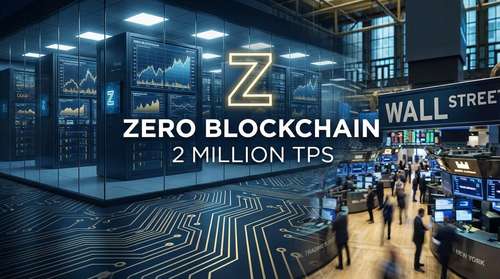
In a move poised to reshape the infrastructure of global finance, LayerZero Labs has officially revealed Zero, a groundbreaking Layer 1 blockchain capable of processing over 2 million transactions per second (TPS). Announced on February 10, 2026, the network represents a massive leap forward in decentralized technology, specifically engineered to meet the rigorous demands of institutional finance and Wall Street. By leveraging advanced zero-knowledge proofs technology, Zero aims to bridge the gap between traditional capital markets and the blockchain ecosystem, backed by industry titans including Citadel Securities and Intercontinental Exchange (ICE).
Shattering Speed Limits: 2 Million TPS Crypto Infrastructure
For years, the blockchain trilemma—balancing security, decentralization, and scalability—has capped the performance of major networks. LayerZero’s Zero blockchain claims to have solved this through a radical architectural overhaul. Unlike traditional blockchains that require every node to replicate every transaction, Zero utilizes a heterogeneous architecture powered by Jolt, a zero-knowledge virtual machine (zkVM).
This technical breakthrough allows the network to decouple transaction execution from verification. According to LayerZero Labs CEO Bryan Pellegrino, this eliminates the "replication requirement" that has historically restricted blockchains to under 10,000 TPS. The result is a high-speed decentralized network that offers virtually unlimited blockspace and execution speeds up to 100,000 times faster than Ethereum. This level of throughput is not just an incremental improvement; it is the prerequisite for moving global markets, such as the NASDAQ or NYSE, entirely on-chain.
Institutional Blockchain Adoption 2026: Wall Street Giants Sign On
The unveiling of Zero has immediately attracted the attention of the world's most powerful financial institutions, signaling that institutional blockchain adoption 2026 is accelerating rapidly. The project launches with strategic partnerships and investment from heavyweights like Citadel Securities, the Depository Trust & Clearing Corporation (DTCC), and ICE (the parent company of the New York Stock Exchange).
These partnerships are far more than just symbolic endorsements. Citadel Securities is actively collaborating with LayerZero to evaluate how the Zero infrastructure can support high-frequency trading, clearing, and settlement workflows. Meanwhile, the DTCC is exploring the network for its tokenization services, and Google Cloud is investigating how the chain could facilitate micropayments for AI agents. As part of this Wall Street DeFi integration, ARK Invest CEO Cathie Wood has joined the Zero advisory board, stating that the technology could "move the industry's roadmap forward by at least a decade."
The Architecture of "Zones": Privacy and Customization
One of the most critical features for institutional players is the network's ability to create distinct "zones." Zero is not a one-size-fits-all chain; instead, it allows for the creation of specialized environments tailored to specific needs. At launch, anticipated for Fall 2026, the network will feature three primary zones:
- EVM-Compatible Zone: A general-purpose environment for existing decentralized applications and smart contracts.
- Privacy Zone: A compliant, privacy-focused layer designed for institutional payments where trade secrecy is paramount.
- Trading Zone: A hyper-optimized environment specifically built to handle the order book throughput required by global exchanges.
This approach addresses a major friction point for LayerZero Labs news watchers: the need for privacy. Institutions cannot operate on fully transparent public ledgers where competitors can front-run their trades. Zero’s architecture ensures that sensitive financial data remains protected while still benefiting from the immutability and settlement speed of a public blockchain.
The Role of the ZRO Token
The native token of the LayerZero ecosystem, ZRO, will serve as the governance and utility token for the new network. Following the announcement, Citadel Securities and ARK Invest confirmed strategic investments in ZRO, further validating the asset's role in the future of digital market structure. The token will be essential for maintaining the security and interoperability of the various zones, ensuring that despite their specialized functions, they remain part of a cohesive, interconnected global network.
A New Era for Global Asset Tokenization
The ultimate vision for Zero is the full-scale tokenization of real-world assets. With the capacity to handle 2 million TPS, the network can theoretically support the trading volume of global equities, bonds, and derivatives markets simultaneously—24 hours a day, 7 days a week. This capability moves the industry beyond the pilot phases of the past few years and into a production-ready environment for the global economy.
As the LayerZero Zero blockchain prepares for its mainnet launch later this year, the competition among high-performance chains like Solana and Aptos is set to intensify. However, with its unique focus on verification over replication and its deep integration with traditional finance incumbents, Zero is positioning itself not just as another "Ethereum killer," but as the foundational layer for the next generation of the internet of value.