
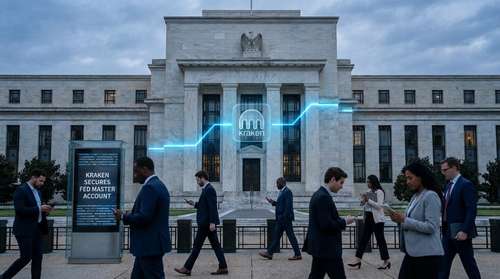
In a watershed moment for the cryptocurrency industry, Kraken Financial has officially secured a Federal Reserve Master Account, becoming the first digital asset native firm to gain direct access to the United States central bank's payment rails. The approval, granted by the Federal Reserve Bank of Kansas City on March 4, 2026, allows the Wyoming-chartered Special Purpose Depository Institution (SPDI) to settle transactions directly via Fedwire, bypassing the traditional commercial bank intermediaries that have long acted as gatekeepers between crypto and fiat economies.
Breaking the Banking Barrier: A Historic First
The approval marks a fundamental shift in the integration of digital assets with the traditional financial system. For years, crypto firms have operated as "peripheral participants," reliant on a patchwork of banking partners to process U.S. dollar transactions. This dependency has often left the industry vulnerable to sudden debanking events and operational bottlenecks. With this new account, Kraken Financial can now hold reserves directly at the Fed and settle payments with the same speed and finality as the nation's largest incumbent banks.
"This milestone marks the convergence of crypto infrastructure and sovereign financial rails," said Arjun Sethi, co-CEO of Kraken, in a statement. "With a Federal Reserve master account, we can operate not as a peripheral participant in the U.S. banking system, but as a directly connected financial institution."
The account is designated as a "limited purpose" or "skinny" master account, serving as a one-year pilot program. While it grants access to core payment systems like Fedwire, it notably excludes certain privileges enjoyed by traditional commercial banks, such as the ability to earn interest on reserve balances or access the Fed's discount window for emergency liquidity.
Bank Policy Institute Response and Industry Pushback
The decision has ignited immediate controversy within the traditional banking sector. The Bank Policy Institute (BPI), a trade group representing the nation's largest banks, issued a sharp rebuke shortly after the announcement. Paige Pidano Paridon, BPI's senior vice president, expressed "deep concern" that the Kansas City Fed moved forward with the approval before the Federal Reserve Board had finalized its broader policy framework for these novel account types.
"This action ignores public comment that the Federal Reserve sought on this framework, and it was issued with no transparency into the process for approval or the risk mitigants that have been imposed," the BPI statement read. Traditional financial institutions argue that granting Federal Reserve crypto access to non-bank entities could introduce systemic risks, given that SPDIs like Kraken are not subject to the same consolidated federal supervision as holding companies like JPMorgan or Bank of America.
Legislative Context: The US Market Structure Bill
This regulatory breakthrough arrives against a backdrop of legislative gridlock. While the Genius Act (Guiding and Establishing National Innovation for U.S. Stablecoins) passed in 2025 to clarify stablecoin issuance, the broader US Market Structure Bill—known formally as the Digital Asset Market Clarity Act—remains stalled in the Senate as of March 2026. The bill, which aims to clearly define the jurisdictional divide between the SEC and CFTC, has faced renewed resistance from banking lobbies over provisions related to stablecoin yield and custody rules.
Kraken's success in securing a master account effectively sidesteps this legislative logjam, proving that state-level innovation—specifically Wyoming's pioneering SPDI charter—can force federal regulatory progress even when Congress is deadlocked. It validates the "full-reserve" banking model, where the institution holds 100% of customer deposits in liquid assets, a sharp contrast to the fractional reserve model of traditional banking.
Market Reaction Amid Volatility
The announcement comes during a week of significant market turmoil. Bitcoin and broader crypto markets experienced a sharp sell-off between March 4 and March 6, driven by geopolitical tensions and pre-NFP (Non-Farm Payrolls) macro anxiety. While prices dipped, with Bitcoin testing support near $71,000, industry analysts view Kraken's operational upgrade as a long-term bullish signal for infrastructure resilience.
By securing cryptocurrency banking regulation 2026 compliance through the front door, Kraken has established a precedent that could stabilize institutional capital flows. Direct access to Fed payment rails reduces counterparty risk, a critical concern for institutional investors who remember the banking failures of previous cycles. As the pilot program progresses over the next 12 months, the entire financial world will be watching to see if this "skinny" account model becomes the new standard for the digital asset economy.