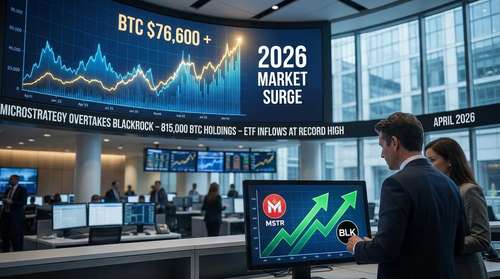
The cryptocurrency market reached a monumental inflection point this Tuesday. Driven by aggressive institutional buying and sudden macroeconomic relief, the Bitcoin price today 2026 has forcefully reclaimed the $76,600 level, erasing weeks of downward volatility. This resurgence goes far beyond a standard technical bounce; it marks a massive structural shift in digital asset ownership. Behind the headline-grabbing Bitcoin 76k news lies a historic changing of the guard: Michael Saylor's MicroStrategy has officially eclipsed BlackRock's iShares Bitcoin Trust, establishing itself as the undisputed largest institutional holder of BTC globally.
MicroStrategy Overtakes BlackRock in Historic Shift
For months, the financial sector watched Wall Street asset managers absorb digital assets at an unprecedented pace. Corporate finance, however, has just flipped the script. Fresh corporate filings reveal that MicroStrategy Bitcoin holdings have officially reached an astounding 815,000 BTC. This massive treasury milestone means the software intelligence firm has surpassed BlackRock in the ongoing institutional accumulation race.
The MicroStrategy vs BlackRock BTC dynamic highlights two fundamentally different approaches to digital asset dominance. BlackRock acts as a conduit, passively absorbing tokens based on retail and institutional client demand for its spot ETF. Conversely, MicroStrategy operates as an active, aggressive accumulator. The firm has consistently weaponized corporate debt, convertible notes, and equity offerings to hoard the asset directly on its balance sheet. This relentless playbook has effectively cemented the company as the apex predator of the digital asset ecosystem, securing a treasury that outpaces the world's most powerful asset manager.
$1.29 Billion ETF Inflows Fuel the April Momentum
While MicroStrategy currently holds the absolute crown, traditional Wall Street funds are accelerating their own pace. The upward price trajectory is heavily supported by over $1.29 billion in Spot Bitcoin ETF inflows recorded across just the last 48 hours. Capital allocators are aggressively moving back into risk-on assets following late-breaking reports of promising ceasefire negotiations in the Middle East.
The easing of these severe geopolitical tensions triggered an immediate drop in crude oil futures, calming long-term inflation fears and providing the perfect macroeconomic runway for the crypto market recovery April 2026 is currently experiencing. Financial advisors and pension funds, previously sitting on the sidelines due to global instability, deployed significant sidelined capital the moment diplomatic progress was announced. Major funds from Fidelity to Bitwise captured massive volume, proving that institutional appetite remains ravenous whenever macro conditions stabilize.
The Accelerating Bitcoin Supply Squeeze
The combined, relentless appetite of corporate treasuries and Wall Street ETFs is fundamentally altering market mechanics. The market is currently experiencing a textbook Bitcoin supply squeeze. Operating deep into a post-halving epoch, network block rewards are drastically constrained. Miners are currently producing just a fraction of the daily volume being absorbed by institutional giants.
When a handful of entities control vast percentages of the circulating supply, the available liquid inventory on public exchanges evaporates rapidly. Recent on-chain data shows exchange balances plunging to multi-year lows this week. Retail traders, family offices, and smaller hedge funds are increasingly forced to bid up spot prices simply to secure minor allocations.
- Permanent Capital: Institutions view these acquisitions as multi-decade treasury reserves, removing coins from active circulation.
- Exchange Depletion: Liquid supply on major exchanges has reached critical lows, exacerbating price volatility to the upside.
- Miner Constraint: Daily newly minted coins cannot satisfy even a fraction of current spot ETF and corporate demand.
Navigating the New Institutional Era
Understanding this new institutional era requires recognizing exactly who is setting the price floor. The reality of the market in late April reveals that absolute digital scarcity is finally being priced in by the world's largest pools of capital. Unlike previous bull cycles that were highly dependent on retail speculation and leveraged offshore derivatives, today's liquidity drought is engineered by regulated, long-term capital.
The fierce competition for the remaining coins will likely intensify as more Fortune 500 companies attempt to replicate Saylor's treasury strategy, albeit at much higher entry points. For market participants, the days of easily accessible, cheap liquidity are firmly in the rearview mirror. As corporate treasuries and Wall Street behemoths continue their race to one million coins, the structural foundation for Bitcoin's next major leg up has been firmly established.