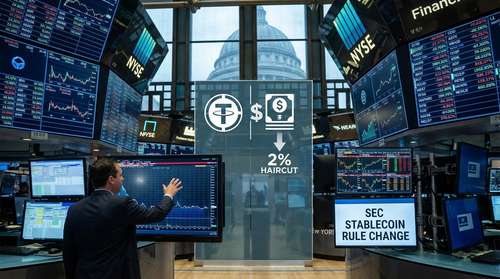
In a watershed moment for the integration of digital assets into traditional finance, the U.S. Securities and Exchange Commission (SEC) has officially lowered the net capital "haircut" for broker-dealers holding qualified stablecoins from a prohibitive 100% to just 2%. The move, announced late Friday by the Division of Trading and Markets, effectively treats dollar-backed stablecoins on par with money market funds, removing one of the most significant regulatory barriers to institutional crypto adoption.
Breaking Down the SEC Stablecoin Rule 2026
For years, Wall Street firms looking to settle trades on-chain faced a massive capital inefficiency. Under the previous application of Rule 15c3-1, broker-dealers were required to treat stablecoin holdings as "non-marketable assets," forcing them to set aside one dollar in capital for every dollar of stablecoin held—a 100% haircut. This made holding digital cash for settlement virtually impossible for regulated entities.
The new guidance, released under the directive of SEC Chairman Paul Atkins, fundamentally rewrites this calculus. Effective immediately, broker-dealers can apply a mere 2% haircut to proprietary positions in "qualified payment stablecoins." This aligns the regulatory treatment of assets like USDC with that of short-term U.S. Treasuries and commercial paper, signaling that the regulator now views compliant stablecoins as "ready market" instruments rather than speculative risks.
The GENIUS Act Implementation in Action
This regulatory pivot didn't happen in a vacuum. It serves as the direct regulatory implementation of the Guiding and Establishing National Innovation for U.S. Stablecoins (GENIUS) Act, signed into law in July 2025. The GENIUS Act established the first federal definition for payment stablecoins, requiring issuers to maintain 1:1 reserves in cash or government securities and creating a clear pathway for state-regulated trust companies to operate nationally.
“We are finally seeing the regulatory gears mesh with legislative intent,” says regulatory analyst Sarah Jenkins. “The GENIUS Act provided the definition, and now the SEC is providing the operational lane. This is the difference between stablecoins being a niche retail product and becoming the settlement layer for global capital markets.”
Winners and Losers: USDC vs. Tether
Not all digital dollars will qualify for the new 2% tier. The guidance creates a strict bifurcation in the market. To be eligible for the reduced broker-dealer capital haircut, a stablecoin must:
- Be issued by a state-regulated money transmitter or trust company.
- Provide monthly attestations from a registered public accounting firm.
- Maintain 1:1 backing with high-quality liquid assets (HQLA).
Market analysts note that this framework clearly favors onshore, transparent issuers like Circle (USDC) and Paxos, while potentially leaving offshore giants like Tether (USDT) subject to the old 100% capital requirement within U.S. broker-dealer accounts. This distinction is expected to drive a massive migration of institutional liquidity toward compliant, U.S.-domiciled stablecoins.
Digital Asset Settlement and Institutional Adoption
The implications for digital asset settlement are profound. With the capital penalty removed, major prime brokers can now hold stablecoins directly on their balance sheets to facilitate 24/7 settlement for clients. This is a critical step for the “Project Crypto” initiative—the joint effort between the SEC and CFTC to modernize market structure—allowing tokenized securities to settle instantly against digital cash without the friction of legacy banking rails.
Chairman Atkins, speaking at a fintech roundtable earlier this week, hinted at this shift, emphasizing that regulators should “stop panicking over price action and start building the structural plumbing.” By validating stablecoin vs money market fund equivalency, the Commission has effectively greenlit the use of blockchain rails for mainstream financial plumbing.
A New Era for Wall Street and Crypto
The 2% rule change represents more than just a technical adjustment; it is a symbolic end to the “regulation by enforcement” era that characterized previous administrations. By reducing the cost of doing business in crypto by 98%, the SEC has opened the door for banks, hedge funds, and high-frequency trading firms to step confidently into the digital asset space.
As the industry digests this news, eyes are now turning to the major custodian banks. With the capital constraints lifted, the race is on to see which Wall Street giant will be the first to offer fully integrated, stablecoin-native prime brokerage services.