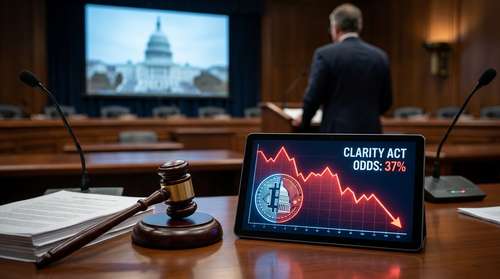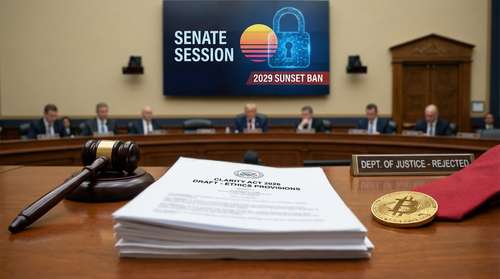
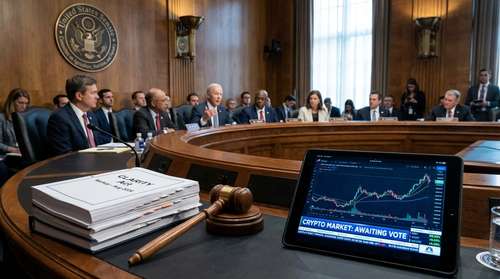
Washington is holding its collective breath as the crypto industry faces a defining moment on Capitol Hill. The Senate Committee on Agriculture, Nutrition, and Forestry is scheduled to hold a critical markup session tomorrow, January 27, to vote on the Digital Assets Clarity (CLARITY) Act. The legislation, once hailed as the bipartisan solution to years of regulatory ambiguity, now hangs by a thread following a high-profile revolt by major industry players led by Coinbase. With the Senate Banking Committee having shelved its own version of the bill just last week, tomorrow’s vote in the Agriculture Committee represents perhaps the final opportunity in 2026 to advance a comprehensive market structure framework.
The "Poison Pill": Stablecoin Yield Ban Sparks Industry Revolt
The controversy threatening to derail the CLARITY Act centers on a late-stage amendment that industry insiders are calling a "poison pill." At the heart of the dispute is Section 404, a provision pushed by banking lobbyists that would effectively ban digital asset platforms from offering yield or rewards on stablecoins. While the Guiding and Establishing National Innovation for US Stablecoins (GENIUS) Act—passed in July 2025—already prohibits issuers from paying interest, the new CLARITY amendment extends this restriction to exchanges and third-party custodians.
Coinbase CEO Brian Armstrong, who publicly withdrew support for the bill last Wednesday, argued that the amendment protects traditional banks from competition rather than protecting consumers. For exchanges, the stakes are financial; stablecoin rewards programs have become a massive revenue driver, generating hundreds of millions quarterly. "We would rather have no bill than a bad bill that cements a banking monopoly on yield," Armstrong stated, triggering a rift that has left lawmakers scrambling to salvage the legislation before tomorrow's gavel drops.
Senate Agriculture Committee Takes Center Stage
With the Senate Banking Committee’s markup cancelled abruptly by Chairman Tim Scott (R-SC) last week due to the industry pushback, all eyes are now on the Senate Agriculture Committee. Chairman John Boozman (R-AR) has expressed determination to push the bill forward, releasing a revised draft on Wednesday that attempts to thread the needle between banking concerns and crypto innovation. However, reports suggest that the committee’s ranking Democrats, including Senator Cory Booker (D-NJ), have yet to fully sign off on the latest language regarding the stablecoin reward ban legislation.
The CLARITY Act is designed to finally settle the turf war between the Securities and Exchange Commission (SEC) and the Commodity Futures Trading Commission (CFTC) by defining which digital assets are securities and which are commodities. If the Agriculture Committee fails to report the bill out tomorrow, analysts warn that crypto regulation news 2026 could be dominated by another year of legislative gridlock, leaving the industry in the same limbo that characterized the previous administration.
New Regulators Waiting in the Wings: The Atkins & Selig Factor
The legislative drama is unfolding against a backdrop of significant changes at the federal agencies. Paul Atkins, who was sworn in as SEC Chairman in April 2025, has already begun dismantling the "regulation by enforcement" approach of his predecessor, dropping high-profile cases against major platforms. However, Atkins has emphasized that he needs Congress to pass the CLARITY Act to provide a permanent statutory foundation for his new "innovation exemption" agenda.
Similarly, CFTC Chairman Michael Selig, who took office in December, has been a vocal proponent of the Digital Asset Market Structure Act components within CLARITY. The bill would grant the CFTC exclusive jurisdiction over the "digital commodity" spot market—a power the agency currently lacks. "Without this act, we are fighting 21st-century fraud with 20th-century tools," Selig told reporters earlier this month. The harmonization of SEC CFTC roles is the bill's strongest selling point, but it may not be enough to overcome the fierce lobbying battle over stablecoins.
Banks vs. Crypto: The Battle for Deposits
The underlying tension driving tomorrow's vote is a fundamental clash between the crypto sector and community banks. The Independent Community Bankers of America (ICBA) and other trade groups have lobbied aggressively for the yield ban, warning that unregulated stablecoin rewards could trigger massive "deposit flight" from insured banks to uninsured crypto platforms. They argue that platforms offering 4-5% APY on dollar-pegged tokens are effectively operating as shadow banks without adhering to capital requirements.
For the crypto industry, however, the ability to pass yield on to customers is a core feature of the technology's efficiency. As lobbyists make their final pitch to committee members this evening, the outcome of tomorrow's markup remains too close to call. If Chairman Boozman cannot secure the votes to pass the bill with the controversial amendment attached, he may be forced to strip the provision—risking the support of banking-aligned senators—or watch the CLARITY Act Senate markup end in failure.