
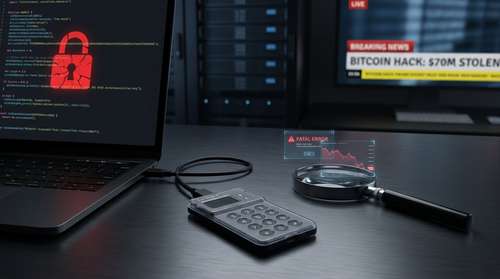
In a devastating blow to the cryptocurrency community, a catastrophic Coldcard wallet exploit resulted in the theft of over $70 million in Bitcoin. In a span of just 41 minutes on July 30, 2026, an attacker systematically drained 1,082.65 BTC from nearly 1,200 air-gapped wallets. Security researchers at Galaxy Digital and Block quickly identified the root cause: a fundamental flaw in the device's software-based pseudorandom number generator (RNG). This breach serves as a stark reminder that even gold-standard offline security measures can fail if the foundational cryptography is compromised.
How the Coinkite Firmware Vulnerability Worked
Hardware wallets are designed to keep private keys entirely disconnected from the internet. However, this Bitcoin hardware wallet hack bypassed physical security completely by exploiting how the device generated its initial recovery seed.
According to technical reviews by Coinkite and independent researchers, the problem stemmed from a Coinkite firmware vulnerability introduced back in March 2021. During wallet setup, devices are supposed to draw entropy (randomness) from a dedicated hardware chip. Instead, a software integration error caused the system to bypass the true hardware random number generator. The process defaulted to a weak software substitute in MicroPython, drawing its data from factory-fixed serial numbers and basic device clock states.
Because the randomness was severely compromised, the device produced a predictable seed phrase RNG. For devices like the popular Coldcard Mk3, the effective entropy dropped to roughly 40 bits. Hackers did not need to touch a single physical device; they simply used algorithms to calculate the predictable seeds and recreate the victims' private keys from afar.
Anatomy of the Heist: Galaxy Research 70 Million Bitcoin Drain
The speed and precision of the attack shocked security analysts. While initial estimates by Chainalysis pegged the losses at $38 million across 500 wallets, a comprehensive report outlining the Galaxy Research 70 million Bitcoin theft revealed a much larger scope. The attacker actually swept 1,196 distinct addresses across just six blockchain blocks.
The operation was highly automated and executed with military precision. Investigations led by Clay Garrett and the engineering team at Block discovered a distinctive pattern in how the transactions were grouped. The thief reportedly used a paid account with a well-known commercial blockchain analytics service to query target addresses and track balances before initiating the mass sweep. The majority of affected wallets held between 1 and 50 BTC, a profile closely matching individual retail investors rather than massive institutional holdings. By the time Coinkite published its security advisory, the funds were already gone and transferred to a handful of dormant consolidation addresses.
Exposing a Critical Crypto Self Custody Security Flaw
This event exposes a massive crypto self custody security flaw. For years, the rallying cry of not your keys, not your coins drove investors toward hardware solutions to escape exchange bankruptcies and phishing attacks. The fundamental defense mechanism has always been distance: an offline device should inherently protect assets from remote digital threats.
However, this incident highlights a severe vulnerability in the software architecture of hardware providers. When a device relies on a flawed mechanism to create its master password, physical isolation becomes completely irrelevant. Unlike the $160 million Wintermute exploit in 2022 that targeted professional market makers exploiting the Profanity tool, this disaster directly hit everyday users who believed their offline vaults were impenetrable. The market sentiment around self-custody took an immediate hit, with users questioning the underlying code securing their assets.
How to Secure Coldcard Wallet Holdings Today
If you generated a recovery seed on an affected device—particularly Coldcard Mk3, Mk4, Mk5, or Q models running older firmware—your funds may be at imminent risk. Coinkite CEO Rodolfo Novak has taken full accountability for the oversight, and the company has released emergency patches. Here is exactly how to secure Coldcard wallet assets immediately:
- Install Emergency Firmware: Upgrade to version 4.2.0 or later for Mk3, 5.6.0 or later for Mk4/Mk5, and 1.5.0Q or later for Coldcard Q devices.
- Do Not Just Update: A firmware update alone cannot magically secure a predictable private key that was already generated.
- Generate a New Seed: Once the patched firmware is installed, you must create a completely new recovery seed phrase. The patch ensures the new seed utilizes the intended 128-bit hardware true random number generator.
- Test and Migrate Your Bitcoin: Send a small test transaction to the new wallet address. Once confirmed, immediately transfer all existing balances to the newly generated and secure wallet addresses. Keep the old seed document strictly as a backup to access past transaction history if needed.
As the crypto industry grapples with the fallout of this massive exploit, the focus on rigorous, open-source firmware auditing has never been sharper. Self-custody remains a powerful tool for financial sovereignty, but as recent events prove, it requires eternal vigilance and prompt responses to manufacturer advisories.