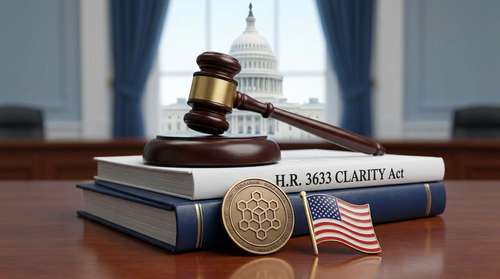
The final wall blocking the most significant piece of cryptocurrency legislation in United States history may have just come down. On the evening of July 20, 2026, President Donald Trump formally agreed to a conflict-of-interest ethics provision for the landmark Digital Asset Market CLARITY Act (H.R. 3633). This breakthrough resolves a months-long partisan deadlock that had effectively stalled the comprehensive US crypto regulation bill in the Senate. By conceding to the strict crypto ethics clause, the administration has cleared a primary hurdle, setting the stage for a critical Senate floor vote before the August recess.
What the CLARITY Act Trump Ethics Deal Means
The standoff over H.R. 3633 was never actually about how to regulate blockchain networks or digital tokens. Instead, it centered on a targeted conflict-of-interest clause designed to restrict the president, the vice president, and members of Congress from directly profiting from digital assets while holding federal office.
The political friction was inextricably linked to the Oval Office. President Trump’s financial disclosures from earlier this summer revealed approximately $1.4 billion in cryptocurrency-related income for 2025. The vast majority of those earnings were tied to his family's decentralized finance project, World Liberty Financial, alongside various memecoins. Senate Democrats, led by figures like Senator Elizabeth Warren, drew a hard line, demanding robust ethical guardrails before they would allow the broader cryptocurrency market structure framework to advance to a floor vote.
According to crypto journalist Eleanor Terrett and multiple industry sources, the White House capitulated late Monday, sending an approved ethics package directly to a contingent of Senate Republicans. While the exact statutory language remains under wraps, Republican Senator Bernie Moreno championed the GOP-backed draft as "the strongest of any piece of legislation ever passed by any Congress". Conversely, Democrats still need to review the finalized text to determine if it meets their threshold for bipartisan support, setting up a potential showdown over the fine print.
Reshaping CFTC SEC Crypto Oversight
If the ethics compromise holds, the Digital Asset Market CLARITY Act will fundamentally rewrite the rulebook for America’s digital economy. For years, digital asset businesses have navigated a murky, regulation-by-enforcement landscape characterized by a bitter jurisdictional turf war. This legislation aims to replace that ambiguity with a clear, functional cryptocurrency market structure.
The core mechanism of H.R. 3633 explicitly divides CFTC SEC crypto oversight by legally classifying different types of digital assets. Under the bill’s provisions:
- CFTC Empowerment: The Commodity Futures Trading Commission will take primary jurisdiction over decentralized digital commodities. This represents a massive expansion of the agency's mandate, requiring significant new funding to police spot markets effectively.
- SEC Boundaries: The Securities and Exchange Commission retains its authority over digital assets that strictly function as securities or investment contracts, curbing the agency's attempts to blanket the entire industry under existing securities laws.
- Consumer Protection: The bill mandates strict bankruptcy protections to prevent a repeat of the FTX collapse, ensuring customer funds are legally shielded if an exchange goes under.
- DeFi Safe Harbors: Decentralized finance developers receive specific legal protections, allowing software engineers to write code without automatically triggering stringent broker-dealer registration requirements.
Enhanced Compliance and Anti-Money Laundering
Beyond market structure, the bill introduces rigorous operational compliance standards. It formally extends Bank Secrecy Act (BSA) obligations to all digital asset brokers, dealers, and exchanges. Compliance teams will be legally required to utilize blockchain analytics tools to monitor for suspicious activities. Furthermore, the Treasury Department gains new "Special Measure 6" authority to sanction foreign jurisdictions and institutions that pose illicit finance risks involving digital assets.
Racing the Clock: Will the US Crypto Regulation Bill Pass?
The CLARITY Act Trump ethics deal could not have arrived at a more critical moment. The legislative clock is ticking loudly in Washington. Lawmakers are highly motivated to push the bill through before the Senate adjourns for its month-long recess on August 7, 2026. Missing this pre-recess window would likely push the debate deep into the fall, where the fast-approaching midterm elections could completely derail the legislation until the next Congress.
Market watchers are already pricing in the optimism. Following the news of the White House's concession, prediction markets on Polymarket rebounded, pushing the odds of the bill passing in 2026 back up to 43% after weeks of steady decline. Industry leaders are urging swift action. Galaxy Digital CEO Mike Novogratz publicly pleaded with lawmakers to finalize the text, noting that American voters firmly believe politicians shouldn't have a financial edge over everyday citizens.
The foundation for passage is undeniably solid. The House of Representatives overwhelmingly passed its version of the bill in July 2025 in a historic 294-134 bipartisan vote. More recently, the Senate Banking Committee advanced the text 15-9 this past May, with key Democrats crossing party lines to support the framework—strictly on the condition that the ethics dispute was resolved.
With the president officially signing off on the crypto ethics clause, the ultimate decision now rests on whether Senate Democrats view the final language as a legitimate safeguard or a political loophole. If the compromise secures the 60 votes needed to break a filibuster, the United States is poised to finally establish clear, lasting rules of the road for the global digital asset industry.