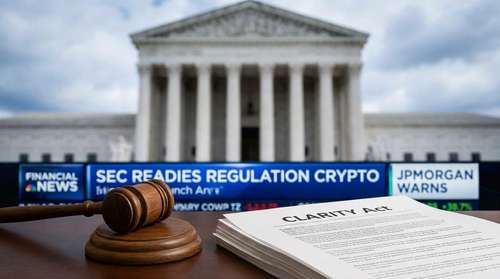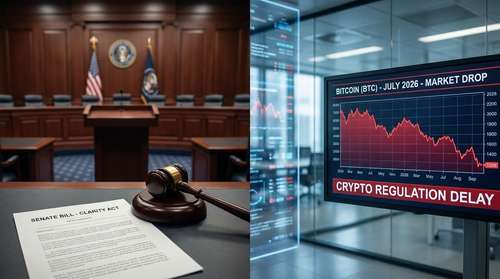
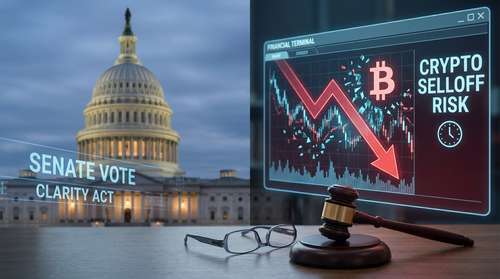
The clock is ticking in Washington as the U.S. Senate races against a tightening calendar to finalize the most consequential digital asset legislation in history. With the chamber's month-long recess scheduled to begin by the end of the week, Senate Majority Leader John Thune has confirmed that a crucial CLARITY Act Senate vote will be placed on the floor. However, the exact timing remains a subject of fierce procedural maneuvering. With lawmakers preparing to depart for their state work periods, the pressure to pass the Digital Asset Market Clarity Act is escalating daily. A failure to secure the 60 required votes would mean more than a simple legislative stall; analysts caution that a deadlock could inject severe volatility into the financial markets right as institutional digital asset adoption finds its footing.
Bernstein Issues a Bitcoin Selloff Warning
Wall Street is keeping a microscopic eye on the legislative schedule, and institutional forecasts are growing increasingly cautious. Analysts at the financial research firm Bernstein have issued a stark Bitcoin selloff warning, noting that any legislative collapse before the recess could trigger a swift, negative reaction across the broader market. Bitcoin has already been trading under pressure as traders weigh the rising possibility of policy gridlock ahead of the upcoming midterm elections.
If the Senate departs without advancing the 616-page bill, the market is likely to interpret the inaction as a signal that comprehensive regulation will not materialize under the current Congress. Bernstein's research suggests that billions in sidelined institutional capital are heavily dependent on the legal certainty this framework promises. Without a successful procedural vote to invoke cloture, the sector risks a painful downward leg in valuations, potentially derailing the anticipated fourth-quarter market rebound.
Inside the DeFi Regulatory Battle and AML Exemptions
Beyond the immediate market impact, a fierce DeFi regulatory battle is threatening to upend the bill's momentum. The legislation attempts to strike a delicate balance by establishing clear parameters for decentralized finance developers, including protections for software publishers and new anti-money laundering (AML) protocols. Yet, law enforcement organizations and the crypto industry are currently locked in a bitter dispute over the operational realities of these exemptions.
Groups such as the National Sheriffs' Association have voiced objections to specific DeFi carve-outs, arguing they might complicate financial crime investigations. In response, the Blockchain Association and other prominent advocacy groups have pushed back aggressively. In a recent letter to Senate leadership, the industry argued that the framework actually strengthens the government's ability to monitor illicit finance by modernizing compliance standards. This friction has made it exceedingly difficult to unify lawmakers who want to champion domestic technology growth without appearing soft on financial crime.
Establishing SEC CFTC Crypto Rules
At its core, the legislation aims to officially end the era of regulation by enforcement. The bill explicitly defines the long-debated SEC CFTC crypto rules, mapping out exactly where the Securities and Exchange Commission's jurisdiction ends and the Commodity Futures Trading Commission's authority begins. By classifying sufficiently decentralized tokens as digital commodities under exclusive CFTC oversight, the framework aims to permanently resolve the jurisdictional turf war that has plagued exchanges, issuers, and developers for over a decade.
Will Politics Force a US Crypto Bill Delay?
Despite the structural benefits of the bill, the legislative math presents the steepest hurdle. Republicans currently hold 53 seats, meaning they must secure at least seven Democratic crossover votes to break a filibuster. While a similar framework cleared the House with wide bipartisan support last year, the Senate version has become deeply entangled in a partisan dispute over government ethics.
The controversy heavily centers on conflict-of-interest provisions. Senate Democrats are demanding stricter safeguards to prevent top federal officials—notably factoring in Donald Trump's reported $1.4 billion in cryptocurrency ventures—from personally profiting from the new regulatory regime. A proposed compromise, spearheaded by Senators Thom Tillis and Ruben Gallego, would grant state attorneys general the power to enforce these ethics restrictions. However, the White House has yet to formally respond to the counterproposal. This administration silence has caused prediction market odds for the bill's passage to plummet to roughly 31%. Without immediate executive branch support, Democratic votes will evaporate, virtually guaranteeing a US crypto bill delay.
Navigating Crypto Regulation News 2026 and Beyond
The macroeconomic implications of this stalemate are vast. Treasury Secretary Scott Bessent has publicly urged the Senate to take decisive action immediately, pushing back against critics and warning of the long-term economic consequences of legislative paralysis. The stakes for crypto regulation news 2026 could not be higher. If the Senate fails to advance the bill before dispersing, the United States risks surrendering its competitive edge to overseas jurisdictions that have already codified their digital asset frameworks.
For now, the digital asset ecosystem is trapped in a tense holding pattern. Whether Senate leaders can bridge the partisan divide and finalize an ethics deal in their final working days remains the ultimate test of political will. Traders, institutions, and developers alike are bracing for the fallout, knowing that this week's outcome will dictate the trajectory of the global digital economy.