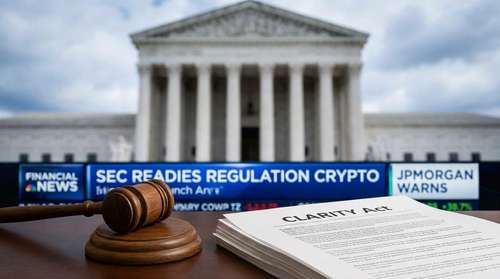

The battle over digital asset regulatory turf just hit a major flashpoint. As published in the Federal Register on August 3, 2026, a highly anticipated SEC Bitcoin options approval is officially on ice. The U.S. Securities and Exchange Commission has formally delayed the launch of Nasdaq’s cash-settled digital asset derivatives, halting the product while the full commission reviews a fierce legal pushback.
The regulatory agency established a firm Bitcoin index options deadline of August 24, 2026, for interested parties and market participants to submit written arguments. This means the highly anticipated QBTC options launch is indefinitely sidelined until regulators can untangle a complex web of authority between traditional finance heavyweights.
How the CME Group SEC Challenge Halts Nasdaq
The timeline of this regulatory clash shows just how quickly market dynamics are shifting. On May 22, 2026, SEC staff initially approved a rule change allowing the Nasdaq PHLX exchange to list cash-settled options on the Nasdaq Bitcoin Index. The product, set to trade under the ticker QBTC, was unique because it referenced an index tracking the direct price of the underlying digital asset, rather than tracking shares of a spot exchange-traded fund.
That subtle structural difference triggered a massive roadblock. In June, the Chicago Mercantile Exchange (CME) filed a formal notice to appeal, effectively staying the approval. The core of the CME Group SEC challenge rests on the argument that Bitcoin is a non-security commodity. CME’s legal team insists that any cash-settled options tied directly to its price should be classified as commodity swaps. Because CME already operates federally regulated futures and options markets under strict supervision, they argue Nasdaq’s new product infringes on established commodity laws.
Understanding the QBTC Structure
To understand why traditional finance giants are fighting over this, you have to look at the mechanics of the proposed Nasdaq Bitcoin index options. The contracts were designed to track one-hundredth of the CME CF Bitcoin Real Time Index. This specific sizing is a deliberate hook tailored for institutional hedging and mid-tier retail access, offering a significantly smaller per-contract notional value than standard institutional contracts.
However, under the original conditional approval, Nasdaq and the Options Clearing Corporation (OCC) still needed to secure exemptions from the Commodity Futures Trading Commission (CFTC) before trading could commence. CME argued that regulators cannot simply use exemptions to shuffle regulatory authority from one agency to another.
Why Institutional Investors Are Watching Closely
The stakes in this regulatory standoff are exceptionally high due to the sheer volume of institutional capital waiting on the sidelines. Portfolio managers and large-scale traders prefer index options because they offer cleaner exposure to broad price movements without the idiosyncratic risks associated with holding shares of a specific fund management company. By tracking a multi-venue aggregate price rather than a single ETF asset value, institutional players can hedge their positions with much greater accuracy.
The delay leaves a significant gap in the sophisticated trading toolkit. While options on specific exchange-traded funds do exist, they carry counterparty and issuer-specific risks. The promise of the frozen Nasdaq product was a democratized, cash-settled mechanism that bypassed those localized risks, creating a purer reflection of real-time market sentiment.
The Expanding SEC CFTC Jurisdiction Dispute
This freeze goes far beyond a single ticker symbol on a digital exchange. The ongoing SEC CFTC jurisdiction dispute asks a foundational question about modern finance: Can a securities exchange list a derivative based directly on a commodity simply through an agency exemption?
Under current United States derivatives law, spot ETF shares are cleanly classified as securities. Bitcoin itself, however, is widely treated as a commodity. CME argues that by approving the QBTC product, the SEC is overstepping its bounds and bypassing the regulatory framework strictly designed for commodity futures markets. If CME successfully defends this legal interpretation, the SEC will lack the authority to approve similar index-based contracts in their current form.
The Future of Crypto Derivatives Regulation
Market participants are now watching the August 24 deadline closely. The outcome of this commission review will likely dictate the next decade of crypto derivatives regulation. If the SEC permanently revokes its approval or if the CFTC steps in to claim exclusive oversight, the path to market for digital asset products will fundamentally change.
Nasdaq would essentially face two difficult choices. The exchange would either need to register its platform as a fully regulated futures and swaps venue under the CFTC, or it would have to completely redesign the QBTC contracts. A redesign would likely force the options to track a registered security, abandoning the direct index-tracking structure that made the product so appealing in the first place.
For now, the digital asset sector remains in a holding pattern. As the traditional finance sector battles for supremacy over digital asset frameworks, the delay serves as a stark reminder that the integration of decentralized assets into legacy markets is still fraught with regulatory friction.