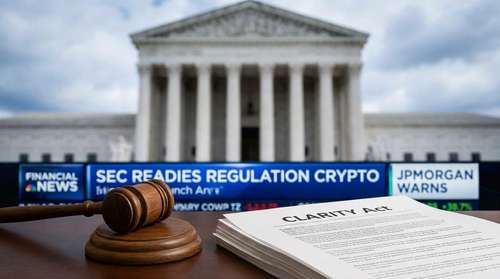

The regulatory landscape for digital assets is once again the center of a high-stakes standoff. In a move that effectively halts the rollout of a highly anticipated derivatives product, the U.S. Securities and Exchange Commission has enacted an SEC Bitcoin options freeze on Nasdaq's newly approved digital asset offering. The pause stems directly from a fierce CME jurisdictional challenge, reigniting a broader debate over who truly controls the oversight of digital commodities.
At the core of this dispute is a fundamental question of regulatory authority. CME Group argues that since Bitcoin is legally classified as a commodity, options tied directly to its value fall under the exclusive jurisdiction of the Commodity Futures Trading Commission (CFTC)—not the SEC. This latest development in the SEC CFTC crypto turf war has triggered a public comment window that remains open through August 24, 2026, leaving traders and institutional investors waiting in limbo.
The Catalyst Behind the SEC Bitcoin Options Freeze
To understand how the market arrived at this regulatory roadblock, you have to look back to May 22, 2026. On that date, Nasdaq PHLX scored a major conditional victory when the SEC approved its proposed rule change to list and trade Nasdaq QBTC options. These contracts were designed to provide a regulated, traditional pathway for investors to gain exposure to Bitcoin volatility without needing to hold the underlying asset.
The product, operating under the ticker QBTC, was structured to offer cash settled Bitcoin options benchmarked against the spot price of the cryptocurrency, fitting neatly within the standard margin framework used for traditional equity index options. The approval was seen as a massive leap forward for crypto derivatives regulation, bridging the gap between legacy brokerages and digital assets.
The celebration was short-lived. By mid-June, CME Group—the undisputed heavyweight in traditional institutional Bitcoin futures—filed a formal petition for review of the SEC's approval order. Under standard regulatory procedures, this notice of intention triggered an automatic stay on the Nasdaq product, effectively pressing pause on the launch and pulling the SEC back to the drawing board.
Unpacking the CME Jurisdictional Challenge
CME Group's argument is not merely a competitive grievance; it represents a foundational legal challenge concerning digital asset classification. The exchange asserts that because Bitcoin is universally recognized by U.S. regulators as a commodity, any financial instrument directly indexing its value must be overseen by the CFTC.
What makes this specific standoff even more intriguing is the underlying data. The proposed Nasdaq product is designed to track a benchmark derived by dividing the CME CF Bitcoin Real-Time Index by 100. Because this is the exact same underlying mechanism that powers CME's own highly successful Bitcoin derivatives, the competitive friction between the two financial titans is palpable. CME is aggressively defending its territory, ensuring that competitors cannot piggyback on similar commodity pricing indices without playing by the exact same regulatory rulebook.
By stepping into the arena of Bitcoin index options, the SEC is, according to CME's filings, overstepping its statutory boundaries. If the SEC were to maintain oversight of the Nasdaq QBTC options, it would establish a contentious precedent where exemptions could be used to transfer oversight from one federal agency to another. This shift would fundamentally alter the framework of crypto derivatives regulation and potentially apply to other digital assets like Ethereum in the future.
The SEC CFTC Crypto Turf War
This conflict highlights an ongoing and increasingly complex SEC CFTC crypto turf war. For years, the two agencies have wrestled for control over the rapidly expanding digital asset sector. The CFTC has historically positioned itself as the primary watchdog for commodities and futures markets, while the SEC has aggressively pursued jurisdiction over anything that could be interpreted as a security.
If CME successfully forces Nasdaq to seek relief and registration under the CFTC, it will cement the commodities regulator's dominance over cash-based crypto derivatives. Conversely, if the SEC retains control over these Bitcoin index options, it opens the door for equity exchanges to bypass traditional commodities regulations, escalating the bureaucratic rivalry to new heights.
What This Means for Cash Settled Bitcoin Options
For the institutional trader and the broader crypto market, the immediate impact is a frustrating delay. The demand for cash settled Bitcoin options has never been higher, particularly among traditional finance players who prefer the security and familiarity of equity-style margin accounts over native cryptocurrency exchanges.
The SEC Bitcoin options freeze leaves liquidity providers and market makers on the sidelines. The QBTC contracts were expected to bring substantial depth to the market, allowing institutions to hedge their spot ETF positions or speculate on volatility without managing physical private keys. Until the jurisdictional dust settles, those capital flows remain trapped behind regulatory red tape.
The August 24 Deadline and Next Steps
The SEC has now opened the floor to the public and industry stakeholders. According to recent federal filings, any party may submit written statements supporting or opposing the original approval order until August 24, 2026. This public comment period is critical, as the SEC will use this feedback to re-examine the CME jurisdictional challenge and determine the ultimate fate of the Nasdaq offering.
Once the August 24 deadline passes, regulators will face a binary choice: either uphold the original approval and brace for a protracted legal battle with CME, or concede jurisdiction to the CFTC, forcing Nasdaq to overhaul its regulatory approach. Whatever the outcome, the resolution of this standoff will redefine the rules of engagement for digital asset derivatives in the United States.