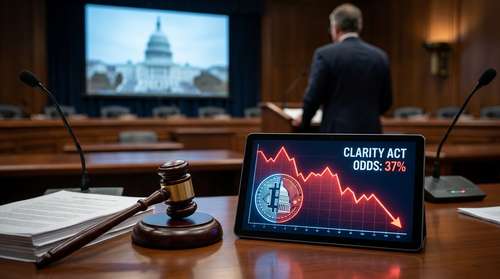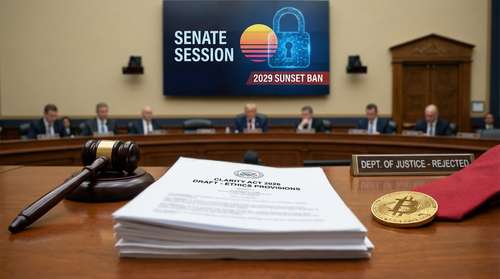
In a watershed moment for the United States financial system, White House AI and Crypto Czar David Sacks has officially confirmed that the landmark Digital Asset Market Clarity Act (CLARITY Act) is heading for a critical Senate committee markup on January 27, 2026. Speaking from the World Economic Forum in Davos, Sacks delivered a bullish forecast that has sent ripples through both Wall Street and Silicon Valley: the imminent merger of traditional banking and the digital asset economy.
Senate Agriculture Committee Set for Historic Jan 27 Markup
After months of legislative wrangling and partisan deadlock, the path forward for comprehensive crypto regulation has finally cleared. The Senate Agriculture Committee, led by Chairman John Boozman (R-AR), is scheduled to hold a business meeting to mark up the legislation this coming Tuesday. This procedural step is widely viewed as the final hurdle before a full Senate vote.
"This is the end of the beginning for the crypto wild west," Sacks told reporters. "We are moving toward a unified system. After this market structure bill passes, banks are going to get fully into the crypto industry. We're not going to have a separate banking industry and a crypto industry—it's going to be one digital assets industry."
Solving the SEC vs. CFTC Jurisdictional Dispute
At the heart of the CLARITY Act is the resolution of the long-standing turf war between the Securities and Exchange Commission (SEC) and the Commodity Futures Trading Commission (CFTC). For years, the lack of clear boundaries has stifled innovation and forced American companies offshore.
The new legislation provides a clear statutory test to determine when a digital asset is a security (under SEC purview) and when it is a commodity (under CFTC oversight). Under the proposed framework, decentralization is the key metric. Assets that meet specific decentralization requirements will be treated as digital commodities, placing them firmly under the CFTC's jurisdiction—a move widely favored by the industry.
Banks Poised to Enter the Digital Asset Market
Perhaps the most transformative aspect of the bill is its provisions for traditional financial institutions. By establishing a federal framework for stablecoins and digital asset custody, the CLARITY Act effectively rolls out the red carpet for major US banks to offer crypto services directly to consumers.
Currently, strict capital requirements and regulatory ambiguity have kept giants like JPMorgan and Bank of America on the sidelines. The CLARITY Act aims to dismantle these barriers, allowing banks to:
- Custody Bitcoin and other digital assets for retail and institutional clients
- Issue their own FDIC-insured stablecoins
- Facilitate seamless fiat-to-crypto settlements
"If the banks don't get involved now, they lose," Sacks warned during his Davos interview, referencing the contentious debate over stablecoin yields. "It is in their interest to work something out, because the status quo of unregulated shadow banking is ending."
Political Tensions and the Path to 2026 Regulation
While the confirmation of the markup is a significant victory, the road to the President's desk remains complex. The Senate Agriculture Committee's draft has faced opposition from some Democrats who argue the consumer protections are insufficient compared to traditional securities laws. Senator Elizabeth Warren and others have raised concerns about potential conflicts of interest and the need for stricter anti-money laundering (AML) controls.
However, the political winds in Washington have shifted. With a pro-crypto administration and increasing bipartisan recognition that the US risks losing its competitive edge to jurisdictions like the EU and Singapore, the momentum for passing the CLARITY Act in early 2026 is undeniable. The legislation builds on the foundations of previous proposals, including the "GENIUS Act," to create a comprehensive regulatory regime.
What This Means for Investors
For the average investor, the passage of the CLARITY Act could mean safer, more accessible crypto markets. The entry of trusted banking institutions is expected to bring immense liquidity and stability to the volatile asset class. Moreover, clear rules of the road will likely spur a new wave of institutional investment, potentially driving the next phase of growth for major digital assets.
As the clock ticks down to the January 27 markup, all eyes are on the Senate Agriculture Committee. If successful, 2026 will be remembered as the year crypto finally grew up and joined the global financial mainstream.