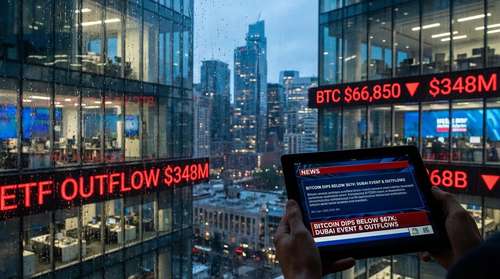
Bitcoin (BTC) plummeted below the critical $67,000 support level early Sunday, March 8, as a perfect storm of geopolitical escalation and institutional capitulation battered the crypto markets. The sharp sell-off follows confirmed reports of an explosion at Dubai International Airport (DXB) caused by intercepted drone debris, alongside data revealing a massive $348.83 million exodus from US spot Bitcoin ETFs on Friday.
Dubai Airport Explosion Rocks Global Risk Assets
The crypto market news March 2026 cycle is currently dominated by escalating tensions in the Middle East. On Saturday morning, witnesses reported a loud explosion near Dubai International Airport, one of the world's busiest aviation hubs. The Dubai Media Office later confirmed that a concourse sustained damage from the falling debris of an intercepted drone, resulting in injuries to four airport staff.
While authorities confirmed the incident was "quickly contained" and not a direct missile strike, the psychological impact on global markets was immediate. The Dubai airport explosion crypto impact was felt instantly as algorithmic traders and retail investors fled risk assets, fearing a broader regional conflict involving Iran and the United States. Flight cancellations and the temporary suspension of operations at DXB have only deepened the sense of uncertainty, driving capital toward traditional safe havens like gold and the US dollar, while leaving Bitcoin exposed.
Record Spot Bitcoin ETF Outflows Signal Institutional Fear
Adding fuel to the fire, institutional investors appear to be de-risking aggressively. Data from SoSoValue released late Friday shows that spot Bitcoin ETF outflows hit a staggering $348.83 million in a single trading session—the largest daily withdrawal since mid-February. This institutional crypto sell-off marks a stark reversal from the inflows seen earlier in the month.
The breakdown of the outflows paints a grim picture of current sentiment:
- Fidelity (FBTC): Led the exodus with $158.54 million in net outflows.
- BlackRock (IBIT): Followed closely, shedding $143.45 million, a rare sign of weakness for the market leader.
- Grayscale (GBTC): Continued its bleeding with smaller but significant withdrawals.
"Institutions are voting with their feet," notes crypto analyst Sarah Jenkins. "When you see BlackRock and Fidelity bleeding over $300 million combined in a day, it tells you that Wall Street is pricing in a prolonged period of Bitcoin geopolitical risk. They are moving to cash until the dust settles in the Gulf."
Bitcoin Price Crash Today: Key Support Levels to Watch
The combination of physical war threats and financial liquidity drains has pushed the Bitcoin price crash today into dangerous territory. After losing the $67,000 foothold, BTC is currently hovering in the $65,800 range. Technical analysts warn that the next major defense line lies at roughly $63,500. A breach below this level could open the floodgates for a drop toward the psychological $60,000 mark.
Market Sentiment Hits "Extreme Fear"
The Crypto Fear & Greed Index has plunged back into "Extreme Fear" territory, reflecting the frayed nerves of traders. Unlike previous dips where "buy the dip" calls were loud, the current atmosphere is one of caution. With the US-Iran conflict showing no signs of de-escalation, traders are wary of holding leveraged long positions over the weekend.
However, some contrarian voices remain. Long-term holders (LTHs) have shown resilience, with on-chain data suggesting that wallets holding BTC for over a year are not participating in the panic selling. For these veterans, the BTC support levels around $65,000 represent a high-value accumulation zone, assuming the geopolitical situation does not spiral further.
What's Next for Crypto Investors?
As we move deeper into March 2026, volatility is the only certainty. Investors should closely monitor official updates regarding the safety of UAE airspace and the opening of US markets on Monday. If ETF outflows continue at this pace into the new week, the bearish pressure on Bitcoin could intensify. Conversely, any diplomatic breakthrough or a pause in hostilities could trigger a sharp relief rally, punishing over-leveraged shorts.
For now, the mantra remains caution. With the correlation between Bitcoin and global geopolitical stability tighter than ever, news from Dubai is just as critical to your portfolio as news from the blockchain.