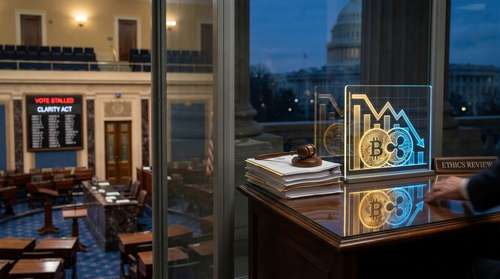

The cryptocurrency market experienced a massive $100 billion influx of capital over the past 24 hours, sending shockwaves through the financial sector. At the heart of this historic rally is a perfect storm of macroeconomic relief and monumental legislative progress. The U.S. Senate is officially moving forward with the CLARITY Act 2026, a comprehensive market structure framework designed to fundamentally reshape US crypto policy. Coupled with a sudden de-escalation of geopolitical tensions in the Middle East, Bitcoin has blasted past $78,000 and is now firmly targeting the $80,000 threshold.
Dismantling Gary Gensler SEC Overreach
For years, the digital asset industry has operated under a cloud of uncertainty, stifled by what lawmakers and industry leaders alike have dubbed 'regulation by enforcement'. The Senate crypto bill, formally known as the Digital Asset Market Clarity Act, strikes directly at this issue by stripping the Securities and Exchange Commission of its blanket authority over the sector.
By establishing a statutory test that draws a bright line between 'digital commodities' and 'investment contract assets', the legislation actively curbs Gary Gensler SEC overreach. Under the new framework, the Commodity Futures Trading Commission (CFTC) will gain exclusive regulatory oversight over decentralized digital commodities, spot markets, and exchanges. This shift promises to protect software developers and decentralized finance (DeFi) protocols from being treated as traditional financial intermediaries, ensuring that code is protected even as misconduct is penalized. Furthermore, the bill introduces a novel Certification of Decentralization, empowering blockchain networks to formally prove they operate outside of centralized corporate control.
Overcoming Legislative Deadlock
While the bill passed the House with strong bipartisan support in July 2025, it faced significant hurdles in the Senate Banking Committee. The primary sticking point centered on stablecoin yields, with traditional banking lobbyists arguing that passive returns on dollar-pegged assets could trigger massive deposit flight. However, recent compromises banning pure passive yield while permitting activity-based rewards have brokered a path forward. Coinbase Chief Policy Officer Faryar Shirzad recently projected that these breakthroughs could lead to a full Senate floor vote by May.
As the Senate Banking Committee prepares for its final markup procedures, industry advocates emphasize that this legislation is fundamentally an investor protection bill. By forcing cryptocurrency exchanges to implement robust anti-money laundering protocols and maintain transparent asset segregation, the CLARITY Act aims to prevent future catastrophic market collapses. It creates an environment where American innovation can flourish without compromising retail safeguards.
Geopolitical De-escalation Fuels the Risk-On Rally
While the promise of definitive SEC crypto regulation provided the structural foundation for this week's surge, macroeconomic developments supplied the rocket fuel. Global markets breathed a collective sigh of relief following major diplomatic breakthroughs in the Middle East.
Iranian Foreign Minister Abbas Araghchi confirmed the complete reopening of the Strait of Hormuz to commercial shipping, a move aligned with a temporary ceasefire framework. Reports indicate the peace plan involves the U.S. releasing $20 billion in frozen funds in exchange for Iran surrendering its uranium enrichment capabilities. This diplomatic pivot immediately triggered an 11% drop in crude oil prices, easing inflation anxieties and sending the S&P 500 to record highs. Risk-on sentiment instantly flooded back into digital assets, pushing the total crypto market capitalization to $2.61 trillion.
Institutional Crypto Adoption and Bitcoin's Next Move
Beyond Bitcoin, the broader digital asset ecosystem is reacting vigorously to the shifting political tides. Ethereum climbed over 3% to reclaim the $2,400 level, while XRP advanced nearly 2.4% following the news. For alternative layer-1 networks and decentralized finance tokens, the removal of existential regulatory threats provides the exact runway needed to scale operations securely within the United States.
The convergence of regulatory certainty and macro stability has dramatically accelerated institutional crypto adoption. Since the beginning of March, Bitcoin exchange-traded funds (ETFs) have absorbed over $2.3 billion in steady inflows, neutralizing the sell pressure that plagued the market earlier this year. Traditional finance players are now pricing in the reality that the United States is finally establishing a safe, compliant sandbox for tokenized real-world assets and digital commodities. Institutional custody providers are already preparing for CFTC registration requirements, which mandate stringent customer asset segregation and market surveillance standards.
Bitcoin Price Prediction 2026: The Path to $80,000
Market analysts are increasingly unified in their outlook. According to Polymarket data, the probability of the flagship cryptocurrency breaching $80,000 before the end of the month has spiked to 65%. A heavy liquidation of short positions—amounting to $306 million wiped out in a single day—has created the optimal conditions for a massive short squeeze.
If corporate earnings remain resilient and the Senate continues its steady march toward passing the CLARITY Act, the baseline Bitcoin price prediction 2026 shifts from simple recovery to aggressive price discovery. With clear rules of the road finally materializing in Washington, the digital asset market is no longer just surviving; it is preparing to lead the next decade of global financial innovation.