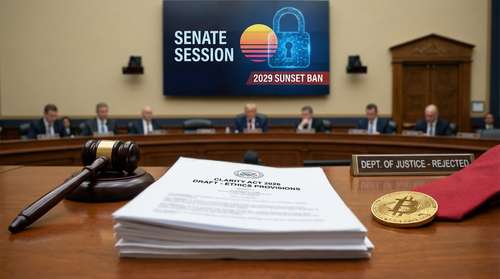

Washington's most ambitious attempt to regulate the cryptocurrency industry has officially hit a wall. As of March 9, 2026, the landmark Digital Asset Market Clarity Act—widely known as the Clarity Act 2026—is entirely stalled in the Senate. A highly anticipated March 1st compromise deadline came and went without a resolution, leaving the US crypto market structure bill in legislative limbo. The core of the bitter dispute? A fierce turf war between traditional banking giants and cryptocurrency innovators over a proposed stablecoin interest ban. While the legislation was originally designed to establish clear boundaries for SEC vs CFTC crypto jurisdiction, it has morphed into an existential fight over the future of digital money, deposit flight, and America's global financial competitiveness.
The March 2026 Stalemate: Banking Giants vs. Crypto Innovators
Last week, the American Bankers Association formally rejected a White House-brokered compromise, solidifying the current congressional gridlock. Traditional lenders, including heavyweights like JPMorgan and other commercial banks, have drawn a hard line in the sand regarding how digital assets interact with savings and yields.
To understand the conflict, you have to look back at the Genius Act implementation from July 2025. The Guiding and Establishing National Innovation for U.S. Stablecoins Act established the baseline rules for the market, effectively approving stablecoins as a payment mechanism and demanding a strict 1:1 backing with US dollars or short-term Treasuries. Crucially, the law barred direct stablecoin issuers from paying interest. However, it left a massive regulatory loophole: third-party platforms, cryptocurrency exchanges, and decentralized finance (DeFi) protocols could still offer lucrative yields on idle balances.
The Threat of Catastrophic Deposit Flight
Banking lobbyists argue that allowing these third-party yields creates a severe systemic risk to the traditional financial ecosystem. If everyday consumers can hold dollar-pegged stablecoins in digital wallets and automatically earn high-yield passive income, banks fear a massive exodus of retail deposits. This phenomenon, known as deposit flight, could severely limit the capital that commercial banks have available to issue mortgages, small business loans, and consumer credit.
Consequently, the banking lobby is demanding that the digital asset legislation 2026 include sweeping, explicit language prohibiting any form of automatic interest, passive yield, or third-party rewards on idle stablecoin balances. They want digital assets treated strictly as a medium of exchange, not a wealth-building savings vehicle.
Crypto Leaders Warn of Lost Global Competitiveness
On the other side of the negotiating table, the crypto industry views the proposed sweeping yield ban as anti-competitive protectionism. Industry leaders argue that traditional banks are simply trying to eliminate a superior financial product through legislation rather than competing in the free market by offering better interest rates to their own depositors.
The stakes for this stablecoin interest ban extend far beyond domestic market share. Prominent figures within the digital asset space, including Coinbase CEO Brian Armstrong, have recently sounded the alarm that overly restrictive crypto banking regulations could severely damage United States financial dominance on the world stage. With the People's Bank of China actively preparing to offer yield on its digital yuan starting earlier this year, American crypto executives warn that blocking dollar-backed stablecoins from offering competitive returns will inevitably drive global users toward foreign sovereign digital currencies. If users cannot earn a return on holding digital dollars, the appeal of holding them diminishes significantly.
SEC vs CFTC Crypto Jurisdiction Takes a Backseat
What makes this impasse particularly frustrating for market participants is that the core purpose of the legislation is being completely overshadowed. The bill was primarily drafted to resolve the decade-long jurisdictional war between federal financial regulators.
By formally classifying sufficiently decentralized tokens as digital commodities under the Commodity Futures Trading Commission (CFTC) and maintaining restricted digital assets (or investment contracts) under the Securities and Exchange Commission (SEC), the bill promises to give the industry the exact regulatory rulebook it has demanded for years. It details exactly how an asset can transition from being a security to a commodity once its underlying network achieves decentralization.
However, until the stablecoin yield dispute is resolved, this entire framework remains frozen. Digital asset exchanges that were actively preparing to register as Digital Commodity Exchanges (DCEs) are now forced to wait, leaving the broader market exposed to the same regulatory ambiguity that has plagued it for over a decade.
What Is Next for Digital Asset Legislation in 2026?
With the Senate Banking Committee postponing further markups indefinitely, the path forward for the Clarity Act is incredibly murky. Crypto firms are not simply waiting around for Congress to act. In recent days, there has been a noticeable surge in companies pivoting toward the Office of the Comptroller of the Currency (OCC) to secure federal trust bank charters. While this alternative regulatory route does not solve the underlying commodity versus security classification problem, it provides a functional workaround for operating on a national scale without relying on partner banks.
Meanwhile, regulators are attempting to navigate the legislative fallout. The SEC has announced a roundtable scheduled for April 16 to review how federal securities laws should apply to digital assets in the absence of new statutory guidelines. Whether the banking lobby and crypto advocates can find a middle ground before the summer recess remains the defining question for the financial sector. Right now, neither side appears willing to blink, and the future of American digital finance hangs in the balance.