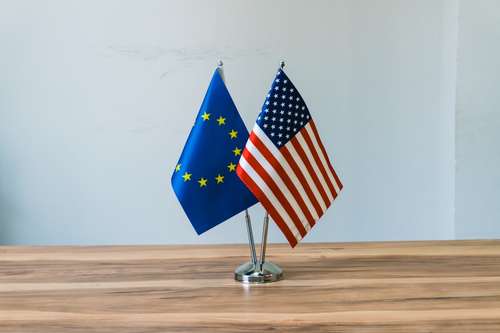
WASHINGTON/BRUSSELS — The transatlantic alliance faces its most severe fracture in decades after President Donald Trump announced a sweeping 10% tariff on imports from eight European nations, escalating a diplomatic standoff over his administration’s attempt to acquire Greenland. The tariffs, set to take effect on February 1, 2026, specifically target key allies including Denmark and Germany, sending shockwaves through global markets and prompting the European Union to officially halt all ongoing trade negotiations with the United States.
The Ultimatum: Escalating to 25% by Summer
In a late-night statement posted to Truth Social from his West Palm Beach estate, President Trump declared that the United States would impose a 10% levy on "any and all goods" entering from Denmark, Germany, France, the United Kingdom, the Netherlands, Sweden, Norway, and Finland. The President framed the economic measures as a direct response to what he termed "European obstructionism" regarding U.S. national security interests in the Arctic.
The administration’s ultimatum carries a steep escalation clause: if a deal for the "complete and total purchase" of Greenland is not reached by June 1, the tariffs will more than double to 25%. "We have subsidized their defense for decades," Trump wrote. "Now, they are blocking our ability to secure the Western Hemisphere with the Golden Dome missile defense system. It is time for Denmark to give back."
Diplomatic Fallout: "Not For Sale"
The catalyst for this trade war appears to be a deadlock in secret negotiations that have been ongoing since late 2025. While the White House views Greenland as a critical strategic asset for rare earth minerals and Arctic defense against Russian and Chinese expansion, Copenhagen and Nuuk have remained firm.
Danish Prime Minister Mette Frederiksen expressed "surprise and regret" at the hostile turn, reiterating that Greenland is an autonomous territory and not a commodity to be traded. Greenland’s Prime Minister, Múte B. Egede, issued a sharper rebuke from Nuuk, stating, "We are open to business, but we are not for sale. We do not want to be American; we want to be Greenlandic."
Troop Deployments Spark Tension
Tensions boiled over earlier this week following reports of symbolic troop deployments by EU and NATO allies to Greenland—a move the White House interpreted as a direct challenge to the Monroe Doctrine. The Trump administration has argued that European hesitation leaves the Arctic vulnerable, citing the need to secure the region following the U.S. military's high-stakes operation in Venezuela earlier this month.
Brussels Strikes Back: Trade Talks Suspended
The European Union’s response has been swift and unified. In a joint statement, European Commission President Ursula von der Leyen and European Council President Antonio Costa condemned the tariffs as "economic coercion" and announced the immediate suspension of all trade talks with Washington, including the fragile "Turnberry agreement" reached last July.
"We will not negotiate with a gun to our head," the statement read. France has gone a step further, with officials in Paris floating the immediate activation of the EU's Anti-Coercion Instrument (ACI), a powerful legal mechanism designed to retaliate against economic blackmail. If invoked, this could lead to mirrored counter-tariffs on U.S. exports, targeting politically sensitive sectors like agriculture and bourbon.
Economic Shockwaves: Markets React
The prospect of a full-blown US EU trade war in 2026 has already rattled financial markets. The Euro fell to a seven-week low against the dollar in early trading on Monday, while futures for the German DAX index plunged by 2.4%. Investors fear that a 10% tariff on German autos and Danish pharmaceuticals could shave roughly 0.3% off the Eurozone's GDP if sustained.
"This is no longer just rhetoric," said Holger Schmieding, a chief economist monitoring the crisis. "Business leaders are scrambling to understand if supply chains will be broken by February. The uncertainty alone is toxic for investment."
The Strategic Prize: Why Greenland Matters
Behind the tariffs lies a cold geopolitical calculus. As Arctic ice melts, new shipping lanes and vast deposits of rare earth minerals—vital for everything from fighter jets to smartphones—are becoming accessible. The U.S. is desperate to break China's stranglehold on these supply chains.
For President Trump, securing Greenland is seen as a legacy-defining move, akin to the Louisiana Purchase. However, by weaponizing trade tariffs against his closest NATO allies to achieve it, he risks fracturing the very alliance structure that secures the North Atlantic. With the February 1 deadline looming, the window for diplomacy is closing fast, leaving the transatlantic partnership on the brink of its most dangerous rupture in history.