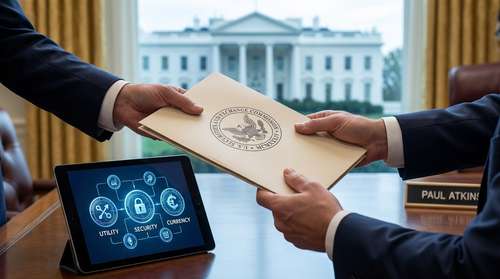
In a watershed moment for the digital asset industry, the U.S. Securities and Exchange Commission (SEC) has officially submitted landmark SEC crypto guidance to the White House, aimed at resolving years of jurisdictional ambiguity. On March 3, 2026, under the leadership of Chair Paul Atkins SEC officials delivered a commission-level interpretive proposal to the Office of Information and Regulatory Affairs (OIRA). This long-awaited framework establishes a formal token taxonomy that promises to categorize digital assets with precision, potentially ending the contentious era of "regulation by enforcement" that has stifled American crypto innovation.
The End of Ambiguity: A Commission-Level Move
The submission marks a decisive shift in U.S. regulatory policy. Unlike previous staff-level bulletins or non-binding speeches, this document represents a formal "Commission Interpretation." This distinction is critical; it carries significantly more legal weight and signals a unified stance from the agency's leadership. By submitting this guidance for interagency review, the SEC is taking a proactive step to define crypto regulatory clarity without waiting for Congress to break its legislative deadlock.
For years, crypto firms have operated in a gray zone, unsure if their tokens would be retroactively classified as unregistered securities. This new guidance aims to provide a "safe harbor" of sorts by clearly delineating the characteristics that separate a security from a commodity or a consumer tool. Industry insiders view this as the most significant regulatory development since the approval of spot Bitcoin ETFs.
Decoding the New Token Taxonomy
At the heart of the proposal is a four-part token taxonomy designed to categorize digital assets based on their economic reality and technical function rather than just their marketing. According to sources familiar with the submission, the framework breaks down digital assets into the following distinct categories:
- Digital Commodities (Network Tokens): Decentralized assets used to pay for network resources (like gas fees) where no central party controls the enterprise. These would likely fall under CFTC jurisdiction.
- Digital Collectibles: NFTs and other unique assets where value is derived from subjective preference or rarity rather than a promise of future profit.
- Digital Tools: Tokens that function as memberships, access keys, or identity certificates, serving a specific utilitarian purpose within an ecosystem.
- Tokenized Securities: Traditional financial instruments (stocks, bonds, real estate) recorded on a blockchain. These digital asset securities remain firmly under SEC supervision.
This granular approach directly addresses the industry's complaint that a "one-size-fits-all" application of the 1946 Howey Test is outdated for modern decentralized technologies. By explicitly carving out categories for commodities and tools, the SEC is effectively narrowing its own jurisdiction to focus strictly on capital-raising activities.
The CLARITY Act 2026 and Legislative Gridlock
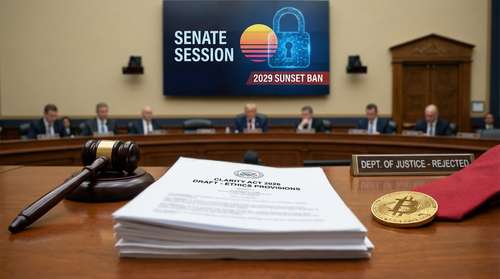
The timing of this submission is no coincidence. It arrives as the bipartisan CLARITY Act 2026 (Digital Asset Market Clarity Act) faces continued delays in the Senate. While the bill passed the House in 2025, it has stalled in the upper chamber due to intense disagreements over stablecoin yield provisions and banking charters.
Regulatory Action vs. Legislative Stalling
With the CLARITY Act 2026 bogged down in committee debates, Chair Atkins appears unwilling to let the industry remain in limbo. This executive action allows the SEC to implement immediate operational standards while lawmakers continue to negotiate. Market analysts suggest that this "dual-track" approach—regulatory guidance moving parallel to legislation—could accelerate the maturation of the U.S. market, regardless of when the bill finally reaches the President's desk.
Impact on US Crypto Regulation News and Markets
The immediate reaction to this US crypto regulation news has been overwhelmingly positive. Institutional investors, who have long cited regulatory uncertainty as their primary barrier to entry, are reportedly preparing to increase their exposure to the asset class. The clear distinction between digital asset securities and non-security tokens allows compliant trading platforms to list assets with confidence, reducing the risk of sudden Wells Notices or lawsuits.
Furthermore, the guidance is expected to harmonize efforts with the Commodity Futures Trading Commission (CFTC). CFTC Chair Michael Selig has simultaneously submitted guidance on prediction markets, signaling a coordinated effort between the two agencies to divide and conquer the digital landscape effectively. This alignment is a stark contrast to the turf wars that characterized previous administrations.
What Happens Next?
The proposal is currently under review by OIRA. Once cleared, it will likely be published for a brief period before becoming effective. While it does not have the permanence of a congressional statute, it provides an immediate and enforceable rulebook for the industry. For the first time in a decade, crypto entrepreneurs in the United States may soon have a clear answer to the question: "Is my token a security?"
As the review process concludes in the coming weeks, all eyes will be on the White House. Approval of this taxonomy would not only cement the U.S. as a global hub for digital innovation but also validate the administration's promise to foster financial technology rather than fight it.