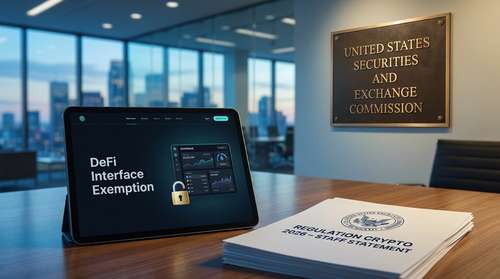
The landscape of United States digital asset oversight is undergoing a tectonic shift. In a major departure from past enforcement-heavy strategies, the Securities and Exchange Commission has unveiled a conditional safe harbor for decentralized finance developers. This landmark move, part of the broader SEC Regulation Crypto 2026 initiative, officially exempts specific crypto user interfaces from traditional securities requirements.
Issued by the SEC's Division of Trading and Markets on April 13, 2026, the staff statement provides a five-year interim relief window for what the agency classifies as "Covered User Interface Providers". For wallet developers, protocol builders, and aggregator front-ends, the guidance offers long-awaited clarity on how to legally operate without triggering the onerous compliance burdens of a national exchange.
The Strategic Pivot Under Paul Atkins' SEC Crypto Leadership
Since taking the helm of the commission, Chairman Paul Atkins has systematically dismantled the agency's previous hostile posture. The Paul Atkins SEC crypto agenda reflects a profound philosophical shift in how the government approaches blockchain technology. Rather than treating every software portal as a financial intermediary, the current administration is drawing a distinct line between passive technological infrastructure and active financial brokering. By shifting from aggressive litigation to proactive accommodation, regulators are acknowledging that applying decades-old rules to autonomous smart contracts stifles innovation.
Breaking Down the DeFi Interface Exemption
The core of this new guidance hinges on the concept of neutrality. Software providers can secure a DeFi interface exemption and avoid strict crypto broker-dealer registration if their platforms act strictly as unbiased communication layers rather than active participants in a trade.
What Qualifies as a Covered Interface?
The SEC defines a "Covered User Interface" broadly, encompassing several tools that facilitate access to blockchain networks. According to the April statement, these include:
- Websites and decentralized application (dApp) browsers.
- Mobile applications designed to interact with smart contracts.
- Browser extensions operating as transaction gateways.
- Software embedded directly into non-custodial wallets.
Guardrails for Self-Custodial Wallet Regulation
To maintain their exempt status over the five-year safe harbor period (valid until April 13, 2031), developers must operate within strict behavioral guardrails. The overarching rule governing self-custodial wallet regulation and front-end portals is that the interface must remain purely non-custodial. The provider cannot hold, route, or exercise control over user funds at any point.
Additionally, platforms must refrain from offering tailored investment recommendations or exercising routing discretion. If a crypto aggregator displays multiple execution options, it must rank those routes using objective, neutral criteria—such as token price or execution speed—rather than subjective claims like "best return". Fee structures must also be transparent and fixed, preventing platforms from earning transaction-based compensation that resembles traditional broker commissions.
How This Shapes Digital Asset Market Structure
This staff guidance effectively splits the decentralized finance sector into two distinct regulatory buckets. The "interface layer" is now shielded by the safe harbor, allowing developers to build sophisticated front-ends without legal paralysis. However, the underlying "protocol layer"—especially platforms that exercise execution discretion or pool user assets in custody—remains outside the scope of this specific relief.
Industry analysts view this as a pragmatic compromise that heavily influences modern digital asset market structure. It keeps American developers competitive in the global market by opening a viable path to ship consumer-facing software, while the agency continues its broader rule-making via its dedicated Crypto Task Force.
Congress and the CLARITY Act Updates
The SEC's administrative actions are not happening in a vacuum. The release of this guidance is tightly coordinated with ongoing legislative efforts on Capitol Hill. Regulators are implementing temporary safe harbors precisely because comprehensive laws take time to draft and pass.
Recent CLARITY Act updates reveal that the Senate Banking Committee is targeting a critical late-April markup for the historic crypto market structure bill. Following an April 16 roundtable in Washington, regulators publicly signaled their alignment with lawmakers. The push for legislation recently gained massive momentum when Treasury Secretary Scott Bessent published an op-ed urging the Senate to pass the bill before the midterm election cycle freezes the legislative calendar.
The SEC and CFTC have already formalized a jurisdiction-sharing agreement through a joint initiative called "Project Crypto," ensuring both agencies are operationally ready to implement the CLARITY Act the moment it receives a presidential signature. If passed, the legislation will permanently solidify the five-category asset framework—sorting tokens into digital commodities, digital collectibles, digital tools, payment stablecoins, and digital securities.
Until that statutory framework is etched into law, the SEC's five-year regulatory window provides much-needed breathing space. Decentralized interface developers can deploy their products with a newfound degree of confidence. By operating as transparent, neutral facilitators, they avoid the crosshairs of traditional securities enforcement while helping to modernize the global financial ecosystem.