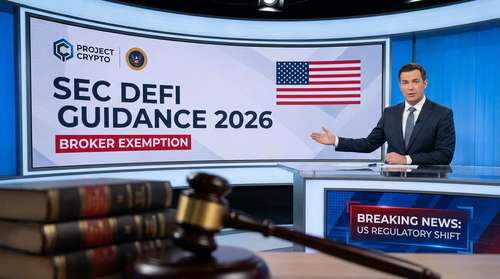
The decentralized finance sector has secured a monumental victory following the release of the SEC DeFi guidance 2026. Reversing years of adversarial enforcement strategies, the U.S. Securities and Exchange Commission formally issued a staff statement on April 13, granting a conditional safe harbor to developers and operators of non-custodial crypto interfaces. This policy maneuver allows eligible decentralized exchange (DEX) front-ends and wallet applications to operate freely without triggering burdensome broker-dealer registration requirements.
The landmark exemption represents the cornerstone of an aggressive campaign to overhaul digital asset oversight. Since taking the helm, Paul Atkins, SEC chairman, has actively dismantled the agency's prior era of regulation by enforcement. His approach acknowledges a fundamental technological reality: passive software tools that merely allow users to interact with blockchain protocols should not be treated as traditional financial intermediaries.
Understanding the 'Covered User Interface' Distinction
At the center of this profound US crypto regulatory shift is a newly minted regulatory classification known as the 'Covered User Interface Provider'. According to the Division of Trading and Markets, this category encompasses websites, mobile applications, and browser extensions that assist investors in preparing transactions using self-custodial wallets. Rather than holding customer assets or actively routing orders to specific liquidity pools, these platforms act solely as technical conduits.
Under the historical interpretation of the Securities Exchange Act of 1934, simply displaying a swap button alongside digital asset price feeds often placed developers in the crosshairs of federal regulators. The agency previously argued these actions constituted soliciting and effecting securities transactions. The updated DeFi user interface regulation changes the paradigm, explicitly acknowledging that providing a graphical interface for self-directed blockchain commands does not automatically transform software developers into registered securities brokers.
The Five-Year Safe Harbor Provision
The agency structured this crypto broker registration exemption as an interim staff position valid for exactly five years, set to sunset on April 13, 2031. This ticking clock serves a dual purpose. It provides the digital asset sector with immediate breathing room to innovate and launch products natively in the United States while giving lawmakers ample time to codify formal, permanent rules.
Four Pillars of the Crypto Broker Registration Exemption
While the relief is extensive, the SEC made it clear that the safe harbor is highly conditional. Developers looking to benefit from the exemption must operate their software within strict, non-discretionary boundaries. If an interface crosses the line into active intermediation, the broker-dealer mandate immediately snaps back into effect.
To qualify, platform operators must strictly adhere to several core operational constraints:
- No Custody or Control: Users must retain absolute control of their private keys and assets at all times. The interface provider cannot touch, hold, or directly route user funds.
- Total Neutrality: The platform cannot push tailored recommendations or solicit specific trades. If sorting mechanisms are used for trade routing, they must rely entirely on objective metrics like execution speed or gas prices.
- Fixed Compensation: Fee structures are tightly regulated. Providers must charge a flat, transparent percentage or fixed fee and are prohibited from accepting payment for order flow from external third parties.
- Complete Transparency: Operators must prominently disclose their lack of SEC registration, detail their conflict-of-interest policies, and provide educational materials showing users how to customize transaction slippage and network settings.
Project Crypto SEC: Moving Capital Markets On-Chain
This week's DeFi guidance is not an isolated policy document. It serves as the opening salvo for Project Crypto SEC, an ambitious, commission-wide initiative spearheaded by Chairman Atkins to modernize federal securities laws. The project's stated goal is to stop American capital markets from stagnating while technological innovation flourishes overseas.
By officially decoupling passive software tools from traditional intermediary regulations, the agency is laying the groundwork for a future where stocks, bonds, and partnership interests can be seamlessly tokenized and traded on automated market makers. Project Crypto recognizes that decentralized networks function efficiently without forced intermediation, drastically reducing friction and settlement risks.
Bridging the Gap to the CLARITY Act Crypto Legislation
While industry advocates like the DeFi Education Fund and Consensys have celebrated the staff statement as a fatal blow to centralized gatekeepers, regulatory experts recognize it remains a temporary fix. The five-year window explicitly places the ball in Congress's court to deliver a statutory solution.
Capitol Hill is currently advancing the CLARITY Act crypto legislation alongside other comprehensive market structure bills, such as the GENIUS Act, aimed at permanently dividing jurisdiction between the SEC and the Commodity Futures Trading Commission (CFTC). Lawmakers are working to replace disjointed state licensing rules with a unified federal framework that accommodates both digital commodities and securities.
In the interim, Atkins and CFTC Chairman Michael Selig have aggressively aligned their respective agencies. The joint coordination under Project Crypto recently produced a 68-page interpretive release clarifying the application of federal laws to digital assets, ultimately stripping away the uncertainty that previously plagued network validators and token issuers. Until formal congressional legislation lands on the President's desk, the SEC's latest tactical shift provides the strongest signal yet that the United States is finally ready to foster, rather than fight, the decentralized financial web.