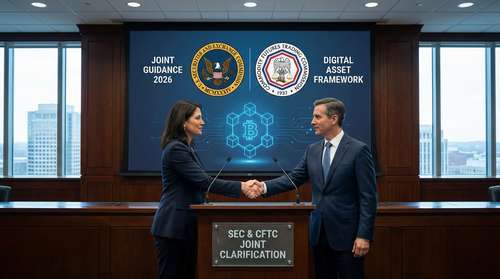
In a watershed moment for SEC crypto regulation 2026, the U.S. Securities and Exchange Commission (SEC) and the Commodity Futures Trading Commission (CFTC) have officially released a landmark joint interpretation. Announced on March 17, 2026, this monumental guidance provides long-awaited US crypto law clarity, fundamentally reshaping how federal laws apply to digital assets. For years, industry leaders, developers, and institutional investors have demanded a clear answer to a fundamental question: are cryptocurrencies securities? With this latest policy announcement, regulators have finally drawn a definitive line in the sand, confirming that most crypto assets are not themselves securities.
The Dawn of Unprecedented US Crypto Law Clarity
Following a historic Memorandum of Understanding (MOU) signed earlier in the month to reduce jurisdictional overlap, SEC Chairman Paul S. Atkins and CFTC Chairman Michael S. Selig presented a unified front designed to end more than a decade of regulatory uncertainty. According to Chairman Atkins, this cooperative approach serves as an essential bridge for entrepreneurs while Congress continues to advance comprehensive, bipartisan market structure legislation.
The SEC joint interpretation crypto document deliberately shifts away from the enforcement-heavy approach characteristic of previous administrations. Instead, the agencies recognize a critical legal nuance: even if a token was initially sold to fundraise as part of an investment contract, that specific contract can eventually conclude. A non-security crypto asset can transition in and out of securities law jurisdiction depending on how it is marketed and offered, but the underlying digital asset itself is not inherently a security. This distinction represents a crucial breakthrough for Bitcoin regulatory news and the broader decentralized ecosystem.
Establishing a Unified CFTC Digital Asset Taxonomy
A central pillar of the new regulatory framework is the formal establishment of a coherent CFTC digital asset taxonomy. By standardizing definitions across federal agencies, the SEC and CFTC aim to reduce the operational friction that has historically plagued American builders. The official digital asset classification framework breaks tokens down into five specific categories:
- Digital Commodities: Assets primarily functioning as decentralized mediums of exchange or stores of value, which fall squarely under CFTC oversight and derivatives enforcement.
- Digital Collectibles: Unique cryptographic assets, such as non-fungible tokens (NFTs), used for provable ownership of digital art, media, or real-world assets.
- Digital Tools: Utility tokens that grant users access to specific blockchain-based software, governance protocols, or decentralized applications without promising financial returns.
- Stablecoins: Digital currencies pegged to fiat currencies like the U.S. dollar, intended to provide price stability for everyday transactions and decentralized finance (DeFi) trading pairs.
- Digital Securities: Tokens that represent traditional investment contracts, equity, or debt, remaining strictly under SEC purview and requiring traditional corporate disclosures.
Are Cryptocurrencies Securities? The Answer is Finally Clear
The most celebrated aspect of this SEC crypto regulation 2026 update is the explicit confirmation regarding the fundamental nature of digital tokens. By formally clarifying whether are cryptocurrencies securities, the SEC has removed a massive cloud of doubt hovering over the U.S. financial market. CFTC Chairman Selig emphasized that for far too long, American innovators have awaited this exact type of structured guidance, noting that the harmonized regulations will allow the industry to truly flourish domestically with clear rules of the road.
Beyond basic token definitions, the joint interpretation specifically clarifies the application of federal securities laws to common industry practices that have long operated in a legal gray area. Activities such as protocol staking, decentralized mining, token airdrops, and the wrapping of non-security crypto assets have now received structured legal boundaries. For example, the guidance outlines how participating in network security through protocol staking does not automatically trigger an investment contract designation for a non-security asset. This level of granular US crypto law clarity ensures that software developers can build decentralized networks without the constant fear of accidental non-compliance.
What Proper Digital Asset Classification Means Moving Forward
The immediate macroeconomic impact of this joint guidance is a dramatically stabilized operating environment for U.S.-based cryptocurrency exchanges, software developers, and traditional financial institutions looking to enter Web3. Proper digital asset classification enables firms to appropriately register, report, and offer innovative financial products without facing redundant or contradictory mandates from different federal watchdogs. For instance, a dual-registered trading venue can now confidently list a digital commodity alongside a digital security by following the newly established boundary lines and reporting requirements.
Furthermore, this proactive stance on SEC crypto regulation 2026 is widely expected to accelerate legislative momentum on Capitol Hill. With key regulatory agencies collaborating effectively, lawmakers now possess a solid, unified foundational framework to construct permanent, codified statutes. As the global financial sector digests this wave of positive Bitcoin regulatory news, the consensus among market participants is highly optimistic. The United States has officially shifted its policy trajectory, positioning the nation to become a secure, transparent, and innovative global hub for the future of digital finance.