
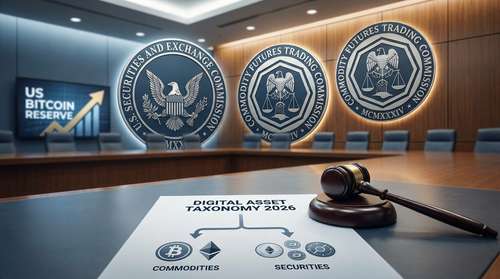
The landscape of American finance experienced a fundamental shift this week. On March 17, 2026, regulators released a highly anticipated 68-page joint interpretation that finally establishes concrete rules for the digital asset space. This landmark SEC crypto regulation 2026 playbook, orchestrated alongside the Commodity Futures Trading Commission, introduces a definitive SEC CFTC token taxonomy. By officially classifying major assets and clarifying the boundaries of federal oversight, the agencies have delivered the crypto market regulatory clarity that Wall Street has demanded for over a decade. Simultaneously, this framework removes the final legislative roadblocks for the expanding US Strategic Bitcoin Reserve, signaling a new era of government-backed digital asset accumulation.
Decoding the Five-Part Token Taxonomy
For years, the industry operated under fragmented, enforcement-first policies that stifled domestic innovation. The new interpretation replaces that uncertainty with a pragmatic five-category classification system: digital commodities, digital collectibles, digital tools, stablecoins, and digital securities. This structural overhaul is the centerpiece of the administration’s ongoing initiative to cement the United States as the undisputed capital of the global digital economy.
The core of the guidance focuses heavily on resolving the persistent debate over digital commodities vs securities. Regulators reaffirmed that the Supreme Court's Howey test remains the governing standard, but they provided a modernized lens for its application. According to the release, assets that derive their value from programmatic functioning and market supply dynamics—rather than the managerial efforts of a central issuer—are firmly outside the scope of traditional securities laws.
While commodities capture the spotlight, the taxonomy also carves out essential protections for digital collectibles and digital tools. Collectibles tied to specific artwork, alongside utility tools consumed in exchange for software services, are officially recognized as non-securities. This critical nuance prevents federal overreach into the burgeoning Web3 creator economy, allowing software developers to build decentralized applications without navigating the costly registration processes designed for corporate equities.
Ethereum Commodity Status Officially Confirmed
Perhaps the most market-moving revelation within the 68-page document is the explicit naming of specific assets. The agencies highlighted Bitcoin, Solana, Cardano, XRP, and Ether as prime examples of digital commodities. The long-awaited Ethereum commodity status affirmation completely neutralizes lingering fears of retroactive enforcement against Ethereum infrastructure providers and network validators.
Furthermore, the document provides pragmatic guidelines on protocol-level mining, staking, and airdrops. Routine blockchain participation is now shielded from being automatically classified as an unregistered securities offering, provided the activities do not guarantee or strictly determine reward amounts through custodial arrangements. This distinction is vital for decentralized finance protocols seeking to operate compliantly within U.S. borders.
Supercharging the US Strategic Bitcoin Reserve
This newly minted legal foundation extends far beyond retail trading and corporate compliance. It directly empowers "Project Crypto," a sweeping interagency harmonization initiative spearheaded by SEC Chairman Paul Atkins and CFTC Chairman Michael Selig. Their immediate mandate is to seamlessly integrate the US Strategic Bitcoin Reserve into the broader American financial system without disrupting traditional markets.
Established via Executive Order in March 2025, the national stockpile has rapidly transitioned from a political talking point to a formidable federal operation. As of late February 2026, the federal government stands as the largest known state holder of Bitcoin, controlling an estimated 328,372 BTC largely derived from law enforcement forfeitures. Speaking at the World Economic Forum, Treasury Secretary Scott Bessent recently confirmed that the administration has permanently halted the auction of seized tokens, redirecting all recovered assets into the sovereign reserve.
With the legal status of digital commodities now cemented, lawmakers are aggressively advancing the 2026 Bitcoin Act. The bicameral legislation seeks to execute a budget-neutral Bitcoin Purchase Program, utilizing Federal Reserve remittances to acquire 200,000 BTC annually. The ultimate goal is to reach a staggering 1 million BTC milestone over the next five years. The joint taxonomy provides the precise jurisdictional alignment necessary for the Treasury to custody and manage these assets without facing internal regulatory friction. States are already following suit, with Texas, New Hampshire, and Arizona passing parallel legislation to build state-level digital asset reserves.
Catalyzing Institutional Crypto Adoption
The ripple effects of this interpretation are already accelerating institutional crypto adoption across Wall Street. Compliance departments at major financial institutions are actively reclassifying their portfolios and updating preclearance policies based on the new guidelines.
Crucially, the guidance outlines exactly how a crypto asset can be sold under an investment contract initially, yet later trade independently of that contract on secondary markets. This solves the infamous token metamorphosis problem, providing a clear off-ramp for legitimate projects transitioning into fully decentralized, functional networks. Asset managers now have a Commission-level roadmap detailing exactly when a non-security asset separates from an investment contract.
You can expect a surge of new product designs tailored to digital commodities, as firms no longer have to fear arbitrary enforcement actions. Coupled with the 2025 GENIUS Act, which clarified the issuance of payment stablecoins for banks and nonbanks, the traditional finance sector finally possesses the comprehensive toolkit required to deploy capital at scale. By clearly defining the boundaries of digital assets and aligning federal agencies behind a unified, pro-innovation vision, the U.S. has laid the definitive groundwork for sustained market leadership.