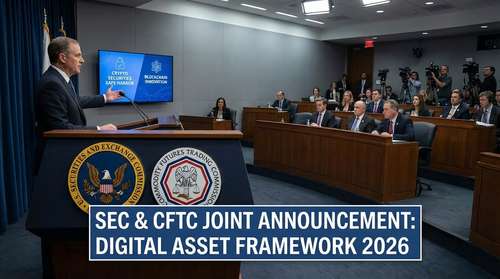
After more than a decade of jurisdictional ambiguity, the United States has officially drawn a clear line in the sand for the digital economy. On March 17, 2026, regulators released the landmark SEC crypto framework 2026, a comprehensive joint interpretation by the Securities and Exchange Commission (SEC) and the Commodity Futures Trading Commission (CFTC). By providing a formal crypto securities definition and outlining clear exemptions for startups, this regulatory overhaul marks a profound shift away from the enforcement-heavy tactics of the past decade.
Establishing Digital Asset Regulatory Clarity
Announced at the DC Blockchain Summit, the new 68-page interpretive release fundamentally categorizes the crypto ecosystem into five distinct buckets: digital commodities, digital collectibles, digital tools, stablecoins, and digital securities. For developers and investors alike, this digital asset regulatory clarity resolves the industry's longest-standing grievance: how the 1946 Howey Test applies to modern decentralized networks.
Most notably, the agencies explicitly named 16 prominent cryptocurrencies—including Bitcoin, Ether, Solana, and XRP—as digital commodities rather than securities. Furthermore, the SEC officially clarified that common decentralized activities such as protocol mining, staking, wrapping, and certain airdrops do not inherently constitute investment contracts.
The Five-Pillar Token Taxonomy
The framework establishes that standard federal securities laws strictly apply only to "digital securities"—essentially traditional securities represented on a blockchain. Digital commodities, conversely, derive their value from the programmatic operation of a system and supply-and-demand dynamics, rather than the managerial efforts of a centralized team. Assets like NFTs and meme coins generally fall under "digital collectibles" or "digital tools," freeing them from heavy SEC jurisdiction.
James Moloney, director of the SEC's Division of Corporation Finance, described this update as "the last chapter in the tale of Howey". The agencies clearly demarcated stablecoins—which are now primarily governed by the GENIUS Act passed in 2025—from speculative commodities and tokenized traditional equities. For hybrid tokens that incorporate explicit profit-sharing mechanisms, however, the SEC retains strict regulatory oversight.
SEC Chair Paul Atkins Proposes Startup Safe Harbors
Alongside the joint interpretation, SEC Chair Paul Atkins outlined a proposed rulemaking structure dubbed "Regulation Crypto Assets". During his address, Atkins emphasized that it was "past time for us to stop diagnosing the problem and start delivering the solution".
To nurture domestic innovation, Atkins introduced a three-pronged "safe harbor" concept for software developers. The proposed "startup exemption" gives early-stage projects a four-year runway to raise up to $5 million using principles-based disclosures rather than full securities registration. For more developed entities, a "fundraising exemption" would permit raises of up to $75 million over a 12-month period.
Crucially, an "investment contract safe harbor" addresses when a token naturally transitions away from being a security. A non-security crypto asset ceases to be subject to an investment contract when the issuer has permanently ceased all essential managerial efforts, either by successfully fulfilling its promises or failing to do so.
Paving the Way for CLARITY Act Crypto Regulation
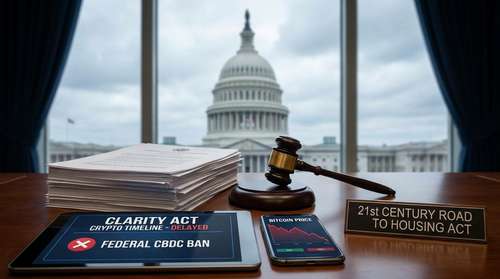
While the joint SEC-CFTC interpretation offers immediate practical guidance, agency leaders recognize that lasting market structure requires a statutory foundation. The newly announced exemptions are specifically designed to act as a regulatory bridge to the impending CLARITY Act crypto regulation.
Officially known as the Digital Asset Market Clarity Act, this legislation passed the House of Representatives in July 2025 and is currently undergoing markup in the Senate Banking Committee as of early 2026. If enacted, the CLARITY Act will codify the SEC and CFTC's jurisdictional division into federal law, while harmonizing rules for decentralized finance (DeFi) developers and secondary market trading. The recent signing of a Memorandum of Understanding (MOU) between the two agencies demonstrates a unified front to end historic turf wars and execute this legislative mandate.
Fueling Blockchain Tech Investment and Institutional Crypto Adoption
The immediate consequence of these distinct regulatory lines is a projected tidal wave of capital entering the sector. A recent EY-Parthenon survey revealed that 66% of institutional investors cited an "uncertain regulatory environment" as their primary barrier to entry. With the removal of arbitrary enforcement threats, institutional crypto adoption is positioned to accelerate rapidly in 2026.
By defining exactly when and how an investment contract terminates, venture capital firms and traditional banks can confidently forecast their compliance costs. This newfound legal predictability is expected to trigger a massive surge in blockchain tech investment, potentially repatriating developer talent that had previously fled to offshore jurisdictions. As the industry finally shifts from legal defense to unhindered technological development, the United States has positioned itself to once again lead the global digital finance frontier.