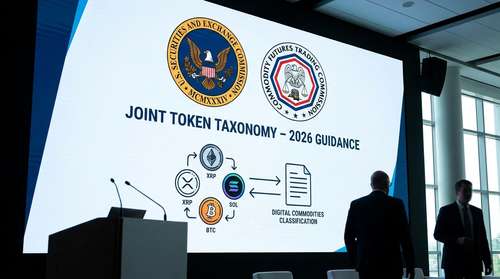
In a definitive move on April 20, 2026, the Securities and Exchange Commission formally reaffirmed its commitment to the landmark SEC CFTC joint crypto guidance, cementing a framework that permanently alters the trajectory of financial markets. After years of regulatory ambiguity and boardroom anxiety, institutional capital finally has the clarity it has been waiting for. The comprehensive 68-page interpretive release, initially unveiled in March and fully implemented this week, officially establishes a structured crypto token taxonomy 2026. By explicitly classifying Bitcoin, Ethereum, Solana, and 13 other major network tokens as digital commodities, regulators have effectively ended the controversial era of regulation by enforcement in the United States.
The Dawn of a New Era: Inside the 2026 Token Taxonomy
Signed by SEC Chairman Paul Atkins and CFTC Chairman Michael Selig, the binding guidance provides a clear delineation of regulatory oversight. It introduces a pragmatic five-category framework designed to replace the decades-old Howey Test as a restrictive, catch-all mechanism. Moving forward, every digital asset is evaluated and placed into one of five distinct buckets: digital commodities, digital collectibles, digital tools, stablecoins, and digital securities.
Only the final category—digital securities—remains under the strict jurisdiction of the SEC. The digital commodities classification shifts the vast majority of market capitalization over to the Commodity Futures Trading Commission (CFTC). Meanwhile, digital collectibles (like NFTs) and digital tools (such as utility credentials) fall largely outside the scope of both securities and commodities laws. Stablecoins are now subject to their own distinct legislative framework under the recently enacted GENIUS Act.
A Clear Exit from the Howey Test
One of the most revolutionary aspects of this US digital asset regulation is the concept of a token's lifecycle. An asset can start as a digital security during its fundraising phase and later graduate to a digital commodity once its underlying network becomes sufficiently decentralized. This answers the industry's most pressing question about how early-stage projects can achieve full compliance without stifling technological innovation.
XRP Solana Commodity Status and the 16 Named Assets
Perhaps the most celebrated revelation in the taxonomy is the explicit naming of 16 tokens as definitive digital commodities. Beyond Bitcoin and Ethereum, the list officially grants XRP Solana commodity status, legally shielding them from future SEC securities claims. The complete roster includes heavyweights like Cardano (ADA), Chainlink (LINK), Avalanche (AVAX), Polkadot (DOT), Hedera (HBAR), Litecoin (LTC), and even internet-culture staples like Dogecoin (DOGE) and Shiba Inu (SHIB).
For tokens like XRP and Solana—which spent years battling existential threats and high-profile SEC enforcement actions—this classification is a monumental victory. The immediate market impact has been profound. Asset managers have already begun flooding the pipeline with S-1 filings for diversified crypto commodity baskets and staking-enabled Exchange Traded Funds (ETFs). Because these assets are no longer classified as securities, compliance departments at major financial institutions are actively removing restrictions on retail trading and institutional custody.
SEC Crypto Enforcement Update: Safe Harbors and Exemptions
Following the foundational release, an April SEC crypto enforcement update has provided even further relief to the decentralized finance (DeFi) sector. On April 13, the SEC's Division of Trading and Markets issued an exemption path allowing user-facing software interfaces that facilitate self-custodial trading to operate without broker-dealer registration, provided they remain neutral.
Furthermore, the joint guidance explicitly confirms that essential network activities—specifically protocol mining, staking, and airdrops—do not intrinsically involve securities transactions. Investors earning yield from staking Solana or Ethereum are essentially providing a service to the network rather than participating in an investment contract reliant on the managerial efforts of a centralized entity. This interpretation safeguards liquid staking providers and decentralized protocols from aggressive and unpredictable enforcement actions.
An Unprecedented Crypto Regulatory Breakthrough
This crypto regulatory breakthrough marks a philosophical and practical shift in how the US government handles blockchain innovation. For over a decade, developers and entrepreneurs operated under the looming threat of sudden subpoenas, forcing much of the industry's talent and capital offshore. Now, market participants possess a clear, 68-page rulebook that defines the economic reality of tokenized assets rather than punishing them for their underlying technology.
The implications for traditional finance are equally staggering. With the compliance barriers permanently removed, traditional brokerages are swiftly integrating the 16 named commodities into their retail offerings. Furthermore, the SEC's April 20 directive on tokenization clarifies that while traditional financial instruments—like tokenized stocks, real estate, and corporate bonds—will rightfully remain subject to stringent federal securities regulations, the broader decentralized economy has finally been liberated to scale without friction.
As the industry digests the latest April reaffirmations and updated broker exemptions, one thing is abundantly clear. The United States has successfully transitioned from being the harshest jurisdictional critic of blockchain technology to a global leader boasting the world's most sophisticated and legally durable digital asset framework. For builders and investors alike, the rules of engagement are finally written in stone.