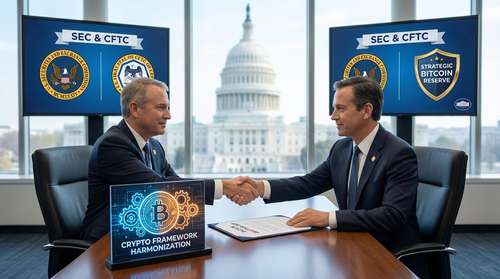
In a watershed moment for the digital asset industry, the U.S. Securities and Exchange Commission (SEC) and the Commodity Futures Trading Commission (CFTC) have announced a landmark initiative to synchronize SEC CFTC crypto harmonization efforts. This pivot, spearheaded by SEC Chair Paul Atkins and CFTC Chair Michael Selig, marks a decisive end to the era of fragmented oversight. The agencies are set to convene a rescheduled joint public event on January 29, 2026, at CFTC headquarters to unveil a unified blueprint aimed at fulfilling the administration's promise to establish the United States as the 'global crypto capital.'
A New Era of Federal Cooperation
For years, market participants have navigated a labyrinth of conflicting guidance, often described by industry leaders as 'regulation by enforcement.' The upcoming joint session, titled "Harmonization: U.S. Financial Leadership in the Crypto Era," represents the first formal step toward dismantling these legacy jurisdictional silos. Chair Atkins explicitly framed the initiative as a corrective measure, stating that the new framework would ensure innovation takes root "on American soil, under American law."
The collaboration comes at a critical juncture. With the Senate Agriculture Committee rescheduling its markup of the Digital Commodity Intermediaries Act due to severe winter weather, the executive branch is moving swiftly to fill the void. This administrative alignment suggests that regardless of legislative timelines, the agencies are prepared to use their existing authority to create a cohesive US digital asset regulation 2026 framework that provides clarity on custody, trading venues, and the treatment of stablecoins.
Strategic Bitcoin Reserve and Treasury Policy
Parallel to the regulatory overhaul, the White House has confirmed a historic shift in Bitcoin treasury policy. Speaking at the World Economic Forum earlier this week, Treasury Secretary Scott Bessent announced that the U.S. government has officially halted the sale of seized digital assets. Instead, these assets will form the bedrock of a new Strategic Bitcoin Reserve, transforming the government's role from a temporary custodian of forfeited funds to a long-term holder.
From Seizure to Stockpile
This policy pivot effectively removes a perpetual supply overhang that has historically dampened market sentiment. Previously, the U.S. Marshals Service would auction seized Bitcoin, often triggering price volatility. Under the new directive, confirmed by recent executive orders, these assets are reclassified as a strategic national stockpile. This move aligns with the administration's broader economic security goals, treating digital scarcity as a component of national financial sovereignty.
Institutional Adoption and Market Response
The regulatory thaw has triggered an immediate response from traditional finance. With the threat of arbitrary enforcement actions receding—evidenced by the SEC's recent dismissal of its lawsuit against Gemini—institutional crypto adoption is accelerating at an unprecedented pace. Major financial institutions are no longer waiting on the sidelines. Filings for new exchange-traded products, including spot ETFs for assets like Solana and XRP, have flooded the regulator's desk in the opening weeks of 2026.
Market analysts predict that this harmonized approach will unlock billions in capital that had been sidelined by regulatory uncertainty. The clarity provided by the impending crypto market structure bill and the agencies' joint framework is expected to allow pension funds and insurance carriers to enter the market with the compliance assurance they require.
The Path Forward: Legislative and Agency Alignment
While the joint SEC-CFTC initiative provides immediate relief, long-term stability relies on legislative action. White House officials have reiterated that a comprehensive market structure bill is a question of "when, not if." The alignment between Paul Atkins SEC chair and his counterparts at the CFTC suggests that the agencies will likely front-run legislation by adopting rules that mirror the proposed congressional standards.
As Washington prepares for the January 29 event, the message to the global market is unambiguous: the United States is open for business. The combination of a coordinated regulatory regime, a federal strategic reserve, and a welcoming environment for institutional capital signals the start of what many are calling the 'Golden Age' of American crypto finance.