
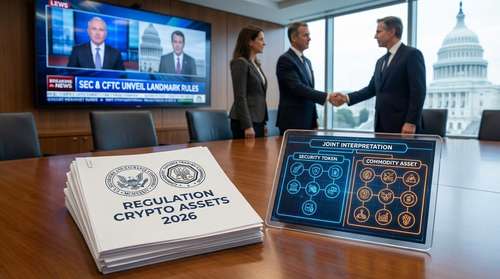
After more than a decade of jurisdictional turf wars and enforcement-driven policies, the United States regulatory landscape for digital assets has finally been radically transformed. On March 17, Securities and Exchange Commission (SEC) Chairman Paul S. Atkins and the Commodity Futures Trading Commission (CFTC) released a landmark joint interpretation that fundamentally alters how the federal government classifies blockchain-based networks. Anchoring this seismic shift is the highly anticipated Regulation Crypto Assets 2026 framework, a comprehensive regulatory overhaul that definitively draws the line between securities and commodities. This coordinated agency action ends years of debilitating uncertainty, offering a clear legal roadmap for both crypto-native builders and traditional institutional banks ready to enter the space.
The End of Enforcement: The SEC CFTC Joint Interpretation
For years, market participants were forced to navigate a punitive gray zone between overlapping federal agencies. The newly published 68-page joint interpretive release replaces that ambiguity with a definitive digital asset taxonomy. By clearly defining jurisdictional boundaries, the government has established actionable guidelines that supersede previous enforcement-centric methodologies.
Under this harmonized rulebook, digital assets are explicitly classified into five distinct categories:
- Digital Commodities: Tokens deriving value from the programmatic operation of a decentralized network. The agencies explicitly named 16 assets in this category, including Bitcoin, Ether, Solana, and XRP.
- Digital Collectibles: Non-fungible tokens (NFTs) and distinct digital items.
- Digital Tools: Tokens utilized purely for functional network utility.
- Stablecoins: Fiat-pegged assets governed separately under the recent GENIUS Act.
- Digital Securities: Traditional securities that have been tokenized on a blockchain ledger.
By officially categorizing major network tokens as commodities, regulators have effectively removed the most significant legal roadblock for the blockchain ecosystem. The SEC also clarified that routine network activities—such as protocol mining, consensus staking, and airdrops—do not intrinsically constitute securities transactions. Simultaneously, the CFTC issued targeted no-action relief for self-custodial wallet providers like Phantom, signaling a synchronized approach to protecting critical network infrastructure.
'Regulation Crypto Assets 2026': The Crypto Safe Harbor Proposal
While the joint taxonomy clarifies existing laws, Chairman Atkins also introduced a forward-looking regulatory mechanism specifically designed to protect early-stage blockchain projects. Determining the exact boundary between a crypto security vs commodity previously relied on fractured judicial rulings applying the 1940s-era Howey test. The new crypto safe harbor proposal introduces three distinct pathways that provide builders with a practical off-ramp from strict federal securities registration.
The Startup and Fundraising Exemptions
To foster domestic innovation, the SEC proposed a "Startup Exemption." This grants decentralized projects a four-year, time-limited safe harbor to raise up to $5 million while providing principles-based public disclosures rather than burdensome registration statements. For more robust capital formation, a separate "Fundraising Exemption" permits developers to secure up to $75 million annually, subject to enhanced financial reporting and transparency requirements.
The Investment Contract Safe Harbor
The most critical element of the Regulation Crypto Assets 2026 proposal is the mechanism for tokens to legally shed their security status. If a network achieves sufficient decentralization and the original issuer ceases all promised "essential managerial efforts," the underlying token is no longer treated as an investment contract. This concept finally provides a viable, compliant path for networks to mature from initial investment contracts into fully decentralized digital commodities.
Paving the Way for Institutional Crypto Adoption
The implications of this joint interpretation extend far beyond compliance requirements for decentralized finance developers. This regulatory clarity serves as the exact catalyst required to trigger widespread institutional crypto adoption across Wall Street.
Pension funds, sovereign wealth managers, and major banking institutions have historically remained cautious, deterred by the lingering threat of sudden SEC litigation. With major digital assets officially classified as commodities, traditional financial institutions can now confidently allocate capital, develop institutional-grade custody solutions, and structure complex derivatives without the looming risk of regulatory retaliation. This structural shift brings digital asset market regulation in line with established commodities like oil or agricultural products, paving the way for deeper market liquidity.
The Future of US Crypto Regulation News
While this administrative reset is a monumental victory for the industry, the structural work is not entirely finished. The SEC and CFTC have successfully drafted the operational blueprint, but agency guidance remains theoretically subject to future administrative policy shifts. To permanently future-proof the industry, Congress must codify this digital asset taxonomy into federal law.
Lawmakers are currently advancing the CLARITY Act, a comprehensive market structure bill that mirrors the new agency definitions. Until that legislation reaches the President's desk, the Regulation Crypto Assets 2026 framework serves as the definitive legal standard for the market. For builders, investors, and legal practitioners, the dark era of regulation by enforcement is officially over, replaced by a logical, coordinated approach that positions the United States to reclaim its leadership in global financial technology.