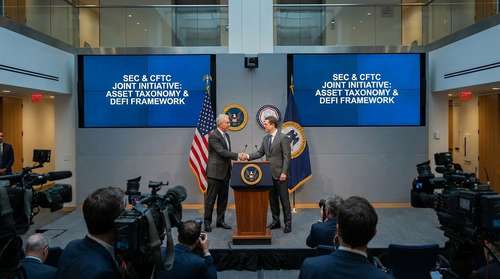
If you have been waiting for regulatory clarity in the web3 space, the landscape of U.S. crypto regulation just experienced a seismic shift. On March 9, 2026, Commodity Futures Trading Commission (CFTC) Chair Michael Selig and Securities and Exchange Commission (SEC) Chair Paul Atkins formally advanced the joint Project Crypto Initiative. This unprecedented regulatory partnership is designed to end years of destructive jurisdictional infighting. By launching a unified framework, the agencies aim to establish a definitive crypto asset taxonomy and roll out long-awaited registration guidelines for non-custodial software developers operating within the decentralized finance (DeFi) and digital wallet sectors.
SEC CFTC Harmonization 2026: Ending the Jurisdictional War
For years, digital asset platforms faced a labyrinth of conflicting federal mandates, often forcing them into duplicative dual-registration scenarios. The Project Crypto Initiative dismantles these hurdles by introducing a cooperative operational model between the two top financial watchdogs.
Through SEC CFTC harmonization 2026, regulators are pivoting from a competitive, enforcement-heavy posture toward a "minimum effective dose of regulation". One of the most promising mechanics of this truce is the exploration of "substituted compliance". Under this arrangement, a firm operating at the intersection of securities and commodities can comply with one agency's framework, and the other regulator will honor it. This eliminates the need for redundant reporting standards, immediately reducing overhead for domestic trading platforms and custodians.
Establishing a National Crypto Asset Taxonomy
A core component of the newly formalized partnership is a joint interpretive framework clarifying which tokens fall under specific jurisdictions. Submitted recently for White House review, this crypto asset taxonomy firmly answers the question of what constitutes an investment contract in the digital age.
Under the Paul Atkins SEC administration, the framework abandons the premise that any token ever sold as a security must perpetually remain one. Instead, the taxonomy categorizes digital assets based on economic reality and function:
- Digital Commodities and Network Tokens: Assets deriving value from a functional, decentralized protocol rather than explicit managerial promises. These are exempt from strict securities laws.
- Digital Collectibles: Items designed purely for collection, such as standard NFTs, provided buyers do not rely on entrepreneurial efforts for a financial return.
- Digital Tools: Tokens offering practical utility, including identity credentials, governance rights, or membership access.
- Tokenized Securities: Digital representations of traditional financial instruments like equities or debt, which remain fully subject to federal securities enforcement.
This functional breakdown finally offers the digital asset market structure the predictable baseline it requires to scale without fear of sudden enforcement actions.
Essential DeFi Developer Guidance and Safe Harbors
Perhaps the most eagerly anticipated element of the Project Crypto Initiative is its approach to on-chain builders. CFTC Chair Selig recently directed staff to begin drafting immediate rulemakings for decentralized finance safe harbors.
For the first time, developers receive clear DeFi developer guidance outlining how to operate without triggering heavy-handed broker-dealer or exchange registration requirements. The new directives establish that writing and publishing non-custodial software—particularly for automated market makers (AMMs), liquidity pools, and digital wallet infrastructure—does not inherently constitute operating an unregistered financial exchange.
By shielding non-custodial wallet providers and protocol creators from arbitrary liability, the U.S. is signaling a massive green light to web3 engineers. The safe harbor rules recognize that open-source code is distinctly different from centralized financial intermediation. Builders creating self-hosted digital wallets will no longer have to worry about being classified as illicit money transmitters simply for giving users direct control over their own private cryptographic keys.
A Modern Digital Asset Market Structure
Beyond developer protections, the joint initiative restructures the broader trading environment. Both agencies have committed to sharing market surveillance capabilities and data, reducing blind spots while streamlining investigations into actual fraud.
The modernization of the digital asset market structure also includes revised collateral eligibility standards and a fresh look at perpetual derivative products. If your firm is looking to offer hybrid products—such as tokenized real-world assets paired with commodities trading—you now have a unified federal response system to consult. Market participants no longer have to guess whether a specific decentralized product violates unwritten agency rules. Institutional capital, which has largely remained on the sidelines due to jurisdictional uncertainty, now has the clear legal foundation required to enter the space aggressively.
The Paul Atkins SEC and Michael Selig CFTC Era
This sweeping policy pivot marks a dramatic departure from the regulatory hostility of the early 2020s. The Paul Atkins SEC strategy centers on capital formation and technological neutrality, sharply contrasting with previous administrations that relied heavily on litigation.
Coupled with Michael Selig's deep expertise in distributed ledger technology at the CFTC, the dual leadership has achieved what Congress has struggled to pass through legislation. The Project Crypto Initiative proves that existing statutory authorities, when applied cooperatively, can foster innovation while protecting investors. By abandoning interagency turf wars in favor of pragmatic, functional rules, the United States is rapidly reclaiming its position as the premier global hub for blockchain development and financial technology.