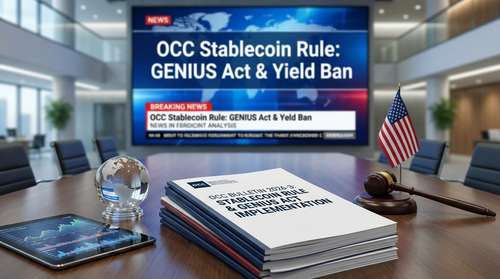
The U.S. Office of the Comptroller of the Currency (OCC) has officially issued a massive 376-page Notice of Proposed Rulemaking (NPRM) to implement the Guiding and Establishing National Innovation for U.S. Stablecoins (GENIUS) Act. Released as OCC Bulletin 2026-3, the proposal outlines a rigorous federal framework for payment stablecoin issuers, introducing a controversial "rebuttable presumption" that effectively bans interest-bearing stablecoin products and establishes a strict $5 million capital floor for new market entrants. This regulatory overhaul marks a pivotal moment in US crypto regulation news, signaling Washington's intent to bring digital assets firmly under the banking umbrella.
The "Rebuttable Presumption": A De Facto Ban on Stablecoin Yields
At the heart of the proposal is a stringent interpretation of the GENIUS Act's prohibition on paying interest to stablecoin holders. While the Act itself bans issuers from directly paying yields, the OCC's new rules go significantly further to prevent evasion. The regulator has introduced a rebuttable presumption that an issuer is violating the law if they—or any affiliate—have an arrangement to facilitate yield payments through third parties.
This provision is designed to close loopholes used by issuers who might partner with exchanges or DeFi protocols to offer rewards. Under the new OCC stablecoin rules 2026, if an issuer has a contract with a third party that subsequently pays yield to token holders, the OCC will presume this is an evasion of the statute. "The OCC understands that issuers could attempt to bypass the ban through arrangements with third parties," the document states, making it clear that regulators will scrutinize any structure that looks like a pass-through interest payment.
For the digital asset market structure, this is a seismic shift. It threatens the business models of numerous fintechs and crypto exchanges that have relied on yield-generation as a primary user acquisition tool. While the presumption can theoretically be rebutted, the burden of proof lies heavily on the issuer to demonstrate that their partnerships do not constitute an evasion of the yield ban.
$5 Million Capital Floor and Bank-Like Standards
Beyond the yield controversy, the rulemaking establishes high barriers to entry for aspiring federal stablecoin issuers. The proposal mandates a minimum capital floor of $5 million for de novo stablecoin issuers, regardless of their size or transaction volume. This requirement mirrors the standards often applied to national trust banks, reinforcing the OCC's view that stablecoin issuers should be regulated with the same rigor as traditional financial institutions.
Comptroller of the Currency Jonathan V. Gould emphasized this safety-first approach in a statement accompanying the release: "The OCC has given thoughtful consideration to a proposed regulatory framework in which the stablecoin industry can flourish in a safe and sound manner." The rules also mandate that issuers maintain liquid reserves backed 1:1 by U.S. dollars or short-term Treasury bills and require redemption at par within two business days.
Critics argue that the $5 million floor could stifle innovation, effectively barring startups from the market and consolidating power among incumbent financial giants and large crypto-natives like Circle or Paxos. However, the OCC maintains that these "capital and operational backstops" are essential to prevent run risks and ensure the stability of the payments system.
GENIUS Act Implementation: What Comes Next?
The release of this rulemaking triggers a 60-day public comment period, during which industry stakeholders, lobbyists, and legal experts will undoubtedly push back against the stricter provisions. The GENIUS Act implementation timeline suggests that final rules could be adopted later in 2026, potentially coming into full effect by early 2027.
Key Provisions at a Glance
- Yield Ban: Strict prohibition on interest payments, extended to third-party arrangements via rebuttable presumption.
- Capital Requirements: A hard floor of $5 million in capital for new entrants.
- Reserve Assets: Mandated 1:1 backing with high-quality liquid assets (HQLA).
- Redemption Rights: Guaranteed redemption at par within two business days.
It is important to note that this rulemaking explicitly bifurcates compliance issues. Anti-money laundering (AML) and Bank Secrecy Act (BSA) compliance will be addressed in a separate, forthcoming rulemaking in coordination with the Treasury Department. This separation allows the OCC to fast-track the prudential standards while the Treasury finalizes the financial crimes framework.
As the digital asset industry digests this 376-page document, the message from Washington is clear: the "Wild West" era of stablecoins is over. Federal charters are coming, but they will come with a price tag and strict limitations that transform stablecoins from high-yield investment vehicles into regulated payment instruments.