
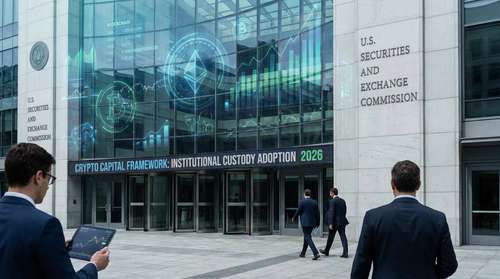
In a watershed moment for the United States financial system, the Securities and Exchange Commission (SEC) has officially dismantled the final regulatory barrier preventing Wall Street from fully embracing digital assets. Late this week, the SEC's Division of Trading and Markets released landmark guidance that allows broker-dealers to classify non-security crypto assets as "financial assets" under Article 8 of the Uniform Commercial Code (UCC). This pivotal move, championed by the Hester Peirce crypto task force, effectively operationalizes the administration's pledge to establish the US crypto capital of the world. As markets responded with a sharp rally over the last 48 hours, institutional heavyweights are already moving to integrate these new institutional crypto custody rules into their core brokerage services.
The 'Financial Asset' Designation: A Legal Game Changer
For years, the ambiguity surrounding the legal status of cryptocurrencies held by regulated intermediaries has chilled institutional adoption. The new SEC digital asset regulation framework changes this dynamic overnight. By permitting broker-dealers to treat assets like Bitcoin and Ethereum as "financial assets" under the UCC, the SEC has provided the legal certainty required for bankruptcy protection. This means that in the event of a brokerage failure, client crypto assets are now distinct from the firm's estate—a protection that was notably absent during the collapse of platforms like FTX.
Legal experts argue this is the "missing link" for traditional finance. "This guidance bridges the gap between 20th-century securities laws and 21st-century technology," notes a senior analyst from a leading D.C. fintech policy firm. The broker-dealer digital asset framework now allows registered firms to hold crypto with the same operational confidence as equities or bonds, effectively greenlighting trillions of dollars in sidelined capital to enter the market.
Solving the Custody Conundrum
The guidance also addresses the thorny issue of "physical possession" and "control." previously, broker-dealers struggled to prove they had exclusive control over digital assets without running afoul of the Customer Protection Rule. The new FAQs and staff statements clarify that maintaining private keys in a manner consistent with industry best practices satisfies these regulatory requirements. This technical nuance is critical: it allows major custodian banks and prime brokers to launch spot crypto trading desks and custody services directly, rather than relying on third-party intermediaries.
Hester Peirce and the 'Project Crypto' Mandate
This regulatory pivot is the direct result of the "Crypto Task Force," led by SEC Commissioner Hester Peirce. Often referred to as "Crypto Mom" for her dissent against previous enforcement-heavy approaches, Peirce has been instrumental in steering the agency toward this pro-innovation stance. Speaking at a joint harmonization event with the CFTC earlier this week, Peirce emphasized that the goal is not just accommodation but leadership. "We are building the runway for the US crypto capital of the world," she stated, signaling that the era of "regulation by enforcement" has officially ended.
The task force's work, dubbed "Project Crypto," is also coordinating closely with the CFTC to harmonize product classifications. This interagency cooperation is unprecedented and aims to eliminate the confusing patchwork of regulations that has historically driven crypto innovation offshore. By aligning the SEC crypto guidance 2026 with CFTC standards, the US is creating a unified, predictable environment for global digital asset firms.
Market Reaction: The Crypto Market Rally 2026
The market's response to the announcement has been immediate and explosive. Triggering a fresh leg of the crypto market rally 2026, Bitcoin and Ethereum both surged to test key resistance levels on Thursday and Friday. Analysts attribute this price action directly to the "institutional green light." Unlike retail-driven rallies of the past, on-chain data from the last two days shows a significant spike in high-value wallet transfers, suggesting that institutional desks are front-running the expected wave of new custody product launches.
Major financial institutions have wasted no time reacting to the news. On Friday morning, leaks from two top-tier investment banks suggested they are fast-tracking plans to offer direct crypto custody to their wealth management clients by Q3 2026. This rapid corporate pivot highlights the pent-up demand for regulated exposure to the asset class.
What This Means for Investors
For the average investor, this framework signifies the maturation of the asset class. The integration of crypto into standard brokerage accounts means that digital assets will soon be visible alongside 401(k)s and stock portfolios, managed with the same user experience and security guarantees. As the SEC digital asset regulation landscape stabilizes, the volatility premium associated with regulatory risk is expected to compress, potentially leading to more stable, long-term growth for major digital assets.
As we move further into 2026, the United States is rapidly reclaiming its position as the epicenter of financial innovation. With the legal rails now firmly in place, the question is no longer if institutions will adopt crypto, but how quickly they can update their infrastructure to meet the new standard.