
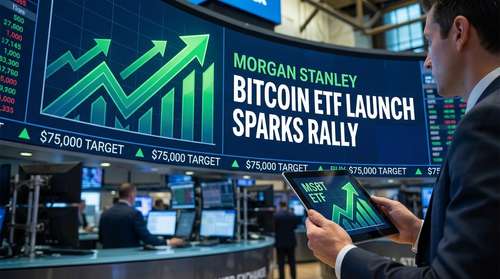
Wall Street just dropped a major anchor into digital assets. On Wednesday, April 8, the highly anticipated Morgan Stanley Bitcoin ETF officially went live on the NYSE Arca under the ticker MSBT. This debut didn't just rattle the fee structures of legacy providers—it coincided with a fierce $595 million market-wide short squeeze. Buoyed by easing geopolitical tensions following a conditional two-week US-Iran ceasefire, Bitcoin surged past $72,700, hitting a three-week high. Now, with a wave of fresh capital entering through legacy banking channels, traders are positioning for a potential test of the critical BTC 75k resistance.
The MSBT ETF Launch: Redefining Crypto Institutional Adoption
Morgan Stanley isn't quietly offering third-party products to its wealthiest clients anymore. The bank is putting its own name directly on the marquee. The MSBT ETF launch marks the first time a top-tier U.S. bank has issued a spot Bitcoin fund. Seeded with approximately $1 million and drawing an impressive $34 million on its opening day, the fund immediately established itself as a heavyweight contender in an increasingly crowded arena.
The real weapon here is pricing power. Morgan Stanley set its spot Bitcoin ETF fees at a razor-thin 0.14%, aggressively undercutting competitors. For comparison, Grayscale's Mini Trust sits at 0.15%, while BlackRock's iShares Bitcoin Trust (IBIT) and Fidelity's Wise Origin fund both charge 0.25%. For institutional allocators managing tens of millions of dollars, an 11-basis-point discount translates to massive annual savings.
But the fee war is only half the story. The firm brings a proprietary distribution channel of roughly 16,000 financial advisors overseeing $9.3 trillion in client assets. Giving these advisors an in-house product to pitch removes the friction previously associated with crypto allocations. As wealth managers begin directing even a fraction of those assets into MSBT, it could quickly rank among the best crypto ETFs 2026, structurally shifting how older, high-net-worth demographics—often referred to as the ultimate gatekeepers of wealth—gain exposure to digital assets.
Geopolitical Relief and the $600 Million Short Squeeze
The timing of the Morgan Stanley Bitcoin ETF debut couldn't have been more explosive for market dynamics. Just hours before the opening bell, former President Donald Trump confirmed a conditional two-week ceasefire with Iran, which was mediated by Pakistan. The diplomatic breakthrough immediately pulled the war premium out of global markets. Oil plunged by more than 10%, settling near $95 a barrel, and capital rotated aggressively back into risk-on assets.
Bitcoin, which had been trading near $65,000 amid escalating Middle Eastern fears, ripped upward in a matter of hours. The speed of the reversal caught heavily leveraged traders completely off guard. Across the crypto market, liquidations approached $600 million within a 12-hour window, with short sellers bearing the absolute brunt of the damage. Nearly $427 million in short positions were forcibly closed—including a massive $11.79 million single liquidation on Binance. This created a cascading buying effect that propelled the spot price to an intraday high of $72,753.
Navigating the Next Move: BTC 75k Resistance
Following the explosive 10% bottom-to-top rally, the technical structure of the market has fundamentally changed. The asset easily sliced through previous supply zones, flipping the critical $69,200 to $70,000 range from resistance back into baseline support.
Looking ahead, any viable Bitcoin price prediction 2026 must factor in both the shifting macroeconomic environment and this newfound institutional access. Momentum indicators remain strong; the Relative Strength Index (RSI) flashed bullish pressure as buyers attempt to consolidate just below the $73,700 supply zone. If the floor holds above $71,000 through the weekend, it indicates the market has transitioned from a short-covering frenzy to genuine spot accumulation.
From there, the path higher faces a major hurdle at the BTC 75k resistance band. Breaking that ceiling would signal a definitive end to the corrective consolidation phase, opening the door for price discovery and a sustained march toward all-time highs.
The Next Phase of Institutional Integration
The traditional finance ecosystem is no longer treating digital assets as a temporary trade. Morgan Stanley's decision to use Coinbase Custody for physical Bitcoin, alongside BNY Mellon for cash administration, proves that Wall Street is building permanent, regulated infrastructure. The bank is already pursuing similar trusts for Ethereum and Solana, alongside plans to roll out direct retail spot trading on E*Trade later this year.
This level of crypto institutional adoption alters the underlying supply and demand mechanics of the market. When financial advisors allocate standard 1% to 4% portfolio weightings to a Morgan Stanley Bitcoin ETF, they are locking away physical supply for years. As the broader market shakes off geopolitical anxiety, the combination of rock-bottom fees, massive wealth advisory networks, and renewed risk appetite sets a uniquely bullish stage for the quarters ahead.