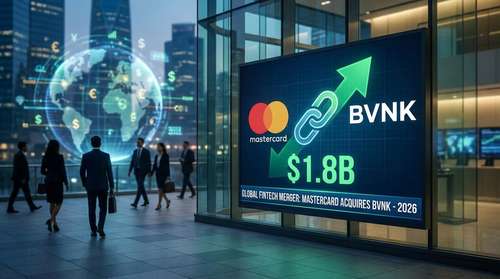
In a decisive step toward the future of global finance, legacy payment networks are accelerating their push into digital assets. Mastercard's BVNK acquisition has officially been finalized in a definitive agreement valued at up to $1.8 billion, marking one of the largest corporate maneuvers in the blockchain sector this year. This landmark fintech merger 2026 underscores a massive shift in institutional strategy, transitioning from traditional fiat systems to comprehensive stablecoin payment infrastructure capable of operating at the speed of the internet.
The deal arrives at a critical juncture for the cryptocurrency industry, aligning with mounting legislative momentum in Washington. As regulatory frameworks like the CLARITY Act 2026 take shape to define the rules of engagement for digital commodities, legacy titans are no longer waiting on the sidelines. By absorbing London-based BVNK, Mastercard is effectively cementing its position at the forefront of the tokenized economy and signaling that blockchain rails are ready for mainstream commercial use.
Inside the $1.8 Billion Fintech Merger
The financial mechanics of the Mastercard BVNK acquisition illustrate the premium traditional finance is now placing on mature blockchain architecture. The $1.8 billion valuation includes an upfront structural buyout alongside $300 million in contingent, milestone-based payments. Founded in 2021, BVNK has rapidly scaled to become a stablecoin-native unicorn, supporting enterprises and payment service providers—including major players like Worldpay and dLocal—across more than 130 countries. The startup effectively processes settlements across all major blockchain networks, providing a robust bridge between local fiat currencies and digital dollars.
Interestingly, this acquisition follows a highly competitive period in the digital asset space. Just months prior, crypto exchange Coinbase was reportedly in talks to acquire BVNK for approximately $2 billion before negotiations stalled in late 2025. Mastercard's successful bid highlights the aggressive nature of Mastercard crypto adoption, proving that traditional payment giants are willing to outmaneuver crypto-native firms to secure foundational on-chain settlement technology. Rather than simply partnering with digital asset providers, legacy institutions are opting to own the underlying infrastructure outright.
Revolutionizing Cross-Border Digital Payments
For decades, legacy correspondent banking networks have struggled with friction, exorbitant costs, and delayed settlement times. The integration of BVNK's stablecoin payment infrastructure allows Mastercard to offer a multi-rail, chain-agnostic ecosystem. This means financial institutions and enterprise merchants will soon be able to route transactions via stablecoins and tokenized deposits just as seamlessly as they currently process traditional credit card payments.
Mastercard's leadership has been vocal about the strategic necessity of this integration. The addition of native on-chain rails to the legacy network will fundamentally support unprecedented speed and programmability for virtually every type of transaction. By combining the global reach of Mastercard's 210-country network with BVNK's borderless, 24/7 architecture, the partnership is poised to dramatically streamline cross-border digital payments. Businesses will be able to handle global remittances, payroll, and complex B2B payouts instantly, entirely bypassing the sluggish pace of traditional wire transfers.
The Interoperability Advantage
Unlike competitors who heavily rely on third-party partnerships for their cryptocurrency integrations, Mastercard is building an uninterrupted pipeline. BVNK Co-Founder and CEO Jesse Hemson-Struthers noted that the combined capabilities of both entities will deliver an unprecedented infrastructure for digital currency-based financial services. This prevents corporate clients from being locked into closed, proprietary ecosystems, allowing for flexible interoperability between various tokenized assets and traditional banking systems.
Navigating the CLARITY Act 2026
The timing of this monumental acquisition is not coincidental. It unfolds against the backdrop of the CLARITY Act 2026 (Digital Asset Market Clarity Act), a comprehensive federal bill currently making its way through the U.S. Congress. The proposed legislation aims to resolve a decade-long jurisdictional turf war between the SEC and the CFTC. By introducing a clear definition for "digital commodities" and establishing federal guardrails for stablecoin issuers, the bill seeks to provide the regulatory certainty the market has long craved.
While the legislation faces a tight window—industry analysts warn that if it does not pass committee by late April, the odds of enactment this year become extremely low—the underlying institutional trend is undeniable. Wall Street and traditional financial conglomerates require regulatory clarity to deploy capital at scale. By acquiring BVNK now, Mastercard is proactively building the compliant on-chain settlement technology necessary to thrive in an incoming regulated digital asset environment, positioning itself ahead of banks that are still waiting for legislative permission.
The Future of Mastercard Crypto Adoption
Mastercard's bold $1.8 billion move sets a powerful precedent for the broader financial sector. Following Stripe's $1.1 billion acquisition of Bridge Network last year, the BVNK deal solidifies the narrative that stablecoins are not merely a volatile crypto trend, but the foundational plumbing for the next generation of global commerce. With the stablecoin market capitalization recently surging past $316 billion, consumer and institutional demand has never been higher.
As this pivotal fintech merger 2026 officially closes, the historical distinction between traditional finance and decentralized technology continues to blur. Mastercard is no longer just a credit card company; it is actively transforming into a universal, multi-asset value-exchange network. For merchants, commercial banks, and everyday consumers, the promise of instant, borderless, and highly programmable money is finally transitioning from a futuristic whiteboard concept to a daily commercial reality.