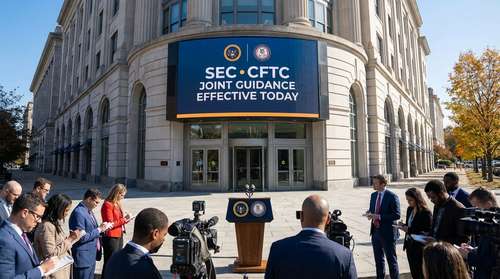
March 23, 2026, marks a defining milestone for the digital asset industry as the landmark SEC CFTC crypto framework officially takes effect today. After a decade of regulatory ambiguity and enforcement-driven oversight, federal regulators have implemented a unified rulebook for the market. Released jointly by the Securities and Exchange Commission and the Commodity Futures Trading Commission, this interpretive guidance fundamentally alters the compliance landscape for developers, exchanges, and institutional investors operating in the United States.
A New Era Under Paul Atkins' Leadership
The swift implementation of this guidance is the crowning achievement of "Project Crypto," an initiative spearheaded by Paul Atkins SEC chair. Working closely with CFTC Chairman Michael S. Selig, the two agencies signed a historic Memorandum of Understanding (MOU) earlier this month to eliminate duplicative oversight and conflicting enforcement actions.
With today serving as the official crypto regulation effective date, market participants finally have actionable legal parameters. The era of overlapping jurisdictions—where a single asset might face conflicting classifications from different federal bodies—is definitively over. Regulators have stated that this is a shift toward principles-based oversight designed to foster domestic innovation while maintaining robust investor protections.
The Definitive Digital Asset Taxonomy
At the core of the newly enforceable guidelines is a comprehensive digital asset taxonomy. The agencies have divided digital assets into five distinct categories based on their underlying utility and economic realities:
- Digital Commodities: Decentralized network tokens not reliant on a central issuer.
- Digital Collectibles: Artwork, in-game items, and unique non-fungible tokens.
- Digital Tools: Functional tokens like identity badges or title instruments.
- Stablecoins: Fiat-pegged assets governed by the GENIUS Act of 2025, which excludes payment stablecoins from securities definitions provided issuers do not offer yield strictly for holding the asset.
- Digital Securities: Tokenized traditional assets or tokens sold subject to an active investment contract.
The most immediate market catalyst is the formal crypto commodity classification. The framework expressly identifies major network tokens—including Bitcoin, Ether, Solana, Cardano, and XRP—as digital commodities rather than securities. For exchanges, this means these assets can be listed and traded without fear of sudden SEC enforcement actions, provided they do not cross into investment contract territory through specific promotional promises.
Refining the Howey Test
To address lingering confusion, the SEC has refined its application of the decades-old Howey test. Under the new framework, a non-security crypto asset only becomes part of an investment contract if the issuer makes affirmative representations or promises regarding "essential managerial efforts". Furthermore, the guidance provides a clear roadmap for assets to transition out of securities status once network decentralization or development goals are met.
Clarity on Staking and Airdrop Laws
For decentralized finance (DeFi) developers and protocol participants, the framework resolves several existential legal questions. Navigating staking and airdrop laws has historically been a legal minefield, but the joint guidance provides bright-line rules for network participation.
Activities fundamental to blockchain operation—including protocol mining, token wrapping, and protocol staking—are not classified as securities transactions. In previous years, major domestic exchanges faced multi-million dollar settlements over their staking-as-a-service programs. The new guidelines establish that providing ancillary services—such as slashing coverage or early unbonding—does not constitute the essential managerial efforts that would trigger an investment contract classification.
Additionally, the distribution of tokens via airdrops does not trigger securities laws as long as the distribution occurs without the requirement of consideration or financial investment from the recipient. This safe harbor allows developers to bootstrap network liquidity and decentralize governance without unintentionally executing an unregistered securities offering.
The Future of US Crypto Regulation 2026
The operational reality of US crypto regulation 2026 looks vastly different than it did just a few months ago. Alongside the taxonomy, the SEC has outlined an upcoming "startup exemption" that will allow emerging projects to raise up to $5 million while adhering to principles-based disclosures rather than full-scale registration.
Industry leaders are already reacting to the shift. Speaking ahead of the DC Blockchain Summit, former Binance CEO Changpeng Zhao called the aligned oversight a "huge step" for the sector, signaling a potential wave of capital returning to American markets. With compliance pathways now clearly drawn, financial institutions have the legal certainty required to fully integrate digital assets into their portfolios.
Market participants must now review their asset listings and communication strategies to ensure compliance with the five-category framework. While the SEC provides oversight on digital securities, the CFTC will concurrently administer the Commodity Exchange Act to police fraud and manipulation across digital commodity spot markets. For an industry that has long pleaded for clear rules, the regulatory environment has finally shifted from punitive enforcement to structured, lawful innovation.