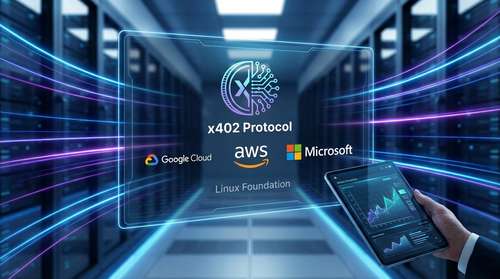
In a watershed moment for digital finance, the newly launched x402 Foundation has officially secured the backing of the world's largest technology and payment companies. On April 2, 2026, the Linux Foundation announced the transition of the x402 protocol into an open governance model, moving it from a proprietary project to a neutral, nonprofit initiative. This strategic move has formally united industry heavyweights to establish a universal framework for AI crypto payments. As artificial intelligence models evolve from passive chatbots to independent digital actors capable of executing complex workflows, the need for a native, frictionless financial layer has become increasingly urgent. For readers tracking the latest cryptovot news, this massive collaboration signals the definitive arrival of the machine-to-machine internet.
Reviving a Legacy Code for the Autonomous AI Economy
The core technology behind this sweeping initiative is not an entirely new concept, but rather a brilliant reimagining of early internet history. Decades ago, the original architects of the web reserved the HTTP 402 status code as "Payment Required." However, without a practical, internet-native way to transfer value instantly, the code remained largely dormant. The internet defaulted to advertising models and cumbersome subscription silos. Today, the x402 protocol activates this long-forgotten standard by embedding secure stablecoin settlements directly into the request-response cycle.
Originally developed and introduced by Coinbase in 2025, the protocol enables servers to instantly prompt automated clients for payment before serving data, API access, or high-tier computational resources. By leveraging low-cost, high-speed blockchain networks like Base and Solana, these micropayments settle in milliseconds. The result is a foundational pillar for the burgeoning autonomous AI economy. Machine agents can now negotiate, verify, and execute digital purchases without human intervention, avoiding the friction of traditional credit card processing or manual account management.
The Power of the Google AWS Microsoft Crypto Alliance
The sheer scale of institutional support sets this development apart from past blockchain experiments. It is exceptionally rare to see rival cloud infrastructure giants align so quickly behind a single initiative, yet the shared necessity of machine monetization has forged a powerful coalition. While market analysts have long tracked isolated Google AWS Microsoft crypto projects, their unified presence as founding members of the x402 Foundation's governing body marks a structural shift in how cloud computing intersects with decentralized finance.
For Amazon Web Services, Google Cloud, and Microsoft Azure, the underlying motivation is pragmatic. These platforms host the vast majority of enterprise artificial intelligence workloads and agentic frameworks. By integrating a standardized payment rail at the infrastructure level, they allow developers to easily monetize server-side tools and microservices. For example, an autonomous research agent running on AWS can now seamlessly pay for a specialized, proprietary dataset hosted on Google Cloud, creating a fluid, interconnected marketplace that ignores traditional corporate boundaries.
Upgrading Web3 AI Infrastructure
From a technical standpoint, the protocol operates as lightweight middleware, demanding minimal setup from developers. Installing an SDK and appending simple payment headers allows any digital endpoint to be protected by an automated paywall. This significant leap in Web3 AI infrastructure effectively bridges the historical gap between traditional Web2 architectures and on-chain settlements. Stablecoins, primarily USDC, act as the lifeblood of this system. By utilizing fiat-pegged assets, the protocol provides predictable value transfer, completely insulated from the price volatility typically associated with digital asset markets.
Defining Global AI Payment Standards
Migrating the standard to the Linux Foundation was a calculated and necessary strategy to ensure neutrality and foster widespread enterprise adoption. A foundational internet protocol controlled by a single corporate entity rarely achieves true ubiquity. Under an open-source, non-profit banner licensed under Apache 2.0, the initiative quickly attracted traditional finance behemoths. Alongside the tech giants, companies like Visa, Mastercard, Stripe, American Express, and Shopify have all joined the foundation as founding members.
This unprecedented gathering of fintech, e-commerce, and cloud leaders is actively writing the definitive playbook for global AI payment standards. Together, they are addressing critical compliance, security, and interoperability challenges before the ecosystem fragments into competing walled gardens. It ensures that whether an agent needs to access a translation API, query a live financial database, or purchase a burst of GPU inference, the transaction is executed securely and instantly.
What This Means for the Machine-to-Machine Future
The technology industry is witnessing the end of the traditional subscription silo for programmatic services. As context windows expand and language models deploy multi-step reasoning capabilities, their practical utility is fundamentally tied to their ability to spend a budget. An automated assistant tasked with researching global market trends can now independently purchase paywalled analytics, rent temporary computing power for heavy data processing, and verify specific institutional data points—settling all costs in real-time via the x402 protocol.
This transition represents the next major evolutionary phase of the internet. The integration of robust cryptographic rails into the fundamental architecture of the web transforms digital currencies from speculative trading assets into essential, utility-driven tools. With the world's most powerful technology companies firmly aligning behind a single open standard, the financial plumbing for the next decade of digital commerce is now officially in place.