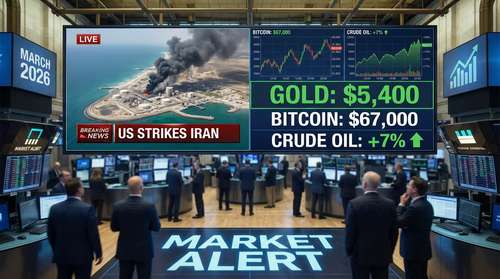
Global markets have been thrown into a whirlwind of volatility this Monday as gold prices shattered historical records, surging past $5,408 per ounce amidst a dramatic escalation in the Middle East. The catalyst—a coordinated US and Israeli military campaign dubbed "Operation Epic Fury"—has officially plunged the region into combat operations, reportedly resulting in the death of Iran's Supreme Leader, Ayatollah Ali Khamenei. While traditional safe havens like gold and oil rallied aggressively, with Brent crude spiking over 7% following a drone strike on Saudi Aramco's Ras Tanura refinery, Bitcoin has staged a remarkable recovery. After an initial flash crash to $63,000, the leading cryptocurrency has resiliently reclaimed the $67,000 level, cementing its status as a digital hedge in times of extreme geopolitical financial volatility.
Safe Haven Assets Surge: Gold Entering Uncharted Territory
The flight to safety has been instantaneous and historic. Gold, long considered the ultimate store of value during times of war, obliterated psychological resistance levels to trade at an all-time high of $5,408 per ounce in early European trading sessions. This represents a staggering intraday move that has caught many institutional short-sellers off guard.
Analysts point to the "fear trade" as the primary driver. With the confirmed death of Iran's Supreme Leader and the subsequent power vacuum in Tehran, uncertainty has reached fever pitch. "This isn't just inflation hedging anymore; this is regime-change pricing," notes a senior commodities strategist at a major London firm. Investors are aggressively rotating capital out of equities and into physical assets, fearing that the conflict could expand to involve other regional powers.
Silver has mirrored this bullish sentiment, rallying alongside gold, while other precious metals have seen similar inflows. The consensus among wealth managers is clear: in a world where US combat operations are active in the Middle East, a diversified portfolio must now essentially include a heavier weighting of non-sovereign assets.
Oil Markets rattled by Saudi Aramco Refinery Strike
Energy markets reacted violently to news that a retaliatory drone swarm had successfully targeted the Ras Tanura refinery, Saudi Aramco's largest facility. Although Saudi officials report the resulting fire has been contained, the temporary shutdown of a facility capable of processing 550,000 barrels per day sent shockwaves through the futures market.
Brent crude prices surged more than 7% immediately following the reports, creating a "war premium" that experts warn could push oil back toward triple digits if the Strait of Hormuz faces credible threats of closure. The attack on Saudi infrastructure serves as a stark reminder of the vulnerability of global energy supply chains in this new theater of conflict.
Impact on Global Inflation
The immediate spike in oil prices threatens to undo months of central bank progress against inflation. A sustained period of oil above $90—which now looks increasingly likely—would almost certainly force the Federal Reserve to reconsider its rate-cut trajectory for 2026. This potential for "sticky" inflation is further fueling the rally in gold, as investors seek protection against a stagflationary environment driven by supply-side shocks.
Bitcoin's Resilience: The Digital Safe Haven Thesis
Perhaps the most intriguing market development has been Bitcoin's price action. In the immediate aftermath of the US announcement of combat operations, algorithmic trading bots triggered a massive sell-off, driving BTC down to a local bottom of roughly $63,000. However, unlike previous risk-off events, the dip was aggressively bought up by both retail and institutional investors.
By Monday afternoon, Bitcoin had not only erased those losses but reclaimed the $67,000 handle, trading with renewed strength. This v-shaped recovery suggests a decoupling from traditional tech stocks and a re-alignment with gold as a "neutral" asset that sits outside the traditional financial system. With the geopolitical financial volatility expected to persist, Bitcoin's ability to hold this support level is being viewed as a critical test of its maturity as a macro asset.
On-chain data indicates that long-term holders added to their positions during the dip, reinforcing the narrative that digital assets are increasingly viewed as a legitimate hedge against kinetic warfare and the fiat currency debasement that often funds it.
Geopolitical Context: Operation Epic Fury
The commencement of "Operation Epic Fury" marks a significant pivot in US foreign policy. Pentagon officials confirmed that the strikes were aimed at dismantling Iran's nuclear capabilities and ballistic missile programs. The death of Supreme Leader Khamenei, confirmed by Iranian state media, has created a power vacuum that introduces unprecedented unpredictability into the equation.
As US naval carrier groups reposition in the Persian Gulf and air sorties continue, the risk of asymmetric warfare—such as cyberattacks on Western financial infrastructure or further strikes on Gulf oil facilities—remains high. This backdrop of "market safe haven rotation" is likely to dominate trading strategies for the foreseeable future.
Investors are advised to remain vigilant. The correlation between gold, oil, and Bitcoin is currently tighter than it has been in years, united by a common thread of geopolitical fear. As the situation in Iran evolves, these three assets will likely serve as the primary barometers for global risk sentiment in March 2026.