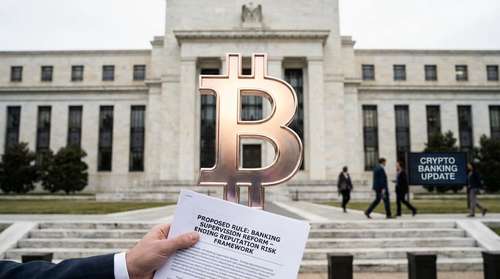
In a watershed moment for the United States cryptocurrency industry, the Federal Reserve Board has officially launched a public comment period on a proposal to permanently remove "reputation risk" from its banking supervisory framework. Announced on Monday, February 23, 2026, this landmark regulatory shift aims to codify a policy that prevents federal examiners from pressuring financial institutions to cut ties with lawful customers—a practice critics have long labeled Operation Chokepoint 2.0. For digital asset firms that have struggled to secure stable banking partners, this proposal represents a potential end to years of systemic debanking and a significant step toward digital asset regulatory clarity.
Codifying the Removal of Reputation Risk
The core of the Federal Reserve's proposal is a decisive move to limit the discretionary power of bank examiners. Historically, regulators could cite "reputation risk" as a standalone reason to criticize a bank's relationship with certain clients, effectively forcing institutions to drop customers in industries deemed high-risk or politically disfavored, such as cryptocurrency. Under the new proposed rule, the Federal Reserve would formally prohibit its supervisors from directing or encouraging banks to sever relationships with customers engaged in lawful activities based solely on reputational concerns.
This development builds upon a guidance update first issued in June 2025, but elevates it from a mere supervisory expectation to a codified rule. By stripping "reputation risk" from the examination manual, the Fed is signaling that banks must judge customers based on tangible financial risk management metrics—such as creditworthiness and compliance with anti-money laundering (AML) laws—rather than subjective judgments about an industry's public image. This shift is critical for establishing a bank reputation risk framework that is objective and predictable.
Dismantling Operation Chokepoint 2.0
For the crypto sector, this proposal is widely viewed as the death knell for "Operation Chokepoint 2.0"—a term coined by industry advocates to describe an alleged coordinated effort by regulators to isolate crypto firms from the traditional banking system. Since 2023, numerous legitimate digital asset companies reported sudden account closures and refusals of service, often without specific financial justification. These actions forced many U.S. crypto firms to seek banking partners offshore, increasing systemic risk and stifling domestic innovation.
The Industry Response
The connection between this proposal and the dismantling of debanking tactics was made explicit by Federal Reserve Vice Chair for Supervision Michelle W. Bowman. In a statement accompanying the proposal, Bowman highlighted "troubling cases of debanking" where supervisors used reputational concerns to pressure institutions against serving customers due to their political views or industry sector. "Discrimination by financial institutions on these bases is unlawful and does not have a role in the Federal Reserve's supervisory framework," Bowman asserted, providing a high-level validation of the complaints long voiced by crypto executives.
Lummis and the Push for Crypto Banking Rights
Political pressure has played a massive role in reaching this inflection point. Cynthia Lummis crypto update discussions have frequently centered on the need for fair banking access. Senator Lummis (R-WY), a staunch advocate for the digital asset space, publicly praised the Federal Reserve's move on social media, framing it as a long-overdue correction. "It is not the Fed's role to play judge and jury for banking digital asset companies," Lummis stated, emphasizing that this rule could finally allow the U.S. to compete as a global hub for financial technology.
The proposal aligns with broader legislative efforts pushing for US crypto banking laws 2026 that guarantee fair access to the financial system. By addressing the "reputation risk" loophole, the Fed is effectively neutralizing one of the primary tools used to shadow-ban the crypto industry. Industry leaders like Alex Thorn of Galaxy Digital have echoed these sentiments, noting that while the proposal is technical in nature, its practical impact on the day-to-day operations of crypto startups could be transformative.
A New Era of Digital Asset Regulatory Clarity?
While this proposal is a crypto debanking solution, it is not an immediate fix. The Federal Reserve has opened the floor for a 60-day public comment period, allowing stakeholders, banks, and the public to weigh in before the rule is finalized. During this time, crypto trade associations are expected to submit detailed feedback to ensure the final language is watertight against future regulatory overreach.
If finalized as written, the rule would mandate that supervisory findings focus strictly on safety and soundness—capital adequacy, liquidity, and operational risk. This distinction is crucial. It means that a bank can no longer be penalized simply for holding the deposits of a Bitcoin miner or a decentralized finance (DeFi) startup, provided those entities comply with the law. For bank compliance officers, this offers much-needed cover to onboard crypto clients without fear of silent retaliation from regulators.
As the 60-day clock ticks down, the message from Washington is clearer than it has been in years: the era of shadow regulation is ending. For the U.S. crypto market, the removal of reputation risk from federal supervision removes a Sword of Damocles that has hung over the industry for nearly half a decade, paving the way for a more mature, integrated, and stable financial ecosystem.