
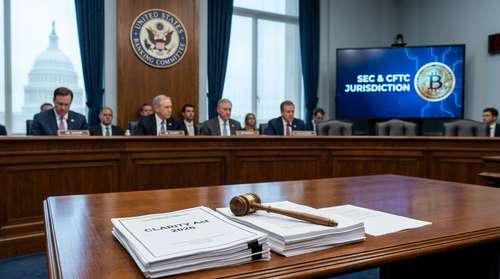
Following a highly anticipated and high-stakes roundtable on April 16, the Senate Banking Committee crypto news cycle is dominating global financial markets. Lawmakers have officially advanced the Digital Asset Market Clarity Act (widely known as the CLARITY Act 2026) into its final markup phase. This bipartisan legislative package represents the most ambitious federal framework in history, aiming to decisively resolve the decade-long SEC vs CFTC crypto jurisdiction battle. By classifying digital assets into three well-defined tiers, the bill promises to replace an exhausting era of regulation-by-enforcement with clear statutory rules. For institutional funds and retail investors who have navigated regulatory ambiguity for years, this critical Senate phase signals that comprehensive US market oversight is finally on the horizon.
Resolving the SEC vs CFTC Crypto Jurisdiction Battle
For over a decade, the digital asset industry has been severely constrained by a relentless regulatory turf war. The new crypto market structure bill decisively addresses this friction by delineating exact boundaries for federal oversight. Under the proposed framework, the Commodity Futures Trading Commission (CFTC) will secure exclusive jurisdiction over digital commodities—assets traded on mature, highly decentralized networks.
Meanwhile, the Securities and Exchange Commission (SEC) retains its traditional oversight role over tokens initially sold as investment contracts, particularly during their capital-raising phases. Crucially, however, the legislation introduces a functional transition mechanism. It formally acknowledges the reality that a digital asset originally sold as a security can eventually mature into a digital commodity once its underlying network achieves sufficient decentralization.
This pragmatic split effectively curbs regulatory overreach while introducing a unified federal registration regime. Crypto exchanges, brokers, and dealers will be able to operate under federal commodity standards rather than navigating a fragmented, state-by-state patchwork of money transmission licenses.
Breaking the Senate Deadlock: The Stablecoin Yield Compromise
Despite passing the House of Representatives with a sweeping 294-134 bipartisan majority in July 2025, the Digital Asset Market Clarity Act spent months stalled in the upper chamber. The primary bottleneck was a fierce, behind-closed-doors debate over stablecoin yield, drawing intense lobbying from traditional financial institutions. Banking advocates, led by the American Bankers Association, strongly opposed allowing passive yield on dollar-pegged stablecoins. They warned that offering competitive returns could spark massive deposit flight from low-yield traditional bank accounts into the rapidly expanding $320 billion stablecoin sector.
Recent back-channel negotiations have successfully bridged this divide. A working compromise now bans pure passive interest while permitting specific, activity-based rewards tied directly to platform usage and payment utility. An April 15 policy note from JPMorgan analysts confirmed that the unresolved issues had dwindled to just a handful of workable technicalities.
Industry executives are expressing immediate optimism about the legislative calendar. Coinbase Chief Policy Officer Faryar Shirzad recently predicted that, with the markup phase now active, the bill is positioned for a full Senate floor vote as early as May.
XRP Commodity Status Update and Immediate Market Reactions
The April 16 Senate breakthrough immediately triggered positive market momentum across the board. Savvy investors closely monitored the XRP commodity status update, as assets burdened by years of persistent regulatory overhang experienced sudden price surges. Because the CLARITY framework provides an explicit, legally binding pathway for established tokens to shed their security classification, legacy networks like XRP stand to benefit immensely from transitioning to CFTC commodity oversight. Institutional capital, which has remained largely on the sidelines awaiting bulletproof legal certainty, is already positioning for major allocations in the second half of the year.
Exploring the Three Tiers of US Crypto Regulation 2026
To understand why the bill is so revolutionary, you have to look at its core classification system. The legislation neatly categorizes the digital economy into three primary buckets: digital commodities, investment contract assets, and payment stablecoins.
By building on the foundations of earlier stablecoin proposals like the GENIUS Act, the current draft ensures that payment stablecoins are subject to rigorous bank-like capital buffers and anti-money laundering (AML) safeguards. Simultaneously, the framework establishes a new $75 million exemption for digital commodity issuers, allowing responsible decentralized finance (DeFi) projects to raise capital legally provided they meet strict disclosure requirements regarding token economics and source code risks.
The Road Ahead for the Digital Asset Market Clarity Act
As the Senate Banking Committee finalizes the markup process, political focus will swiftly shift to the full Senate floor. White House advisers have signaled that technical hurdles are falling rapidly, aligning perfectly with the industry's push to solidify rules before the midterm election cycles complicate matters.
If the current bipartisan momentum holds, the United States is poised to establish a resilient, competitive financial framework that actively keeps digital asset innovation onshore. Market participants and traditional financial firms should begin preparing immediately for the incoming dual SEC and CFTC compliance landscape. The passage of the CLARITY Act 2026 will not just end an era of agency overreach; it will usher in a mature, institutional-grade era for the entire digital economy.