
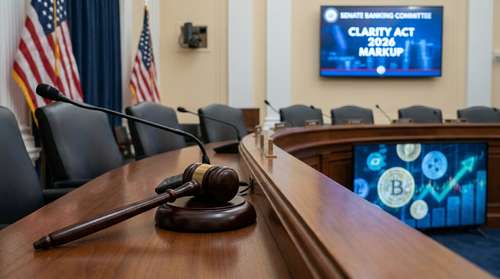
In what could become the defining moment for the future of decentralized finance, the U.S. Senate Banking Committee released the final 309-page text of the Digital Asset Market Clarity Act on May 12, 2026. Just days ahead of a high-stakes CLARITY Act 2026 markup scheduled for May 14, this sweeping legislative draft sets the stage for a massive overhaul of how the United States handles digital currencies. Following months of tense negotiations that culminated in a breakthrough bipartisan stablecoin deal, lawmakers are finally drawing the jurisdictional boundaries needed to integrate blockchain innovation with the broader economy.
The legislation passed the House of Representatives overwhelmingly in July 2025 under the banner of H.R. 3633. However, it stalled in the upper chamber through multiple canceled sessions. Now, as the clock ticks toward the Memorial Day recess, political pressure is escalating to solidify a functional US digital asset policy before election-season gridlock freezes Washington.
The Bipartisan Stablecoin Deal: Yield, Reserves, and Bank Pushback
At the center of the recent legislative momentum is the highly debated "Section 404" compromise spearheaded by Senators Thom Tillis (R-N.C.) and Angela Alsobrooks (D-Md.). Their bipartisan stablecoin deal directly tackles the single most contentious issue blocking the bill's path: whether crypto platforms can pay interest to users holding stablecoin balances.
Under the new federal stablecoin framework, the act imposes a strict 1:1 reserve mandate. Issuers must back every token in circulation with high-quality liquid assets, explicitly restricted to short-duration U.S. Treasuries (under 90 days), overnight repurchase agreements, and central bank deposits. More importantly, the compromise establishes a critical distinction between passive yield and activity-based rewards. While users cannot earn passive interest merely for parking their tokens on an exchange, platforms can still offer rewards tied to genuine transaction activity or merchant payments.
The banking industry has not taken this lying down. The American Bankers Association (ABA) remains fiercely opposed to any loopholes that could allow tech firms to replicate high-yield savings accounts without holding a banking charter. Over the past weekend, this powerful lobbying group flooded the Senate Banking Committee with letters, arguing that yield-bearing stablecoins threaten to drain FDIC-insured deposits and destabilize local mortgage funding. For traditional institutions, the prospect of a parallel, lightly regulated financial system siphoning off consumer liquidity is a worst-case scenario. This dynamic has forced banks to become sophisticated political operators ahead of the 2026 midterms, fighting to ensure the final bill strictly mirrors traditional banking regulations.
Drawing the Line in US Digital Asset Policy
Beyond stablecoins, the draft text attempts to end the years of enforcement-by-litigation that have frustrated the crypto industry. The bill creates a definitive split in financial markets regulation, explicitly granting the Commodity Futures Trading Commission (CFTC) exclusive jurisdiction over spot and cash markets for "digital commodities". This covers tokens intrinsically linked to functioning, decentralized blockchains.
Protecting Developers and Defining Decentralization
Simultaneously, the Securities and Exchange Commission (SEC) retains its authority over investment contract assets and primary market fundraising. This division of power has been absent from U.S. law since Bitcoin's inception. By clarifying these specific regulatory domains, the legislation gives institutional fiduciaries and massive brokerage firms the legal certainty they need to confidently offer asset custody and trading services to mainstream investors.
The bill also includes major victories for decentralized finance (DeFi) builders. Non-custodial blockchain developers receive a safe harbor preventing them from being classified as money transmitting businesses merely for writing open-source code. However, platforms that fail to meet strict decentralization standards will be treated as traditional financial institutions, subject to rigorous Bank Secrecy Act and anti-money laundering reporting rules.
Ethics Fights Threaten the Senate Stablecoin Bill
Despite securing the fundamental market structure provisions, the path to the President's desk is heavily contested. As the committee prepares for Thursday's CLARITY Act 2026 markup, members have filed well over 100 proposed amendments. The sheer volume of these filings mirrors the contentious dynamics of a previously canceled January session, signaling that a fierce ideological battle lies ahead on the Senate floor.
Senator Elizabeth Warren is spearheading the opposition, filing more than 40 individual amendments aimed at tightening consumer protections. A significant sticking point revolves around government ethics. Senator Chris Van Hollen has introduced proposals that would outright ban senior government officials, the President, and their immediate families from owning or promoting crypto-related businesses. With the White House setting a July 4 target for the bill's passage, Democratic lawmakers have labeled these ethics constraints as a non-negotiable component of the Senate stablecoin bill.
What This Means for Crypto Regulation News in 2026
The stakes for the upcoming executive session cannot be overstated. If the committee fails to advance the legislation before the May 21 recess, key sponsors have warned that meaningful cryptocurrency regulation might be pushed to the end of the decade.
For the first time, however, prediction markets are pricing the odds of the bill becoming law in 2026 at roughly 60%. As financial markets regulation evolves in real-time, checking the latest crypto regulation news 2026 headlines has never been more critical for investors. If the committee navigates the CLARITY Act 2026 markup successfully, the crypto industry will finally get the rules of the road it has been demanding for over a decade.