Monday, January 19, 2026 — The Bitcoin network is undergoing a seismic shift in its fundamental security structure. For the first time since late 2025, the global Bitcoin hashrate 2026 metrics have slumped below the psychological threshold of 1,000 EH/s (exahashes per second), hitting a four-month low of 995 EH/s early this morning. This sharp decline confirms what industry analysts have warned of for months: the crypto mining AI pivot is no longer a future trend—it is an immediate operational reality draining power from the blockchain.
The Great Power Migration: AI vs. SHA-256
The driving force behind this hashrate contraction is a stark divergence in unit economics. While Bitcoin hovers around the $90,000 mark, the Bitcoin mining profitability crisis has pushed the "hashprice"—the expected daily revenue per petahash—down to a razor-thin $35–$40. In contrast, AI infrastructure mining contracts are offering miners exponentially higher margins.
"We are witnessing the greatest capitulation of hashrate in history, but it's not because miners are going bankrupt—it's because they are evolving," explains Elena Rostova, senior analyst at Digital Assets deeply tracking the sector. "Why would a facility mine Bitcoin for $1 of revenue per kilowatt-hour when they can lease that same power capacity to an AI firm for $25 per kilowatt-hour? The math is undeniable."
This economic disparity has turned the mining sector into a battleground for megawatts. Major players like Core Scientific and IREN (formerly Iris Energy) have aggressively reallocated their power capacity. IREN's stock has surged following its massive $9.7 billion cloud agreement with Microsoft, a move that signaled the effective end of 'pure-play' mining for institutional giants.
HPC Data Centers Crypto Transition Accelerates
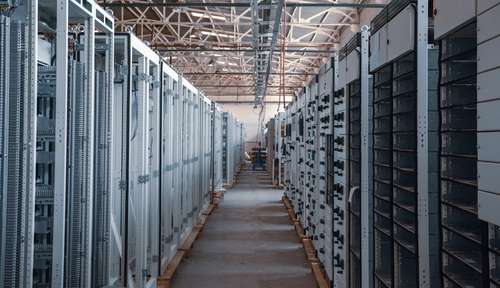
The pivot is transforming industrial mining sites into HPC data centers crypto firms once only dreamed of building. Facilities in Texas and North Dakota, originally designed to run ASIC miners for SHA-256 hashing, are being rapidly retrofitted with liquid cooling systems to house NVIDIA's Blackwell GPUs.
Core Scientific has led this charge, rejecting a $9 billion buyout offer earlier this month to maintain its independence as a premier AI colocation provider. Their partnership with CoreWeave has set a blueprint for the industry: secure the power, upgrade the cooling, and switch off the Bitcoin miners. As these gigawatt-scale sites go offline from the Bitcoin network to service AI workloads, the global hashrate naturally contracts.
Grid Competition Heats Up
The transition hasn't been without political friction. The mining energy grid competition reached the White House last week, with President Trump commenting on Truth Social that Americans "should not pay higher electricity bills" due to the insatiable energy thirst of data centers. This regulatory spotlight is accelerating the timeline for miners to lock in long-term AI contracts before potential grid interconnection moratoriums can be enacted.
Network Difficulty and Security Implications
For the Bitcoin protocol, this exodus of industrial power has triggered a notable bitcoin network difficulty drop. The network adjusted downward to approximately 146.4 trillion this week, providing a brief respite for the remaining miners who are sticking to the 'digital gold' thesis. However, the drop below 1,000 EH/s raises questions about long-term network security budgets.
"The network is functioning exactly as designed," notes protocol engineer James Wu. "As difficulty drops, the remaining efficient miners—those with access to near-zero cost energy or who are geographically stranded from high-speed data lines—become more profitable. We aren't seeing a security crisis; we are seeing a specialization of the miner base."
The Future of Mining: A Hybrid Model
As we move deeper into 2026, the pure-play Bitcoin miner is becoming an endangered species. The new industry standard is a hybrid model: allocating stable, high-uptime power to AI compute services to cover operational expenses (OpEx), while using interruptible, lower-tier power for Bitcoin mining to capture upside volatility.
Companies like Hut 8 have exemplified this, securing a $7 billion lease with Fluidstack while maintaining a flexible fleet of ASICs. This diversification strategy effectively hedges against the brutal volatility of crypto markets, ensuring that even if Bitcoin enters a prolonged bear market, the lights stay on—powered by the insatiable demand for artificial intelligence.