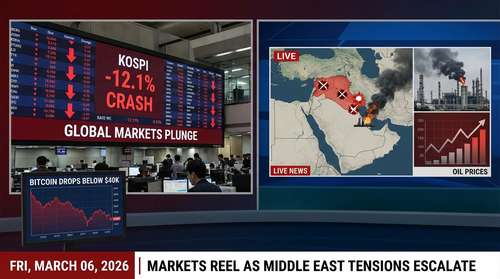
NEW YORK — Global financial markets are facing a reckoning this Friday, March 6, 2026, as a historic sell-off in Asia and deepening turmoil in the Middle East send shockwaves through Wall Street. The week has been defined by extreme volatility, punctuated by a massive 12% crash in South Korea’s KOSPI index—a decline that has reignited fears of a global contagion. As traders brace for the critical U.S. unemployment rate March 2026 data release this morning, the traditional flight to safety has taken a chaotic turn, with Bitcoin safe haven test 2026 failing to hold up against surging oil prices and geopolitical panic.
KOSPI Meltdown: Anatomy of a 12% Crash
The financial earthquake began earlier this week in Seoul, where the benchmark KOSPI index suffered its worst single-day decline in decades, plummeting over 12% on Tuesday. The crash triggered multiple sidecar trading halts and circuit breakers, freezing the market as panic selling consumed the exchange. Analysts point to a "perfect storm" of factors: South Korea's heavy reliance on imported energy, which leaves it uniquely vulnerable to the oil price jump war impact, and an unwinding of crowded trades in the AI semiconductor sector.
Tech giants Samsung Electronics and SK Hynix, which had rallied aggressively on the AI boom, saw double-digit losses, dragging the broader index down. "This isn't just a correction; it's a liquidity event," said a senior analyst at a major Seoul brokerage. "When the Strait of Hormuz is threatened, economies that import 100% of their oil, like ours, are the first to bleed." The shock has since reverberated across Asian markets, with Japan's Nikkei and Hong Kong's Hang Seng also posting significant losses, though none as severe as the carnage in Seoul.
Middle East War Escalation Fuels Oil Surge
Driving the global market crash Friday narrative is the rapidly deteriorating situation in the Middle East. With the Middle East war economic impact now undeniable, Brent crude has surged past $85 per barrel, with some analysts warning of a return to triple digits if the conflict broadens. The recent escalation involving direct confrontations between major regional powers has spooked energy markets, raising the specter of supply disruptions in the critical Strait of Hormuz shipping lane.
"The risk premium is back with a vengeance," noted a commodities strategist in London. "We are seeing a direct correlation between the headlines coming out of the Gulf and the red ink on trading screens worldwide." The surge in energy costs is stoking fears of stagflation—stagnant growth coupled with high inflation—which is particularly dangerous for the U.S. economy as it navigates a delicate landing.
Bitcoin Fails the 'Safe Haven' Stress Test
Perhaps the most surprising development for crypto investors has been the performance of digital assets. Despite the chaos, the Bitcoin safe haven test 2026 appears to be failing. Instead of rallying alongside gold—which has hit new highs—Bitcoin has traded in lockstep with risky tech stocks, dropping roughly 4% amid the turmoil. This crypto market volatility today challenges the long-held narrative of Bitcoin as "digital gold."
Crypto Decouples from Gold
"Investors are treating Bitcoin as a risk-on asset, not a hedge," explained a crypto fund manager. "When margin calls hit in the equity markets, traders sell what is liquid, and crypto is the only market open 24/7." This week's price action suggests that institutional adoption has tightly correlated crypto with the Nasdaq, making it vulnerable to the same macroeconomic headwinds facing Big Tech.
All Eyes on U.S. Unemployment Data
As the trading week closes, the market's collective anxiety is focused on the U.S. Bureau of Labor Statistics. The U.S. unemployment rate March 2026 report, due out at 8:30 AM ET, is expected to be the final arbiter of market direction for the weekend. A weaker-than-expected number could signal that high interest rates and global instability are finally cracking the American labor market, potentially forcing the Federal Reserve to intervene.
Conversely, a strong jobs report could complicate the Fed's ability to cut rates, leaving markets trapped between a hot economy and soaring energy costs. "Traders are sitting on their hands," said one floor trader. "Nobody wants to be long going into this weekend with the geopolitical news cycle moving this fast."