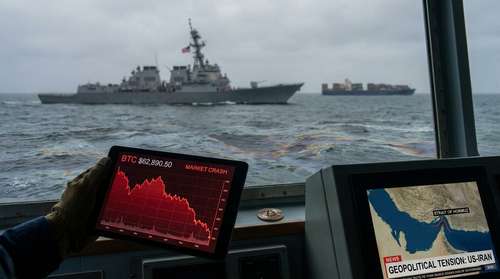

The global financial landscape was thrown into turmoil today as geopolitical tensions reached a boiling point, sending a shockwave through digital asset markets. A sharp shift in the Bitcoin price Strait of Hormuz correlation emerged immediately following the collapse of peace talks in Islamabad. As the United States officially announced a naval blockade of the critical oil transit route, panic rippled across risk assets. Bitcoin (BTC) abruptly dipped to $70,623 on April 13, 2026, triggering widespread margin calls and erasing billions in open interest.
This unprecedented escalation has forced traders to quickly reevaluate their exposure to risk-on assets. With oil markets reacting violently and inflation fears reigniting, digital currency investors are watching the charts closely. The flagship cryptocurrency has lost roughly 3% of its value over the past 24 hours, shedding the bullish momentum that had pushed it above $73,000 just days prior.
Collapse of Peace Talks Sparks US Naval Blockade News
The catalyst for today's market turbulence was the sudden breakdown of diplomatic negotiations between the US and Iran. After a grueling 21-hour weekend summit in Pakistan, US Vice President J.D. Vance confirmed that the delegations had walked away without reaching a ceasefire agreement. In a rapid response, President Donald Trump took to Truth Social to announce that the US would begin interdicting vessels paying illegal tolls to the Iranian government.
The U.S. Central Command clarified late Sunday that the blockade targets vessels entering or departing Iranian ports. This aggressive military posture immediately stoked fears of a prolonged closure of the global energy chokepoint. The immediate fallout saw oil prices spike by a staggering 9.5%, leading macroeconomic analysts from Saxo Bank to warn of a potential full-blown energy crisis. This latest US naval blockade news is heavily influencing trading algorithms across all financial sectors.
Crypto Liquidations Today: The Rush for the Exits
As traditional markets braced for the Sunday evening futures open, the 24/7 crypto markets took the immediate hit. The geopolitical shock triggered one of the most brutal waves of crypto liquidations today. Over-leveraged long positions were wiped out in minutes as capital scrambled for safety.
Many institutional investors aggressively reduced their exposure in response to the escalating Bitcoin geopolitical risk. When inflation models started projecting that rising oil prices could push the US Consumer Price Index (CPI) above 4.0%, the narrative of imminent rate cuts quickly evaporated. This perfect storm of macroeconomic dread resulted in what many are already calling the crypto market crash April 2026, shifting sentiment from extreme greed to sheer caution almost overnight.
Can Bulls Defend the BTC Support Level 70K?
From a technical perspective, the market is severely testing a critical psychological and structural barrier. The rapid sell-off pushed prices to an intraday low of $70,623. Defending the BTC support level 70K is now the primary objective for bulls. If this threshold breaks on high volume, analysts warn of a steeper retracement toward the mid-$60,000 range.
Order book data from major exchanges shows a massive cluster of buy walls positioned just below $70,000. However, the sheer momentum of the current geopolitical panic means these defensive lines could easily be breached if military escalation in the Middle East continues.
Market Reactions on Synthetic Futures
Early indicators from offshore platforms like Hyperliquid showed intense downward pressure on synthetic perpetual futures for the S&P 500, dragging digital assets down in tandem. Historically, Bitcoin has occasionally acted as a safe-haven asset during regional conflicts, but the immediate reaction to global supply chain disruptions is almost always a liquidity-driven sell-off.
Inflation Fears Complicate the Recovery Outlook
Beyond the immediate military concerns, the secondary effects of the blockade are causing severe headaches for monetary policymakers. The Kobeissi Letter recently highlighted that US CPI inflation had just jumped from 2.4% to 3.3%. According to their macroeconomic models, a prolonged closure of the Strait of Hormuz could push inflation well above 4.0%.
For cryptocurrency investors, this presents a complicated scenario. Bitcoin was originally championed as an inflation hedge. However, in the modern institutional era, it often trades like a high-beta technology stock. If the Federal Reserve is forced to maintain high interest rates to combat oil-driven inflation, liquidity will continue to drain from risk assets. This structural shift explains why the initial reaction to the blockade was a flight to cash rather than a rotation into decentralized digital scarcity.
MicroStrategy BTC Purchase 2026: Institutional Conviction
Despite the broader market panic, the largest corporate holder of Bitcoin remains steadfast. Just days before the diplomatic breakdown, Michael Saylor's firm executed another massive MicroStrategy BTC purchase 2026. Between April 1 and April 5, the company acquired exactly 4,871 BTC for approximately $329.9 million.
- Average purchase price: $67,718 per coin
- Total holdings: 766,970 BTC
- Estimated total cost: $58.02 billion
- Funding mechanism: STRC preferred stock issuance
This aggressive acquisition, financed through traditional equity markets rather than operating cash, highlights a stark contrast in market behavior. While retail traders and leveraged funds dump their assets amid the Strait of Hormuz crisis, MicroStrategy continues to pull down its cost basis, capitalizing on dips below its $75,644 overall average. Saylor's recent resurrection of his famous orange dot tracker on social media, accompanied by the message to think bigger, serves as a stark reminder of the long-term conviction held by institutional whales.
Interestingly, MicroStrategy's accumulation is vastly outpacing the rate at which new Bitcoin is mined. In March alone, miners produced roughly 16,200 BTC, while MicroStrategy scooped up over 46,000 coins. This supply-side exhaustion means that once the geopolitical dust settles, the available liquidity on exchanges could be significantly tighter than bearish traders anticipate.
Navigating the Coming Week
The next few days will be critical for both global diplomacy and financial markets. If military tensions ease and the blockade is limited in scope, Bitcoin could see a swift recovery bounce off the $70,000 floor. Conversely, if the conflict broadens and oil prices remain inflated, the crypto sector may face extended downward pressure.
Traders must remain vigilant. Heightened volatility is guaranteed as traditional equity markets fully price in the weekend's events. Monitoring open interest, funding rates, and diplomatic channels will be essential for anyone navigating this complex macroeconomic maze.