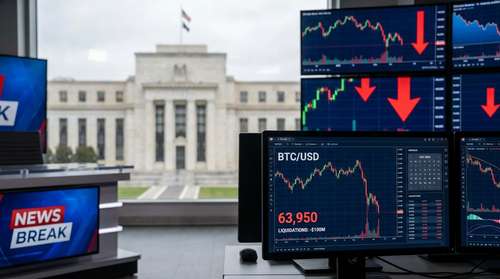
The cryptocurrency market faced a brutal awakening on Tuesday morning as the Bitcoin price drop July 2026 shattered crucial support levels. Bitcoin violently plummeted below the heavily defended $64,000 mark, crashing to roughly $63,200 in early Asian trading. The sudden downward spiral wiped out over $100 million in long leveraged positions in less than an hour, catching thousands of overextended traders completely off guard.
This aggressive sell-off isn't happening in a vacuum. Digital assets are currently caught in the crosshairs of intense risk-off sentiment directly tied to the upcoming Fed interest rate meeting. With global markets increasingly nervous about persistent inflation and shifting macroeconomic policies, cryptocurrency investors are rushing to de-risk their portfolios before policymakers make their next move.
How Kevin Warsh and the FOMC Meeting Sparked a Crypto Market Crash
The primary catalyst for this massive market correction stems from mounting anxiety surrounding the Federal Reserve. Wall Street is bracing for Wednesday's critical policy announcement, and speculation is running rampant that a surprise hawkish pivot is on the table.
Investors are paying extraordinarily close attention to the Kevin Warsh FOMC dynamic. Since taking the helm as Fed Chair, Warsh has abandoned the traditional playbook of heavy forward guidance, repeatedly refusing to make pre-commitments regarding monetary policy. This lack of hand-holding has left markets on edge. While many mainstream institutions previously expected rates to remain steady at the current 3.5% to 3.75% range, institutions like Citadel Securities are now projecting a surprise 25-basis-point rate hike.
Warsh recently emphasized that policymakers have absolutely no tolerance for persistently elevated inflation. With household consumption growing at a moderate rate and business investment remaining robust—fueled by the construction of data centers and demand for AI equipment—the central bank has the economic runway to tighten conditions if necessary. The mere fear of rising borrowing costs instantly drained liquidity from speculative assets, accelerating this latest crypto market crash.
Asian Equity Rout Compounds BTC Liquidations Today
The timing of the central bank anxiety collided perfectly with regional macroeconomic instability. Bitcoin’s sudden price drop was severely exacerbated by a broader, tech-led equity rout across Asian markets earlier in the Tuesday trading session. Investors are growing increasingly concerned about AI-related credit risks, triggering a widespread retreat from both technology stocks and digital currencies.
The sheer scale of the BTC liquidations today highlights just how fragile market structure had become during the recent consolidation phase. When Bitcoin slipped beneath the $64,000 threshold, it triggered a cascading wave of automated margin calls.
The Anatomy of the $100 Million Wipeout
Flash liquidations occur when exchanges forcibly close traders' leveraged positions because their account equity can no longer cover the required maintenance margin. Here is what drove Tuesday's rapid destruction of capital:
- Over-leveraged Longs: Traders aggressively bet on a pre-FOMC breakout above the $65,000 resistance level, utilizing high leverage that left them vulnerable to minor downside volatility.
- Algorithmic Selling: As key technical supports broke, automated trading bots executed market sell orders en masse, accelerating the price plunge.
- Evaporating Liquidity: Market makers pulled their bids ahead of the Federal Reserve announcement, widening spreads and ensuring the price had to fall further to find willing buyers.
Institutional Investors Signal Caution Amidst ETF Outflows
This localized panic among retail traders was preceded by clear institutional bleeding. U.S.-listed spot Bitcoin exchange-traded funds (ETFs) signaled early trouble by recording over $465 million in massive outflows between July 23 and July 24. This sudden reversal effectively snapped a seven-session streak of positive institutional inflows.
When institutional safety nets vanish, retail and leveraged traders are left highly exposed to sudden crypto liquidations. The broader crypto fear and greed index has now retreated firmly into fear territory, sitting at a cautious 29 out of 100. Without the constant buying pressure from spot ETFs, Bitcoin lacks the immediate momentum needed to absorb large-scale selling events.
Bitcoin Prediction: Navigating the Technical Downside
The immediate outlook for the top cryptocurrency hinges entirely on Wednesday's press conference. If the Fed does proceed with an unexpected rate hike to combat inflation, any short-term Bitcoin prediction leans heavily bearish. Market analysts warn that the next critical support floor sits at $62,000, with much stronger foundational support waiting down at $60,000.
Conversely, if Chairman Warsh holds rates steady and strikes a more balanced tone regarding the economy's evolution, Bitcoin could see an aggressive relief rally as sidelined capital rushes back into the market. Until the central bank officially reveals its hand, traders should anticipate elevated volatility, widening price swings, and the ever-present threat of further leverage wipes.