
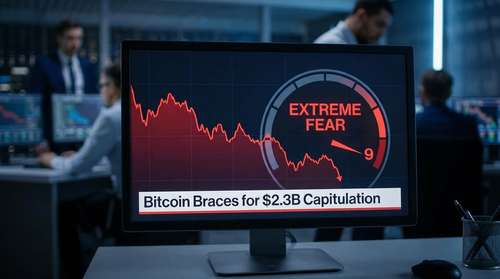
On February 19, 2026, the cryptocurrency market remains paralyzed in a state of 'Extreme Fear,' with the Crypto Fear & Greed Index hitting a historic low of 9. Bitcoin is currently struggling to hold the crucial $66,000 level following a massive $2.3 billion capitulation event that has shaken investor confidence to its core. As record outflows of $8.5 billion bleed from US-listed spot ETFs since the October 2025 peak, traders are asking the ultimate question: is the bottom finally in, or is this the prelude to a deeper crypto winter?
The $2.3 Billion Capitulation Event: A Historic Flush
The market is reeling from one of the most severe capitulation events in digital asset history. On-chain data confirms that Bitcoin investors have locked in over $2.3 billion in realized losses over the past week. This magnitude of surrender rivals the darkest days of the 2022 bear market, specifically the Terra (LUNA) collapse and the FTX fallout.
Analysts at CryptoQuant have flagged this sell-off as a potential "reset" moment. The capitulation was driven largely by short-term holders—those who bought near the $126,000 all-time high in October 2025—panic-selling as prices crumbled below psychological support levels. With Bitcoin currently trading around $66,500, down over 47% from its peak, the market has effectively washed out months of speculative leverage.
ETF Outflows Hit $8.5 Billion as Institutions De-Risk
The institutional narrative, once the primary driver of the 2024-2025 bull run, has faced a severe stress test. Since October 2025, US-listed spot Bitcoin ETFs have recorded a staggering $8.5 billion in net outflows. This exodus marks a sharp reversal from the aggressive accumulation seen earlier in the cycle.
According to recent reports from 10X Research, the selling isn't just retail panic; it's a structural de-risking by major players. The so-called "carry trade"—where hedge funds arbitraged the difference between spot and futures prices—has unwound rapidly as funding rates turned negative. Despite the gloom, BlackRock's IBIT and other major funds still hold significant assets, but the relentless daily outflows have dampened any immediate hope for a V-shaped recovery.
The "Software-mageddon" Correlation
Compounding the crypto-specific woes is the broader tech sector meltdown dubbed "Software-mageddon." As AI and software stocks plummeted in early 2026, questioning the ROI of massive capital expenditures, Bitcoin's correlation with the Nasdaq spiked. Hedge funds, facing margin calls on their tech portfolios, treated Bitcoin as a source of liquidity, selling the asset to cover losses elsewhere. This correlation crisis has temporarily shattered the "digital gold" safe-haven narrative.
Macro Triggers: Tariffs and the Fed Factor
The roots of this crash trace back to geopolitical and macroeconomic shocks that began late last year. The market structure was first fractured by President Trump's announcement of 100% tariffs on Chinese imports in October 2025, which triggered a global liquidity shock and the infamous "10/10 crypto crash."
More recently, the nomination of Kevin Warsh as Federal Reserve Chair has spooked risk assets. Markets are pricing in a more hawkish Fed stance, fearing higher-for-longer interest rates to combat potential tariff-induced inflation. This macro headwinds double-whammy has left Bitcoin fighting an uphill battle against a strengthening US Dollar and rising yields, an environment historically hostile to non-yielding assets.
Is the Bottom In? Analyzing the Fear Index at 9
The Crypto Fear & Greed Index sitting at 9 is a rare statistical event. Historically, single-digit readings have marked generational buying opportunities, appearing only during peak despair events like the COVID crash of March 2020 or the 2022 lows. Contrarian investors argue that when sentiment is this universally negative, the selling pressure is often near exhaustion.
Technical Outlook:
- Support: Bitcoin must defend the $60,000 - $62,000 zone. A break below this could open the door to a retest of the realized price, estimated around $55,000.
- Resistance: Bulls need to reclaim $70,000 to break the bearish market structure.
- On-Chain Signal: The MVRV (Market Value to Realized Value) ratio is approaching undervaluation territory, suggesting the risk-reward ratio is shifting in favor of long-term accumulators.
While the "Extreme Fear" signal is flashing a potential bottom, caution remains the watchword. With the macroeconomic landscape still shifting and ETF flows yet to stabilize, the path to recovery will likely be volatile. For now, Bitcoin remains in the trenches, bracing for its next decisive move.