
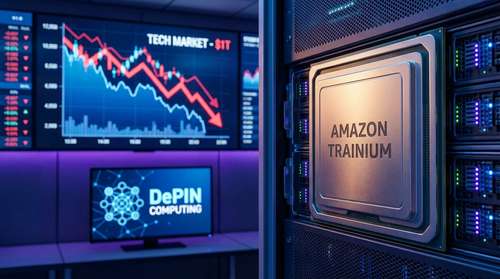
Amazon has officially dropped a financial anvil on the technology sector, committing to a record-shattering $200 billion capital expenditure plan for 2026. The announcement, made during a volatile week for tech stocks, effectively doubles down on the company's aggressive AI infrastructure strategy, centering on its proprietary AWS Trainium custom silicon. The sheer scale of the investment—up nearly $70 billion from 2025 levels—has triggered a massive sell-off, wiping approximately $1 trillion in market value from the Nasdaq-100 as investors question the sustainability of the industry's spiraling AI arms race.
The $200 Billion Bet: Capex Shockwaves Hit Wall Street
In a move that stunned analysts and fund managers alike, Amazon CEO Andy Jassy defended the astronomical spending plan, framing it as a non-negotiable stake in the future of computing. The Amazon AI capex 2026 roadmap allocates the lion's share of funds to expanding data center capacity and deploying millions of custom AI chips. While Amazon argues this infrastructure is critical to meet "insatiable" demand for generative AI models, Wall Street's reaction was swift and brutal.
Tech giants including Microsoft, Alphabet, and Meta saw their stocks plummet alongside Amazon, contributing to a broader tech market volatility 2026 event. The concern isn't just the spending—it's the timeline for returns. With Amazon's free cash flow projected to dip into negative territory for the first time in years, the narrative has shifted from "growth at all costs" to "show us the profits."
Trainium 3 and Project Rainier: Breaking the Nvidia Monopoly
At the heart of Amazon's spending spree is a strategic pivot away from reliance on Nvidia GPUs. The recently unveiled Trainium 3 chip, built on a 3-nanometer process, promises 4x the performance of its predecessor and is already being deployed in massive clusters. This push for AWS Trainium custom silicon is exemplified by "Project Rainier," a colossal AI training cluster dedicated to Anthropic's Claude models, which went live late last year with over 500,000 chips.
For AWS, the math is simple: by controlling the silicon stack, they can offer compute at 50% lower costs than Nvidia-based instances. However, building the fabs and data centers to host these chips requires upfront capital that is currently spooking the market. "We are monetizing capacity as fast as we can install it," Jassy assured investors, but the market's $1 trillion correction suggests skepticism is at an all-time high.
The Rise of Hybrid Compute
Interestingly, Amazon's roadmap doesn't exclude Nvidia entirely. Leaked details about the upcoming Trainium 4 suggest support for NVLink Fusion, hinting at a future of hybrid clusters. This pragmatism indicates that while Amazon wants to own the infrastructure, they acknowledge the entrenched status of CUDA in the developer ecosystem.
DePIN: The Decentralized Counter-Narrative
As centralized tech giants like Amazon concentrate power in mega-data centers, a counter-movement is gaining traction in the crypto world: decentralized compute infrastructure. The massive costs associated with Amazon's centralized approach have inadvertently strengthened the DePIN crypto narrative (Decentralized Physical Infrastructure Networks).
Projects like Render, Akash, and AIOZ are pitching themselves as the democratic alternative to AWS's walled gardens. By aggregating idle GPU power from across the globe, these protocols offer a fraction of the cost for training smaller models and running inference. As AI agent compute demand skyrockets in 2026, these autonomous software agents are increasingly turning to permissionless, decentralized networks to source processing power without the massive overhead of enterprise contracts.
Is the AI Infrastructure Investment Bubble Bursting?
The $1 trillion wipeout raises a critical question: is this the bursting of the AI bubble, or merely a correction? Proponents argue that AI infrastructure investment is a multi-year cycle similar to the build-out of the internet backbone in the late 90s. Skeptics, however, point to the diminishing returns of scaling laws and the sheer energy requirements of chips like Trainium 3.
For crypto investors, this volatility presents a unique opportunity. If the centralized cloud becomes too expensive or gatekept, the flight of capital toward DePIN tokens and decentralized AI platforms could accelerate. Amazon's $200 billion gamble is a signal that the stakes have never been higher—but in the chaos of this shakeup, the decentralized web might finally find its killer use case.