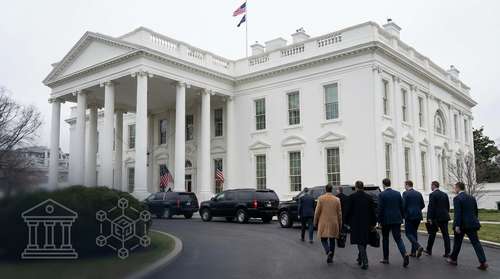
The White House has issued an emergency summons to top executives from Wall Street’s largest banks and the cryptocurrency industry’s leading firms for a high-stakes summit on Monday, February 2. The closed-door meeting, orchestrated by White House AI and Crypto Czar David Sacks, represents a final administration push to salvage the CLARITY Act 2026 (Digital Asset Market Clarity Act), which dramatically stalled in the Senate Banking Committee earlier this week amid a bitter lobbying war over stablecoin yields.
The 'Yield War' That Froze Washington
The summit comes just days after Senate Banking Committee Chairman Tim Scott was forced to postpone the markup of the CLARITY Act, a piece of legislation widely expected to be the historic framework that would finally integrate digital assets into the U.S. financial mainstream. The collapse of the talks has been attributed to a fierce disagreement over "Section 404," a controversial provision that would effectively ban non-bank crypto entities from offering interest or "yield" on stablecoin deposits.
For the banking lobby, represented by the American Bankers Association, the provision is a necessary safeguard. They argue that allowing unregulated crypto firms to offer high-yield stablecoin accounts creates an uneven playing field that could siphon trillions in deposits away from community banks. However, crypto leaders, including Coinbase CEO Brian Armstrong—who publicly withdrew support for the bill citing this specific clause—argue that the ban stifles innovation and protects legacy financial monopolies.
“We’d rather have no bill than a bad bill that hands the future of finance to incumbents who haven’t innovated in decades,” Armstrong stated earlier this week, signaling the depth of the rift. The White House Crypto Summit aims to force a compromise before the legislative window closes for the year.
Sacks' Vision: One Unified Digital Economy
Presiding over the summit will be David Sacks Crypto Czar, whose mandate from President Trump is clear: end the regulatory civil war and merge traditional finance with the digital asset economy. Sacks, who has previously called for a “whole-of-government” approach to crypto, views the current stalemate as a threat to American financial competitiveness.
Speaking on CNBC prior to the summit announcement, Sacks laid out the administration's stance: “After the market structure bill passes, banks are going to get fully into the crypto industry. We’re not going to have a separate banking industry and crypto industry—it’s going to be one digital assets industry.”
Sacks’ strategy appears to be a "grand bargain": giving banks the regulatory green light to provide direct crypto banking regulation-compliant services—such as custody and spot trading—in exchange for dropping their hardline opposition to stablecoin yields. If successful, this framework would unlock institutional bitcoin adoption on a scale never before seen, allowing customers to buy, sell, and hold crypto directly through their JPMorgan or Bank of America accounts.
High Stakes for Institutional Adoption
The urgency of the summit reflects the massive pent-up demand from institutional capital waiting on the sidelines. With the US digital asset policy in limbo, major asset managers have hesitated to launch planned tokenized funds and direct lending products. The Senate finance markup was viewed as the starting gun for this new era, and its delay has sent jitters through the market.
Industry insiders suggest that if Monday’s summit fails to produce a handshake deal, the CLARITY Act could be shelved until after the midterms, effectively freezing US digital asset policy for another two years. However, if Sacks can broker a peace treaty between the "Titans" of Wall Street and Silicon Valley, the path would be cleared for the Senate to pass the bill by late February.
Who Is At The Table?
While the full guest list remains confidential, sources confirm that attendees will include CEOs from the "Big Four" US banks, leaders from major crypto exchanges including Coinbase and Kraken, and key stablecoin issuers like Circle. The presence of both Treasury officials and Senate Banking Committee staff suggests that any agreement reached in the Roosevelt Room could be fast-tracked into legislative text immediately.
Monday’s meeting is not just about a single bill; it is a decisive moment that will determine whether the U.S. retains its leadership in the global financial system or cedes ground to jurisdictions with clearer crypto banking regulation.