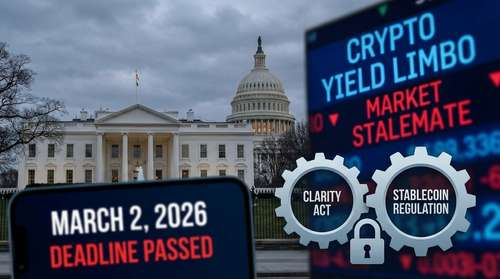
The White House's self-imposed March 1 deadline to resolve the bitter dispute over stablecoin yields in the CLARITY Act 2026 has passed without a breakthrough, plunging the crypto market into a fresh cycle of regulatory uncertainty. As negotiations in the Senate Banking Committee stall, the clash between Wall Street banking groups and digital asset firms has intensified, leaving the fate of the comprehensive Digital Asset Market Clarity Act hanging in the balance. With the deadline missed, industry eyes are now fixed on how this legislative limbo will impact the broader digital asset market structure heading into the second quarter.
The Yield vs. Reward Impasse
At the heart of the deadlock is a fundamental disagreement over the definition of "yield" versus "rewards." Traditional banking lobbyists have drawn a hard line, arguing that allowing stablecoin issuers to offer interest-like returns mimics regulated bank deposits. They warn that without strict prohibitions, the CLARITY Act 2026 could trigger massive deposit flight from community banks to digital wallets, destabilizing the traditional financial system.
Conversely, crypto advocates argue that a blanket ban on all rewards stifles innovation. They distinguish between passive interest—which they agree implies a security or deposit—and "activity-based rewards" tied to transaction volume or network participation. "We are not asking to be banks," said one high-ranking crypto lobbyist involved in the closed-door meetings. "We are asking for the right to incentivize user engagement in a Web3 economy. Conflating the two is a tactic to protect legacy market share."
White House Crypto Policy Under Pressure
The failure to reach a compromise is a significant blow to the administration's White House crypto policy, which had prioritized passing market structure legislation before the midterm election cycle heats up. White House crypto adviser Patrick Witt had set the March 1 target to force a consensus, warning stakeholders that continued delays risks killing the bill entirely for this session.
Despite the setback, administration officials reportedly remain engaged. Sources close to the negotiations indicate that the White House is drafting new compromise language that might allow for "de minimis" rewards or yield generated strictly from underlying treasury collateral, though neither side has yet agreed to these terms.
JPMorgan Crypto Forecast and Market Reaction
Markets reacted cautiously to the news, with major stablecoins maintaining their pegs but trading volumes dipping as institutional investors await clearer signals. However, not all outlooks are grim. A new JPMorgan crypto forecast released Monday suggests that while the delay is a short-term headwind, the probability of passage remains high.
JPMorgan analysts, led by Nikolaos Panigirtzoglou, predict that if the stalemate is resolved by May, the CLARITY Act 2026 could still serve as a massive catalyst for a market rebound in the second half of the year. The bank's note highlights that crypto yield regulation is the "final hurdle" in a bill that otherwise has broad bipartisan support, having already passed the House as H.R. 3633 with a decisive vote.
SEC vs Stablecoins: The Enforcement Threat
The legislative vacuum leaves the industry vulnerable to continued "regulation by enforcement." Without the clear jurisdictional lines proposed in the CLARITY Act, the ongoing SEC vs stablecoins battle could escalate. SEC Chair Gary Gensler has previously signaled that without congressional action, the agency views most yield-bearing stablecoin products as unregistered securities.
"Every day we go without the CLARITY Act is another day the SEC can claim total jurisdiction," noted a legal expert from the Blockchain Association. "The industry needs this bill to formally divide oversight between the SEC and CFTC. If the yield debate kills the bill, we are back to square one: fighting subpoenas instead of building products."
What’s Next for Stablecoin Regulation News?
Despite the missed deadline, optimism hasn't entirely evaporated. Ripple CEO Brad Garlinghouse publicly stated he still sees "90% odds" of the bill passing by April, citing the immense political capital already spent to get H.R. 3633 this far. The focus now shifts to the Senate Banking Committee's next markup session, where a new amendment on crypto yield regulation is expected to be introduced.
For now, the stablecoin regulation news cycle remains dominated by this singular issue. Until banks and crypto firms can agree on where a "reward" ends and a "deposit" begins, the U.S. remains one step away from the regulatory clarity it desperately needs to compete globally.