
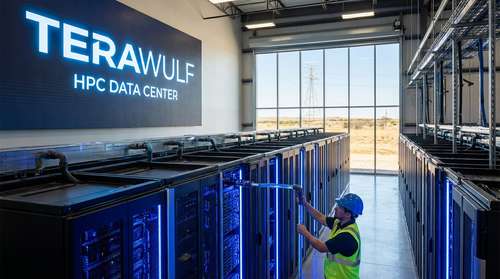
TeraWulf (WULF) has officially cemented its status as a leading high-performance computing (HPC) powerhouse, announcing today that it has secured definitive project-level financing for its massive 168 MW Texas AI infrastructure project. The deal, which focuses on a new liquid-cooled facility in Abernathy, Texas, marks a decisive turning point in the company's aggressive Bitcoin miner AI pivot. Following the announcement, TeraWulf WULF stock surged in pre-market trading, reflecting strong investor confidence in the company's strategic shift away from pure-play crypto mining toward stable, contracted high performance computing revenue.
Abernathy Campus: The Jewel of Texas AI Infrastructure
The newly financed project is a joint venture with AI cloud infrastructure firm Fluidstack and is backed by a global hyperscale partner—reportedly Google—which is providing credit support for the long-term leasing obligations. Located at the Abernathy campus, this state-of-the-art facility will deliver 168 MW of critical IT load (up to 240 MW gross capacity) specifically designed for next-generation AI workloads.
Unlike traditional air-cooled mining farms, the Abernathy site features advanced liquid cooled data centers capable of handling the intense thermal density of modern GPU clusters. "This financing is more than just capital; it's a validation of our industrial-scale energy strategy," said TeraWulf CEO Paul Prager. The facility is slated for commissioning in the second half of 2026, positioning TeraWulf to capture the exploding demand for AI compute capacity.
Financing the Future: HPC Data Center Financing Strategy
The successful close of this HPC data center financing package complements TeraWulf's recent broader capital raising efforts, including a massive $1.025 billion convertible note offering completed late last year. By securing project-level debt specifically for the Texas site, TeraWulf preserves its corporate balance sheet while ensuring the project is fully funded through construction.
Key financial highlights include:
- Investment-Grade Backing: The financing is underpinned by long-term hosting agreements with investment-grade counterparties, significantly de-risking the project.
- Scalable Capital: The structure allows for future expansion, with the joint venture retaining rights to develop subsequent phases at the Abernathy campus.
- Revenue Visibility: The shift to HPC provides TeraWulf with predictable, high-margin revenue streams, a stark contrast to the volatility of Bitcoin spot prices.
From Crypto to Compute: The Ultimate Diversification
This deal exemplifies the industry-wide trend of crypto mining diversification, but TeraWulf is distinguishing itself through execution. While many miners merely talk about AI, TeraWulf is actively deploying infrastructure. The company's pivot leverages its core competency—securing vast amounts of low-cost, zero-carbon power—and reapplying it to the more lucrative AI market.
Why The Pivot Matters for Investors
For shareholders, the transition to AI infrastructure fundamentally changes the valuation metrics for TeraWulf WULF stock. Instead of being tethered to the boom-and-bust cycles of cryptocurrency, the company is building a business model based on long-term infrastructure utility. Analysts have noted that AI-ready power capacity is currently the most scarce resource in the technology sector, putting power-rich miners like TeraWulf in the driver's seat.
Market Reaction and Competitive Landscape
The market has responded enthusiastically. TeraWulf WULF stock has outperformed many of its peers in the mining sector, such as Riot Platforms and Marathon Digital, which remain more heavily exposed to Bitcoin price fluctuations. By locking in the Texas AI infrastructure deal, TeraWulf joins an elite tier of miners, including Core Scientific and IREN, who have successfully bridged the gap to HPC.
With an ambitious goal to deploy an additional 250 to 500 MW of HPC capacity annually, TeraWulf is not just participating in the AI revolution—it is powering it. As the Abernathy facility moves toward its 2026 launch, the company's transformation from a Bitcoin miner to a premier digital infrastructure operator appears all but complete.