
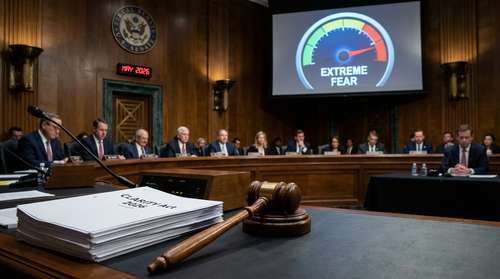
The US Senate gavels back into session today, April 13, 2026, shifting the focus of the global digital asset industry squarely onto Capitol Hill. Following a brief Easter recess marked by intense geopolitical turbulence and a brutal market correction, lawmakers are officially initiating the high-stakes Senate Banking Committee markup of the CLARITY Act 2026. For investors actively tracking US Crypto Regulation News, the legislative maneuvers over the next few days are critical. This landmark bill aims to establish a definitive federal rulebook for digital assets, landing at a moment when broader market sentiment has plunged into deep distress.
The Stablecoin Deadlock and Legislative Compromise
The Digital Asset Market Clarity Act has faced an uphill battle since clearing the House, largely due to fierce lobbying from the traditional banking sector. At the heart of the debate is the need for comprehensive stablecoin legislation US policymakers can uniformly agree on. Traditional financial institutions have vehemently opposed allowing crypto exchanges to offer passive yield on stablecoin deposits, fearing massive capital flight from conventional savings accounts into digital platforms.
Recent closed-door negotiations have reportedly produced a working compromise spearheaded by Senators Thom Tillis and Angela Alsobrooks. According to draft texts circulated prior to today's markup, the updated framework will likely ban passive yield on stablecoins entirely, but permit specific activity-based rewards tied to network utility and transaction processing. This middle-ground approach seeks to protect incumbent banks while preserving the foundational utility of digital dollars. If the Senate Banking Committee markup successfully advances the legislation, it will establish the most significant legal foundation for the industry to date, shifting vast swaths of market oversight from the Securities and Exchange Commission directly to the Commodity Futures Trading Commission.
Navigating the CFTC's Preemptive Enforcement Push
Lawmakers are not the only federal officials moving aggressively this week. The Commodity Futures Trading Commission has launched a coordinated strike to solidify its authority over decentralized platforms ahead of any final Senate vote. In early April, the agency filed federal lawsuits against three states—Illinois, Arizona, and Connecticut—arguing that the Commodity Exchange Act grants Washington exclusive jurisdiction over all swaps. This crucially includes event contracts and prediction markets.
This aggressive litigation aligns closely with recent remarks from CFTC Enforcement Director David Miller, who explicitly identified decentralized prediction markets as a top regulatory target. Miller emphasized that insider trading principles apply directly to event contracts, warning that the agency will scrutinize platforms for spoofing, wash trading, and Anti-Money Laundering violations. By attempting to override state-level gambling restrictions, the CFTC is effectively writing a de facto DeFi regulatory framework in real time. The agency's push highlights a growing urgency to preempt fragmented state laws before the CLARITY Act 2026 formalizes a unified federal hierarchy.
Market Contraction Amid Macroeconomic Uncertainty
While Washington debates jurisdictional boundaries, retail and institutional traders have endured a punishing start to the month. Bitcoin recently slipped down to test the $70,000 threshold, even touching lower support levels near $67,000 and dragging the broader altcoin ecosystem down with it. Escalating geopolitical tensions in the Middle East, combined with persistent inflation data, triggered a rapid derisking across all speculative asset classes.
Consequently, the widely tracked Bitcoin Fear and Greed Index has plummeted back into "Extreme Fear" territory, dropping below 10 at its lowest point. Historically, such depressed sentiment readings have marked critical inflection points, often preceding significant market recoveries. The index dropping to single digits has historically served as a strong entry signal for contrarian buyers. However, retail investors have largely sidelined themselves over the last 48 hours, spooked by the sudden volatility, widespread liquidations, and the looming threat of heavy-handed government enforcement.
Setting the Stage for Enterprise Capital
The current price contraction and legislative hurdles have not deterred enterprise buyers. In fact, underlying metrics suggest that institutional digital asset adoption is steadily accelerating. Corporate treasuries and spot Bitcoin exchange-traded funds continued to post strong inflows throughout the first quarter of 2026, treating the recent price dips as discounted entry opportunities rather than signals of long-term structural failure.
For these large-scale capital allocators, the current Senate session is the missing puzzle piece. Wall Street has long demanded clear, codified rules before committing greater percentages of managed wealth to decentralized networks. The successful passage of the CLARITY Act would finally end the restrictive era of regulation-by-enforcement. By legally distinguishing digital commodities from investment contracts, and setting firm reserve requirements for stablecoin issuers, the bill provides a compliant, risk-adjusted pathway for traditional asset managers.
As lawmakers take their seats this Monday morning, the industry watches closely. The decisions formulated in these committee rooms will likely dictate whether the United States retains its competitive edge in financial technology or cedes vital ground to more agile global markets.